

Trying to get your products found online can feel like you're playing a game where the rules change overnight. What worked just a few years ago, like cramming keywords into product descriptions, is now a surefire way to get ignored. The simple truth is that winning at product SEO isn't just about ranking on Google anymore. It's about being everywhere your customers are.
If your strategy still centers on a single keyword list for your own website, you're fighting yesterday's war. The real action has moved beyond your .com and onto a dozen different platforms, each with its own algorithm, audience, and rules of engagement.
We’re in an era where discovery happens on Amazon, Google Shopping, eBay, and even social marketplaces. This is where a modern approach to product SEO is no longer optional. You simply can't copy and paste the same title and description everywhere and expect to get results.
Getting traffic to your website isn't the only prize. The new standard is what we call channel-aware visibility. This means showing up with the right information, in the right format, on every single platform where a customer might be ready to buy.
A title that’s perfect for your Shopify store might be truncated and useless on Google Shopping. Meanwhile, Amazon’s A9 search engine is a completely different beast, prioritizing attributes and sales velocity your website doesn’t even track. Trying to manage this manually across hundreds or thousands of SKUs is a recipe for errors and lost revenue.
This shift is only getting more intense. With the rise of AI Overviews and more zero-click searches, the battle isn't for the click anymore. It's for the customer's attention right on the results page itself.
To illustrate this change, it's helpful to compare the old way of thinking with the new reality of product search.
| Factor | Traditional Approach | Modern Approach (with PIM/AI) |
|---|---|---|
| Goal | Rank on Google for a few keywords. | Achieve visibility across all sales channels. |
| Content | One-size-fits-all descriptions. | Channel-specific, optimized content. |
| Data Focus | Basic product info (title, description). | Rich, structured attributes for filtering. |
| Keywords | Repetitive keyword stuffing. | Natural language, semantic search terms. |
| Process | Manual, ad-hoc updates. | Automated, centralized, and scalable. |
| Assets | A few static images. | Optimized images, videos, 360-views. |
This table shows just how much the game has changed. A modern strategy isn't just an upgrade. It's a fundamental rethinking of how products get discovered and sold online.
This is the part where so many brands stumble. They jump straight into writing copy or taking new photos without first getting their core product information in order. If you don't have a clean, centralized source of truth for your data, you're building your entire visibility strategy on a foundation of sand.
This leads to the classic problems we see hurting sales every day:
Optimizing product pages is a proven sales driver, especially with structured data and rich media. In fact, some studies show adding videos can boost conversions by as much as 53 times. For anyone selling on a marketplace, poor product SEO means getting buried by competitors who are simply better at managing their data.
That's why getting your product data organized isn't just a "nice to have." It's the non-negotiable first step.
Before you can even think about winning at product SEO, you have to get your data house in order. For most businesses, product information is a complete mess. It's scattered across countless spreadsheets, random folders, and a dozen different supplier portals. This data chaos is the single biggest killer of effective SEO.
Trying to optimize your listings without clean, centralized data is like trying to build a house without a blueprint. You might have all the right materials, but the end result will be a disaster. The very first step is to pull all that scattered information into one central hub.
This is exactly what a Product Information Management (PIM) system is for. Think of it as the single source of truth for your entire product catalog, consolidating all those specs, attributes, images, and descriptions into one place. If you're new to the concept, our guide on what a PIM system is will get you up to speed.
The goal isn't just to store data. It's to structure it so it's ready for any channel you sell on.
As the game has changed from old-school keyword stuffing to a more complex, AI-ready approach, this central hub has become non-negotiable.
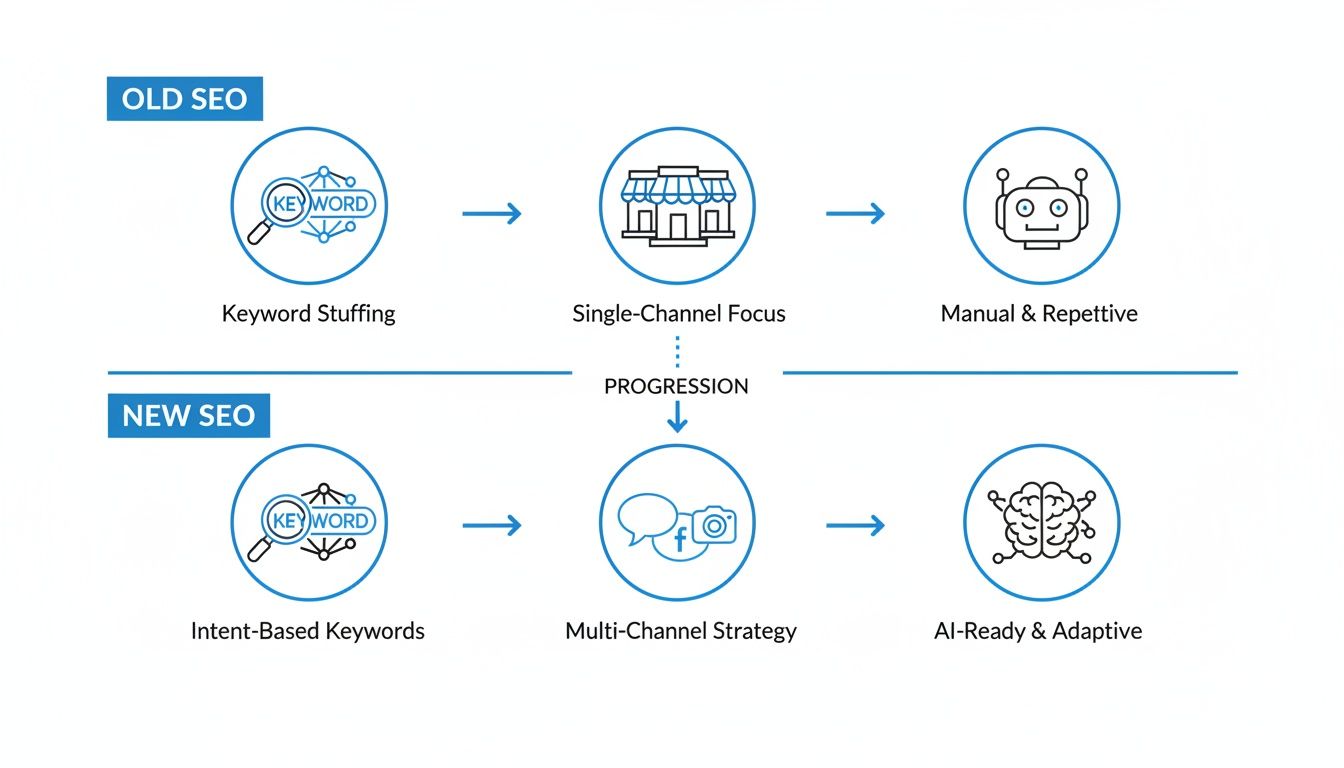
You simply can't compete in today's multi-channel world if your data is still stuck in the past.
Getting organized starts by creating a data model. This is the blueprint for your product information, defining exactly what attributes you need for each product type. It's what ensures consistency across your entire catalog.
For example, a "running shoe" in your catalog might need specific attributes like:
A well-defined data model guarantees that you collect and store this information the exact same way for every shoe you sell. That consistency is gold for search engine algorithms and marketplace filters. Without it, you end up with gaps and weird mismatches that tank your visibility.
Your data model is the foundation of your entire product SEO strategy. A weak model means weak listings. A strong, detailed model gives you the raw materials to create killer content for any channel.
One of the biggest headaches for any ecommerce team is dealing with data from multiple suppliers. Every supplier sends their own spreadsheet format, uses different names for the same attributes, and delivers wildly varying data quality. Trying to merge all this by hand is a soul-crushing, error-prone nightmare.
This is where a modern PIM really shines, especially with features like a Data Holding Bay.
Think of it as a secure sandbox. You can import new supplier data without it touching your live, customer-facing product listings.
Inside this holding bay, you can finally take control of the chaos:
This simple workflow transforms a messy, manual chore into a controlled, efficient process. It ensures every update actually improves your data quality instead of just creating new problems to solve later. By building this single source of truth first, you're setting the stage for everything else to succeed.
Alright, your product data is clean, organized, and all in one place. Now for the fun part: turning that raw information into compelling content that’s perfectly tuned for every single place you sell.
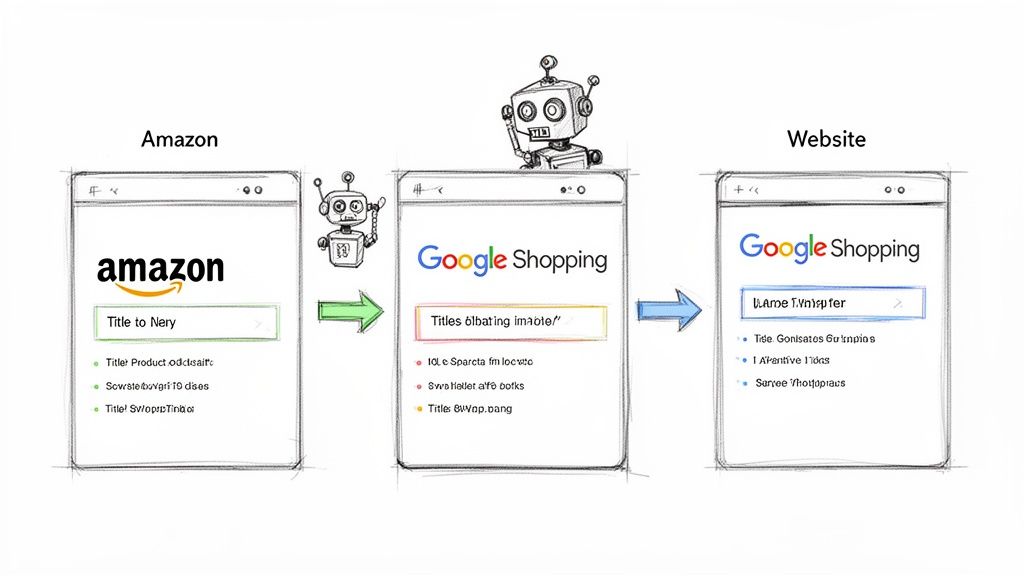
Let's be real, a "one-size-fits-all" approach to product content is dead. A title that crushes it on your own website will likely get butchered by character limits on Google Shopping. And Amazon? That's a whole different ballgame, with its own A9 algorithm demanding a specific structure.
This is where AI stops being a buzzword and becomes a workhorse for your SEO for products. When you have a solid PIM system as your single source of truth, you can unleash AI to generate countless versions of your content, each one purpose-built for a specific channel.
Think of your product attributes, like material, dimensions, color, and special features, as individual ingredients. AI’s job is to take those raw ingredients and follow a unique recipe for each channel.
This is all handled through prompt templates. A prompt template is just a pre-written set of instructions that tells an AI model exactly how you want it to write.
For instance, you'd set up different templates for:
You build these templates once, and the system can automatically spin up optimized titles, bullets, and descriptions for every product across all channels. You go from inconsistent, manual copywriting to a scalable, automated content machine.
This whole process of creating content that resonates with AI-powered search is a discipline we now call Generative Engine Optimization (GEO). It’s all about writing for systems like Google’s AI Overviews. GEO is less about stuffing keywords and more about answering a shopper's question clearly and with authority.
This is where having structured data gives you an almost unfair advantage. When your content is built from clean, distinct attributes, an AI can easily understand your product and serve it up as a direct answer.
The goal of GEO is to make your product the definitive answer. When someone asks an AI assistant for the "best waterproof hiking boots for wide feet," you want your product information to be so clear and well-structured that the AI presents your boot as the top solution.
The impact of AI on search is exploding. Recent data shows AI is completely changing product SEO, with 17.3% of Google's top 20 results now featuring AI-generated content. Businesses using AI are also churning out 42% more content monthly, letting them optimize for different platforms much faster. As NanoPIM users know, this is about turning raw specs into channel-ready copy in a flash.
While AI is a beast for generating content at scale, it’s not perfect. You absolutely cannot "set it and forget it." A non-negotiable part of any AI workflow is the human-in-the-loop review.
This just means that after the AI does its thing, a real person from your team gives it a final look. This step is critical for a few reasons.
This blend of AI speed and human oversight gives you the best of both worlds: the efficiency of automation without sacrificing the quality and trust that your brand is built on. The same logic applies to imagery. You can use an AI Ghost Mannequin service to create professional photos at scale, but a final human check ensures they hit your brand standards. With a system like NanoPIM, this entire review and approval workflow is baked right in.
You can write the most compelling, channel-perfect product copy in the world, but if search engines can't find and make sense of it, you're invisible. This is where the technical side of SEO comes into play. It’s the behind-the-scenes work that connects your brilliant content to the algorithms that control your visibility.
Getting the technical details right is what separates products that get found from those that just don't show up. It's about speaking the language of search engines so they can reward you with better rankings and those eye-catching rich results that customers can't resist.
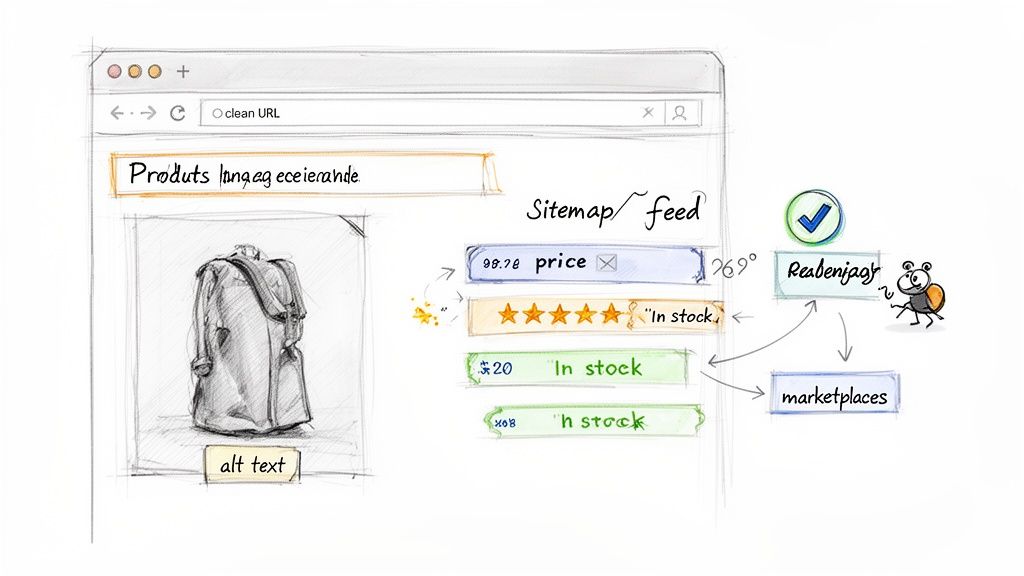
Your most powerful weapon for technical product SEO is structured data, usually implemented with schema.org. Think of it as leaving a detailed note for Google, Bing, and other crawlers, telling them exactly what's on the page.
When you add structured data to your product pages, you're explicitly pointing out the important bits:
This clarity is what enables search engines to feature your product with rich results (or rich snippets). These are the enhanced listings you see with star ratings, pricing, and availability right there on the search results page. They demand attention and can dramatically boost your click-through rates.
A key component of implementing technical SEO that gets your product noticed involves mastering your keywords for Amazon listings to effectively drive traffic and sales. While structured data helps Google, a solid keyword foundation is what helps you win on marketplaces.
This is where a PIM shines. Instead of manually coding every page, you can automate it. By mapping your existing product attributes, like 'Price' and 'Stock', to the right schema properties once, you ensure every single product page is marked up with perfect, error-free code automatically.
Your product images do more than just look pretty. They're a huge part of SEO for products. Since search engines can't actually "see" a picture, you have to give them context. This is what image optimization is all about.
The two most critical pieces are file names and alt text.
IMG_8432.jpg. Instead, use something like waterproof-hiking-boot-mens-size-10.jpg. This gives search engines an immediate clue about the image's content.Trying to manage this for thousands of images is a recipe for disaster. A good DAM (Digital Asset Management) system, which often comes with a PIM, lets you create rules to automatically generate optimized file names and alt text from your product data. For instance, you could build a template that pulls from the product name, color, and material to create perfect alt text every time.
Finally, you can't ignore the basic plumbing: your URLs and product feeds. These foundational elements can make or break your entire SEO effort.
Clean, Crawlable URLs
Product page URLs should be simple, logical, and easy for both people and search bots to read. A clean structure like yourstore.com/shoes/mens-trail-runner helps search engines understand your site's hierarchy. You want to avoid long, messy URLs full of random parameters. They just confuse crawlers and can drag down your ranking potential.
Healthy, Error-Free Product Feeds
Your product feeds are the data files you send out to channels like Google Shopping and Facebook. They have to be perfectly formatted and constantly updated. Any error, like a wrong price or a missing attribute, can get your products disapproved or even get your entire account suspended. If you're serious about this, our guide on Google Shopping feed optimization is a must-read.
Using a PIM to manage and sync these feeds is the only sane way to avoid these costly mistakes. It guarantees that the data sent to every channel is always accurate, complete, and perfectly formatted for that channel's unique rules, keeping your products live and selling.
So you’ve pushed your new product content live. Now what? The biggest mistake you can make is walking away and calling it a day. The real work, and the real growth, starts the moment you hit "publish."
This is where you close the loop. You’ve put in the effort to build a single source of truth and craft channel-specific listings. Now it’s time to see what’s actually moving the needle. You'll turn your product data from a static library into a dynamic engine that actively drives performance.
You can't fix what you can't see. Drowning in spreadsheets isn’t the answer. What you need is a central command center. A dashboard that gives you an honest, at-a-glance view of your product SEO health.
When this is tied directly to your product data in a system like NanoPIM, the insights become instantly actionable. You’re not just looking at numbers. You’re seeing the direct link between the content you created and its real-world performance.
Your essential dashboards should be tracking:
These dashboards cut through the noise. They tell you exactly where to focus your energy so you're always tackling the highest-impact tasks, not just guessing what needs to be fixed next.
To truly understand performance, you need to track the right metrics. This table breaks down the essentials for evaluating your product SEO efforts across different channels.
| Metric | What It Measures | Tool to Use | Why It's Important |
|---|---|---|---|
| Organic Rankings | Your product's position in search results for specific keywords. | SEMrush, Ahrefs, Google Search Console | The most direct indicator of your SEO visibility. Higher rankings mean more organic traffic. |
| Click-Through Rate (CTR) | The percentage of users who click your listing after seeing it. | Google Search Console, Amazon Brand Analytics | Measures how compelling your title, main image, and price are at a glance. |
| Conversion Rate | The percentage of visitors who make a purchase after clicking. | Google Analytics, PIM/DAM Analytics, Marketplace Reports | The ultimate measure of your content's effectiveness. It shows if your content is persuasive. |
| Content Score/Completeness | The percentage of required and optional attributes that are filled out. | Your PIM system (e.g., NanoPIM) | A foundational metric. Incomplete listings are often suppressed or perform poorly. |
| Page Dwell Time | How long users spend on your product page after arriving. | Google Analytics, Hotjar | Indicates user engagement. Longer dwell times suggest your content is interesting and helpful. |
By monitoring these key indicators, you get a holistic view of what's working and where you need to make adjustments, ensuring your optimization efforts translate into actual sales.
Assumptions are the enemy of good ecommerce. You might be convinced that a clever, brand-forward title is the way to go, but your customers might just want a straightforward, attribute-packed title that gets right to the point.
The only way to know for sure is to test it. A/B testing is simply showing two different versions of your content to shoppers and seeing which one performs better. And no, it’s not just for landing pages. You absolutely should be testing the core elements of your product listings.
For example, you could run tests on:
By running these experiments, you replace guesswork with real-world data. Over time, you'll build a playbook of what resonates with your specific audience on each platform, making every new product launch more successful than the last.
This data-first mindset is a cornerstone of any modern SEO for products strategy. It ensures your optimizations are guided by actual customer behavior, not just your own gut feelings.
With a large catalog, you can't be everywhere at once. Things break. A top-seller might suddenly see its performance tank, inventory could run low, or a marketplace could change its requirements overnight. Automated alerts are your safety net.
Think of them as your 24/7 watchdogs, notifying you the moment a problem crops up so you can react before it hurts your bottom line.
Here are a few essential alerts you should have running:
This kind of proactive monitoring transforms your team from firefighters to strategists. Instead of spending your day hunting down problems, you can focus on growth, confident that the system has your back. This continuous loop of measure, test, and monitor is what delivers long-term, sustainable results from your product SEO.
Shifting to a modern product SEO strategy is a big move. It’s a departure from the old ways of doing things, so naturally, a ton of questions pop up. Where do you even start? How do you handle all the moving parts?
We get it. We’ve been there. So, we've gathered the most common questions we hear and answered them with practical, no-fluff advice to help you get started on the right foot.
The idea of implementing a Product Information Management (PIM) system feels massive. Intimidating, even. But it doesn't have to be. The secret is to start small and get a quick win. Forget trying to import your entire catalog in one go. That's a recipe for disaster.
Instead, pick just one product line or a single category you know inside and out. Your goal is to get the data for that small, manageable group of products cleaned up and perfectly structured inside the PIM.
This approach pays off immediately:
Once that first product line is dialed in, you have a working blueprint. Rolling out the rest of your catalog becomes a rinse-and-repeat process, not a monumental effort. It’s all about building momentum.
AI is an incredible tool for creating content at scale, but it’s not a "set it and forget it" solution. Think of it as a brilliant, lightning-fast junior copywriter, not a creative director. It’s there to do the heavy lifting, not to replace human judgment.
The most effective workflow is a partnership: let AI generate the first drafts, then have a human refine them. AI is fantastic for creating multiple versions of a title or description for different channels, but a person is still needed to check for brand voice, accuracy, and that subtle emotional connection.
Use AI to kill the tedious, soul-crushing work. This frees up your team to focus on high-level strategy and creative polish. A human-in-the-loop review process isn't just a good idea. It's non-negotiable for making sure the final copy is something you’re proud of.
This is the big one. Measuring the return on investment (ROI) for product SEO is all about connecting your optimization efforts directly to sales. This is where having your data centralized in a PIM with built-in analytics becomes a game-changer. You need to track the metrics that matter to the bottom line.
First, set a clear baseline before you make any changes. Then, keep a close eye on these key performance indicators (KPIs):
By tracking these, you can draw a straight line from "we optimized our hiking boot listings" to "we saw a 15% increase in organic sales for that category." That's how you prove your work has value and move the conversation beyond fuzzy metrics. It’s about showing exactly how better data and smarter content lead directly to more money in the bank.
Ready to stop juggling spreadsheets and start building a modern product SEO strategy? NanoPIM gives you the AI-powered tools to centralize your data, create channel-specific content, and measure what truly matters. Learn more at nanopim.com.


