

You can’t write a great product description without a solid foundation. It's the boring but critical prep work that separates copy that converts from copy that gets ignored.
Great descriptions aren't just dreamt up. They’re built from a simple, repeatable process. You gather the facts, find your voice, and then centralize everything so your team can work efficiently.
Before you write a single word, you need a game plan. Think of it like assembling furniture. If you don't start with all the right pieces laid out, you're going to end up with a wobbly, unusable mess. Your ingredients here are data, voice, and customer insights.
First things first, you need to get your facts straight. This means digging into the technical specifications and manufacturer data sheets. Don't guess, don't assume, and don't rely on memory.
These documents are your source of truth for the non-negotiables: dimensions, materials, certifications, and performance specs. If you've ever stared at one of these dense documents and felt lost, our guide on how to read a product data sheet can help you decode them.
Getting this part right is all about building trust. A single wrong detail can destroy it. Calling a backpack "waterproof" when it's merely "water-resistant" is a guaranteed path to angry customers and a flood of bad reviews. Accuracy isn't optional.
Once you have the objective facts, you need to decide how you're going to talk about them. This is your brand voice. Are you the quirky, fun friend or the trusted, professional expert? A company selling skateboards is going to sound very different from one selling enterprise software, and for good reason.
Your voice shouldn't be about what you like. It should be about what resonates with your ideal customer. What language do they use? What values do they hold? Your brand’s voice should feel familiar and authentic to them, turning a simple purchase into a real connection.
A product isn't just an object; it's a "souvenir" of your brand. Customers don't buy what your product is, they buy what it stands for. This is why conveying the right feeling is just as important as listing the right specs.
This simple flow to gather data, define voice, and centralize is the bedrock of a scalable content strategy.
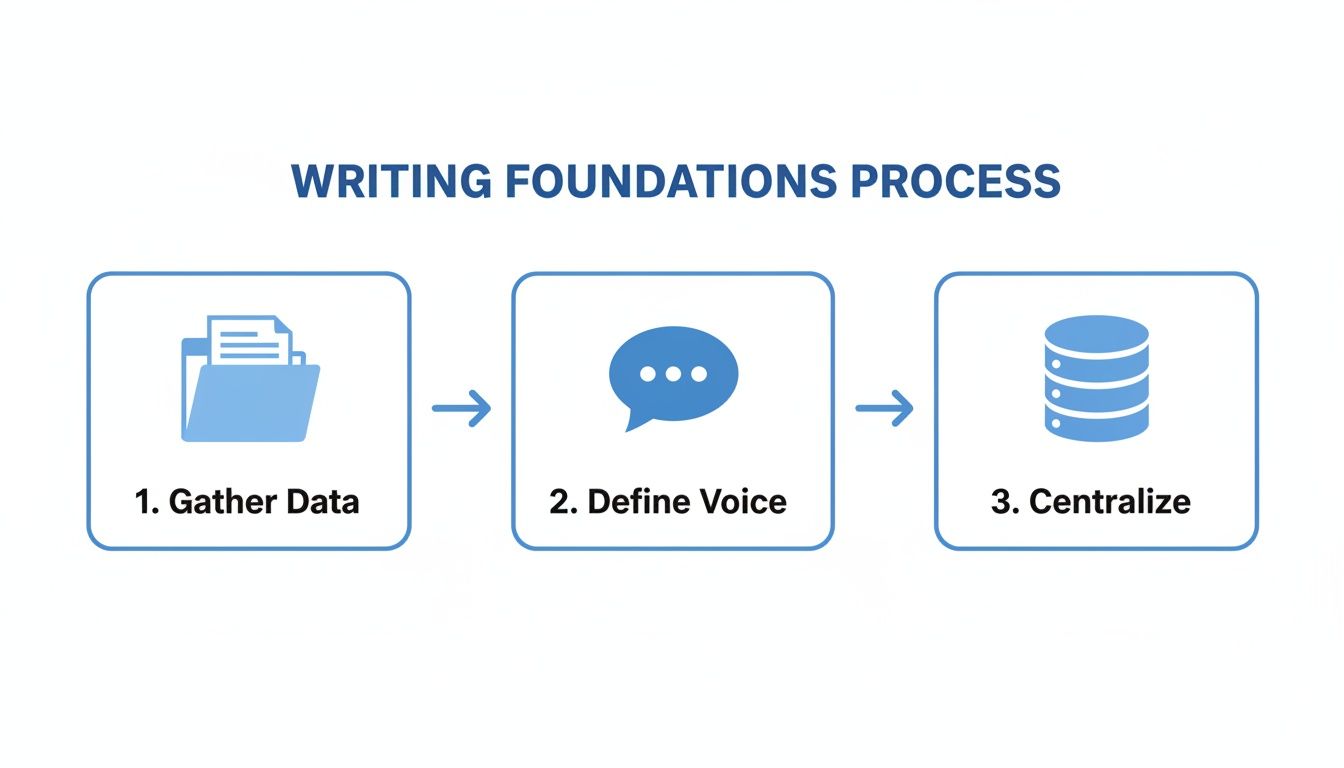
Stick to this process, and you’ll find that every description you create is built on a solid, consistent base.
Often, your most powerful copy isn't written by you at all. It’s already been written for you by your customers. They'll tell you exactly what matters in their own words. You just have to know where to look.
To strike this gold, you’ll need to do a little digging. Here's a quick reference for the most valuable places to look and what to look for.
This isn't just about collecting feedback; it's about translating it into powerful marketing angles.
For example, if customers constantly rave that your hiking boots are "perfect for rocky trails," that’s a killer benefit you need to shout from the rooftops. If they’re always asking if a shirt runs "true to size," you need to address that head-on.
This is how you move from listing features to selling benefits. Instead of saying a camera has a "fast f/1.8 aperture," you can say it "takes those beautiful, blurry-background portraits, even when the lighting is terrible." This is a benefit that speaks directly to a customer's real-world goal.
Having all this fantastic information is one thing. Keeping it from descending into chaos across a dozen different spreadsheets, docs, and email threads is another. This is where a Product Information Management (PIM) system becomes your best friend.
A PIM acts as your "single source of truth," a central hub for every last piece of product information. Think of it as a master library where you can store:
By bringing it all together, you ensure everyone from marketing to sales to customer service is singing from the same hymn sheet. This isn't just about organization. It's about building a scalable, repeatable system for creating incredible, customer-focused content across your entire catalog.
You’ve done the homework and gathered the raw data. Now comes the fun part: turning all those facts and insights into a core message that actually sells. This isn't about writing one-off descriptions. The real goal is to build a scalable system that pumps out compelling, on-brand copy, every single time.
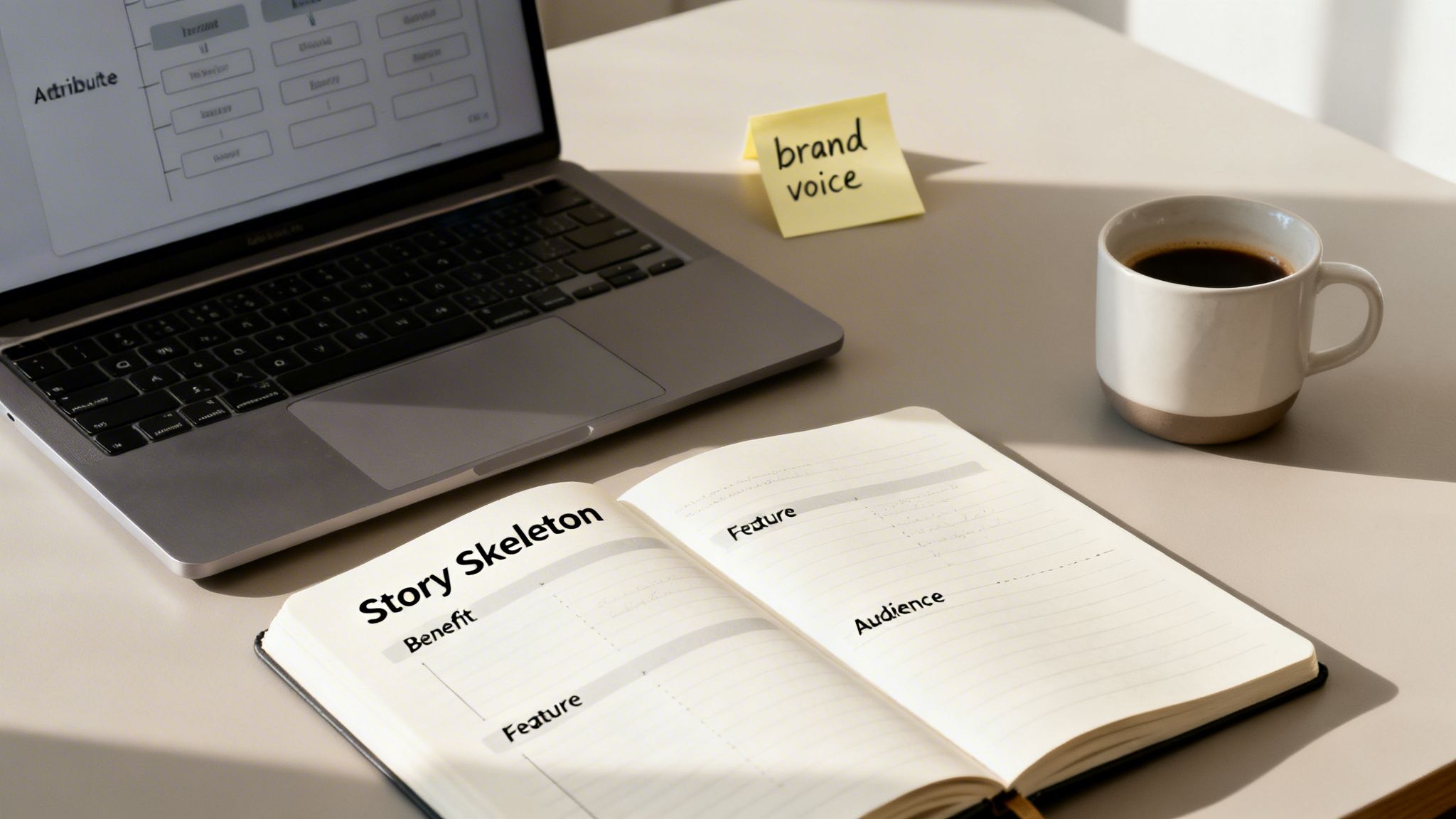
The secret? Move beyond generic formulas and start building a "story skeleton" for each product category. Think of it as a flexible guide, not a rigid template. It ensures every description you write hits the key points that matter most to your customers.
Here’s a hard truth: people don't just buy "stuff." They buy solutions. They buy feelings. They buy a better version of themselves. Your product description's main job is to connect the dots between its features and those very human desires.
The most common mistake I see is teams just listing specs. A backpack has "YKK zippers" and is made of "ripstop nylon." Okay, but so what? Those details are lifeless. They don't answer the customer's real, unspoken question: "Why should I care?"
Your job is to translate every feature into a tangible, real-world benefit.
This simple shift in perspective is the single most important part of writing product descriptions that convert. You stop describing an object and start telling a story about what that object makes possible.
A story skeleton is an attribute-driven template you can apply across an entire product category. It's not a rigid copy-paste job, but a structured outline that maps your key data points to a persuasive narrative. It's how you maintain brand consistency while making each description feel unique and relevant.
Let’s say you’re working on a "Women's Running Shoes" category. Your story skeleton might look something like this:
This is where a Product Information Management (PIM) system becomes your superpower. You can map the specific data for each shoe, like "Max-Cushion Foam" or "Breathable Mesh Upper," directly into this skeleton. It creates a powerful, semi-automated workflow that saves countless hours.
A story skeleton ensures that no matter who on your team is writing, the final output always focuses on what the customer values most. It systematizes the art of turning data into desire.
Your value proposition is your simple, clear promise of value. It's the reason a customer should buy from you and not from the dozens of other options out there. This promise needs to be woven throughout your story skeleton.
Are you the most durable? The easiest to use? The most stylish? You can't be everything to everyone. Pick one or two things that truly set you apart and build your entire message around them.
Take a high-end coffee maker, for example. The description shouldn't just talk about brewing coffee. It should be laser-focused on the value proposition of "barista-quality espresso at home, without the complexity." Every feature mentioned, from the pressure gauge to the one-touch cleaning, must support that core promise.
This focus is non-negotiable. Studies have shown that a strong, clear value proposition can dramatically increase conversion rates. It cuts through the noise and gives customers a compelling reason to choose you. When you master this, you’re no longer just selling a product; you’re selling a better experience.

You’ve nailed the core message. But what good is a perfect description if it's buried on page ten of the search results? A brilliant description is worthless if no one ever finds it.
This is where optimization comes in. It's about making your content work smarter for you on search engines and major marketplaces.
The biggest mistake I see is the copy-paste approach. Writing one description and blasting it everywhere is a surefire way to get lost in the noise. Every platform, from Google to Amazon, plays by its own rules. To win, you have to learn the game and tailor your message for each channel.
Let's get back to basics. If you want your products to be discovered, you need to speak your customer's language. That means understanding keywords, which are the exact words and phrases people type into a search bar.
But not all keywords are the same. Broad terms like "running shoes" are incredibly competitive and attract window shoppers. The real money is in long-tail keywords. These are longer, more specific phrases that signal a customer is ready to buy.
See the difference? The person using that long-tail search knows exactly what they want. If your product is the answer, you're on the fast track to a sale. Tools like Google Keyword Planner or Ahrefs are great for uncovering these high-intent phrases.
Think of keyword research as a form of listening. You're uncovering the exact language your customers use to describe their problems. When you mirror that language back to them, you build an instant connection.
Search engines have evolved. They don’t just match keywords anymore; they understand intent. With the rise of AI-powered search, this is more true than ever. If you want to show up, you need to understand how to rank in AI Overviews by providing clear, direct answers.
This means your descriptions can't just be a list of features. They need to answer the questions a customer is already asking.
When you structure your content to answer these questions, you’re not just optimizing for a machine. You're providing real value to a human being, which is exactly what modern search algorithms are designed to reward. If you want to go deeper, check out our guide on Generative Engine Optimization strategies.
Marketplaces are a different beast. Your core message is the same, but the packaging has to change. On platforms like Amazon, visibility is everything.
Here’s a quick breakdown of where to focus your energy:
Product Titles
This is your most valuable real estate for both search and clicks. Don't just slap the product name there. Front-load it with your most important keywords and attributes.
A solid formula is: Brand + Main Keywords + Key Feature + Size/Color
Example: "BrandX Waterproof Hiking Boots for Men, Breathable Suede, Size 11"
Bullet Points
On Amazon, the five bullet points are where the action is. Most shoppers skim these instead of reading the full description. Start each bullet with a capitalized benefit, then follow up with the feature that makes it possible.
Backend Keywords
Most marketplaces have a hidden "backend keywords" field. This is your secret weapon. Use it to add synonyms, common misspellings, and related terms that didn't fit in your title or bullets. It’s free SEO juice, so don't leave it on the table.
Tailoring your content for each channel feels like extra work because it is. But it’s work that pays off. It puts your products directly in front of customers who are ready to buy, wherever they happen to be shopping.
We've all been there. You're staring at a blinking cursor, trying to summon the perfect words for a new product. That blank page can feel like the biggest hurdle in getting content out the door. This is where AI writing tools can completely change the game. They can act as your creative co-pilot to get from zero to a solid first draft in minutes.
The trick is to treat AI not as a magic "write for me" button, but as an incredibly fast, knowledgeable assistant. You're still the one in the driver's seat. Your instructions, called the prompt, are the single most important factor in getting back copy that's actually useful.
Throwing a generic prompt like "write a product description for a backpack" at an AI will get you exactly what you deserve: a generic, boring result. To get great output, you have to feed it great input. Think of your prompt as a creative brief, giving the AI all the context it needs to nail the assignment.
A powerful prompt needs to include these essentials:
When you include these elements, you're not just asking for words. You're guiding the AI to create content that’s strategically aligned with your actual business goals.
The real beauty of using AI is how fast you can adapt a core message for different channels. Instead of rewriting everything from scratch, you just tweak the prompt. It's a massive time-saver.
Here’s a quick-start table with some prompts you can steal and adapt for your own products.
These examples show how a well-crafted prompt guides the AI to generate copy that fits the platform and the customer. To see this in action, you can try out specialized platforms like lunabloomai's AI writing app that are built for this kind of work.
Modern PIM and content platforms are taking this a step further. It's no longer just about generating text. Now, they can also score the content against your own predefined rules. This is a huge leap forward for maintaining quality and consistency, especially at scale.
For instance, a system like NanoPIM can automatically check an AI-generated description for critical details:
This automated scoring turns a subjective review process into a data-driven one. It provides an objective quality check that frees up your team from tedious manual edits, letting them focus on high-level strategy and creative polish.
This AI-assisted workflow, from prompt to draft to scoring, is how you break free from the blank page. It helps you start managing a library of high-quality, channel-ready product descriptions. It’s about using technology to amplify your team's creativity, not replace it. You can see how these capabilities are changing content workflows by reading more on the role of AI in digital asset management.

AI can get you 80% of the way there, but that last 20% is where the magic happens. This is where human expertise becomes non-negotiable. An AI draft is an incredible starting point, but it's your team that injects brand personality, catches subtle errors, and ensures flawless accuracy.
Relying solely on AI is a massive gamble. It's like a chef using a top-of-the-line food processor. It does the heavy lifting, but the chef still has to taste, adjust the seasoning, and plate the final dish. Your team provides that critical, final quality check.
A human editor is your last line of defense against mistakes that, while subtle, can be incredibly costly. AI is a data-processing machine. It doesn't have the lived experience or the nuanced context your team brings to the table.
Here’s where a human review really makes its mark:
A human review isn't just about catching typos. It's about protecting your brand's reputation, building trust with your customers, and making sure your content actually connects with another human. This final polish is what separates the good from the great.
Without a defined process, content review descends into a chaos of endless email chains and conflicting feedback. A simple, structured workflow means every piece of content gets the right eyes on it before it ever sees the light of day. This is where a modern Product Information Management (PIM) system becomes your best friend.
Keep your workflow straightforward. For us, a good process looks like this:
Using a PIM with built-in version control is a total game-changer here. You can track every single edit, see who made it, and even roll back to a previous version if you need to. It creates a transparent audit trail that kills confusion and keeps everyone accountable.
Your job isn't over once you have one perfect description. Now you have to manage content for different product variants and global markets. This is exactly where most teams get lost in spreadsheet hell.
How do you write compelling, unique descriptions for a single t-shirt that comes in 10 colors and 5 sizes without losing your mind? You don't. Instead, you use structured content.
Create one fantastic core description that covers the fabric, fit, and feel. Then, use specific attributes to handle the rest. For instance, a "color" attribute automatically swaps "Classic Blue" for "Vibrant Red" on the correct product page. Managing this inside a PIM like NanoPIM keeps your content from becoming a duplicated mess.
Localization is so much more than just translation. It's about adapting your entire message, including your tone, your jokes, and your cultural references, to fit local customs and search habits. A clever turn of phrase in the U.S. might fall completely flat (or worse, be offensive) in Japan.
Truly effective localization means:
This human-led approach to variants and localization turns a potential content nightmare into a streamlined, scalable system. It guarantees every customer, no matter where they are or which option they choose, gets a polished and relevant experience.
We get a lot of questions about what it really takes to write product descriptions that sell. Below are some of the most common ones we hear, along with some straightforward answers from our experience.
Honestly? It depends. There’s no magic word count. The right length is all about the product's complexity and, just as importantly, where the customer is reading it.
The best rule of thumb is to be as detailed as you need to be, but as concise as you can possibly be. Your job is to give a shopper every piece of information they need to feel confident hitting "add to cart," without burying them in a wall of text.
For a complex, high-ticket item on your own site, like a professional-grade camera, a detailed description of 300-400 words with deep technical specs is perfectly fine. A customer making that kind of investment needs that level of detail.
But for a simple t-shirt on an Instagram post, a punchy 50-75 words is way more effective. And on a marketplace like Amazon, the game changes completely. It’s all about a keyword-packed title and five powerful bullet points that do all the heavy lifting.
The goal isn’t a word count. The goal is giving the buyer clarity and confidence. You need a different approach for different channels to get there.
This is where a PIM shines. It helps you manage all these different length versions for every channel, all flowing from a single, organized source of product truth.
So many brands stumble over the same few hurdles, completely killing the power of their product descriptions. Just sidestepping these common mistakes will put you lightyears ahead of most of your competition.
Here are the top three we see constantly:
Another classic error is a complete tone mismatch. Writing with dense, technical jargon for a product aimed at total beginners is a fast way to confuse and lose a sale. You have to write for your audience, always.
A Product Information Management (PIM) system is your content command center. It fundamentally changes your entire approach to writing descriptions. It helps you shift from a chaotic, spreadsheet-driven mess to a streamlined, scalable operation.
First, it brings all your raw data together. This includes technical specs, supplier files, marketing copy, and digital assets, into one central source of truth. This alone is a game-changer, giving your whole team a single, reliable place to work from.
From there, a modern PIM can use that data with AI and structured templates to generate channel-optimized first drafts in seconds. A system like NanoPIM can even score that AI-generated content against your own custom rules for SEO, brand voice, and completeness. This gives you instant, objective feedback.
Finally, it wraps the whole process in a structured workflow for your team to review, edit, approve, and even localize those descriptions for different countries. It turns a painful, manual headache into an efficient content factory.
Ready to stop wrestling with spreadsheets and start creating better product content faster? NanoPIM centralizes your product data and uses AI to help you craft perfect, channel-optimized descriptions in a fraction of the time. See how it works at NanoPIM.


