

Multi-channel marketing is not some complex, abstract theory. It’s about showing up wherever your customers already are, whether that is on social media, in their email inbox, or on a marketplace like Amazon.
At its heart, a multi-channel strategy is about giving your customers choices. It’s the difference between a business that only sells from a brick-and-mortar shop and one that sells in-store, on its website, and through a mobile app.
This is non-negotiable today because your customers are all over the place. They might see your ad on Instagram during their lunch break, search for reviews on Google later that evening, and finally decide to buy from your website or Amazon store the next day. If you’re not there at each of those touchpoints, you’re practically invisible. A great campaign makes sure your message is the same everywhere, so you do not confuse, and lose, customers with conflicting offers.

The real magic happens when every channel feels connected. Picture this: a customer sees a new jacket in a TikTok video, gets an email with a 10% discount for it, and then finds the exact same product details and price on your website. That’s a smooth, trustworthy experience that leads to a sale.
Now, imagine the opposite. The price on the website is different from the ad, the product photos don’t match, and key details are missing from the description. That kind of friction does not just feel sloppy; it costs you sales and kills brand trust.
This is precisely why having a single source of truth is so critical.
A Product Information Management (PIM) system is your command center for all product data. It guarantees every detail, from descriptions and specs to images and pricing, is accurate and consistent across every single channel. It's what makes successful multi-channel campaigns manageable instead of chaotic.
The data speaks for itself. Brands that use three or more channels in a campaign see a staggering 287% higher purchase rate compared to single-channel efforts. Why? Because you’re creating more opportunities to connect with customers on their own terms.
To put this into perspective, here’s a look at how performance stacks up.
This table shows the clear performance differences between using single versus multiple marketing channels, based on recent data.
The numbers don't lie. Spreading your efforts not only increases immediate sales but also builds a much stickier customer base for the long haul.
While multi-channel marketing is about using various platforms, the end goal is to create one unified customer journey. This is where you start getting into approaches like Actionable Omnichannel Retail Strategies, where the lines between channels blur into a single, seamless experience.
A cohesive strategy builds a powerful brand presence that follows the customer, offering them a reliable and familiar experience no matter how they choose to engage. This is the foundation for not just attracting customers, but keeping them.
Before you can even think about launching slick marketing campaigns across Amazon, Google, and your social feeds, you have to get your house in order. I'm talking about the one thing that will absolutely kill a campaign before it even starts: messy, inconsistent product data.
It's the number one killer of multi-channel success.
Think about it from a customer's perspective. They see a killer deal on a pair of running shoes in an Instagram ad. They tap through to your site, but the specs are slightly different. A few days later, they search on Amazon and find the same shoe with a totally conflicting description. That tiny bit of confusion plants a seed of doubt, kills trust, and you just lost a sale.
This is where the real work begins, building your campaign’s command center.
For so many growing businesses, product information lives everywhere and nowhere at the same time. You’ve probably got one spreadsheet for the website, another for your Amazon listings, a Dropbox folder choked with outdated images, and critical details living on a product manager’s laptop.
This kind of chaos makes running a real multi-channel campaign practically impossible.
In this kind of environment, you are not managing a campaign; you are just plugging leaks. Scaling becomes a total nightmare because every new product or channel just adds another knot to an already tangled web.
This isn’t a sustainable way to grow. To actually succeed, you need a single source of truth for every last piece of your product information.
A Product Information Management (PIM) system is the concrete foundation you need for any serious multi-channel marketing. It's the central hub that stores, manages, and enriches every piece of product data you have.
Imagine having one secure, organized place for every product attribute, high-res image, marketing blurb, and technical spec. But it's not just about storage. A good PIM is designed to structure all that data so it’s perfectly formatted and ready for any channel you throw at it.
A PIM lets you:
This turns your data from a frustrating liability into your most powerful asset. For a deeper look at building this core for your business, check out our guide on building an effective data management strategy.
Getting all your data in one place is the first big win. The next is structuring it intelligently.
Different channels have completely different rules and expectations. An Amazon title has strict character limits and keyword rules that are nothing like a Google Shopping title. Your website product page needs rich, descriptive storytelling that would be out of place in a marketplace bullet point.
Here’s a practical example of how this plays out for a "Waterproof Hiking Backpack":
By structuring your data this way inside a PIM, you can automatically generate the right content for the right channel. This is the system that lets you scale your marketing without getting buried in manual work. It ensures every customer gets the best, most accurate information, no matter where they find you.
Alright, you’ve wrestled your product data into a single source of truth. Now for the fun part: getting tactical. Planning your first multi-channel campaign is not about just throwing everything at the wall and hoping something sticks. It's about being deliberate.
It’s about understanding your audience and building a plan that guides them smoothly from one channel to the next.
The first move is simple, but it’s the one people constantly miss. You have to know what success actually looks like.
Before you spend a single dollar, you need a clear "why." A campaign without a goal is just expensive noise. Are you trying to launch a new product? Drive traffic to your site? Feed your sales team with fresh leads? Or just get your name out there in a new market?
Your objective will steer every other decision you make.
Getting specific makes your goals real. "Get more sales" is a wish, not a target. A precise number gives your team a finish line they can actually see and race toward.
This is also where you have to be realistic about your budget and resources. Juggling all the moving parts of a multi-channel campaign is no small feat, which is why smart teams rely on good campaign management software to keep everything from assets to budgets in one place.
This kind of organized approach is becoming non-negotiable. The global multichannel marketing market is exploding, projected to jump from $9.25 billion in 2024 to $11.65 billion in 2025. That growth tells you one thing: if you are not centralizing your content and coordinating your channels, you are already behind.
This is the foundational data flow that makes it all possible.
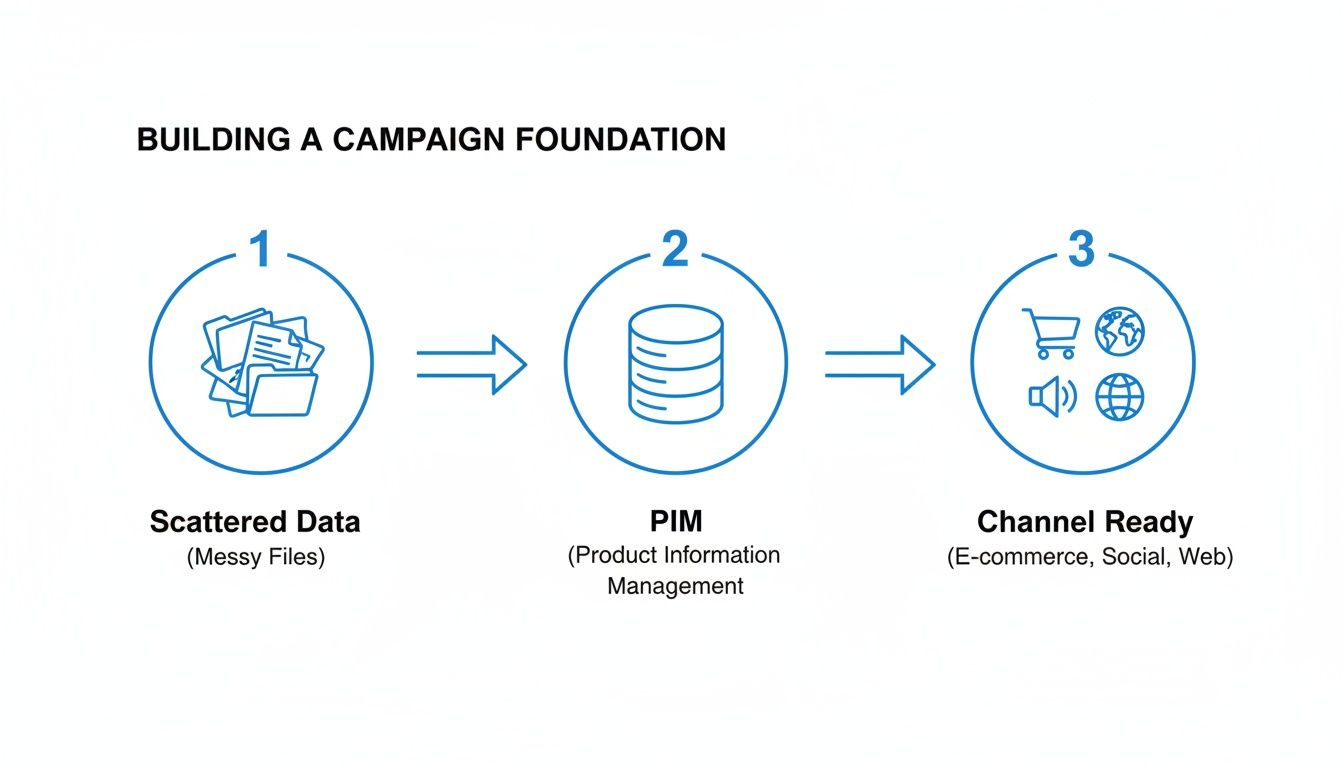
You can see how moving from a mess of scattered data to a clean PIM is what gets your assets "channel-ready." It's the essential first step to running a cohesive plan.
Once you know your destination, you need to know who you're taking with you and where they hang out. Do not just guess. Dig into your data, like website analytics, social media demographics, and past purchase history, and build a real customer persona.
Ask yourself some direct questions:
With that persona clear in your mind, you can start to map out their journey. Think of it as a visual storyboard of how someone might interact with your brand to reach their goal. It helps you get ahead of their needs and create an experience that feels connected, not disjointed.
Let's put this into practice. Imagine we are launching a new line of sustainable, high-tech sneakers called the "Eco-Runner."
Our goal: Drive 1,000 sales in the first month.
Our audience: Environmentally-conscious millennials who are active on Instagram and trust influencer reviews.
Here’s what a simple, connected campaign could look like:
See how that works? It’s not just a random list of marketing tasks; it's a connected plan. The message is consistent, but the delivery is tailored to each platform. The Instagram Reel creates the initial buzz, the email follows up with your loyal fans, Google Ads scoops up active shoppers, and the Amazon page gives them all the proof they need to click "buy."
That’s what planning a great multi-channel campaign is all about. It’s one seamless conversation that meets your customer exactly where they are.
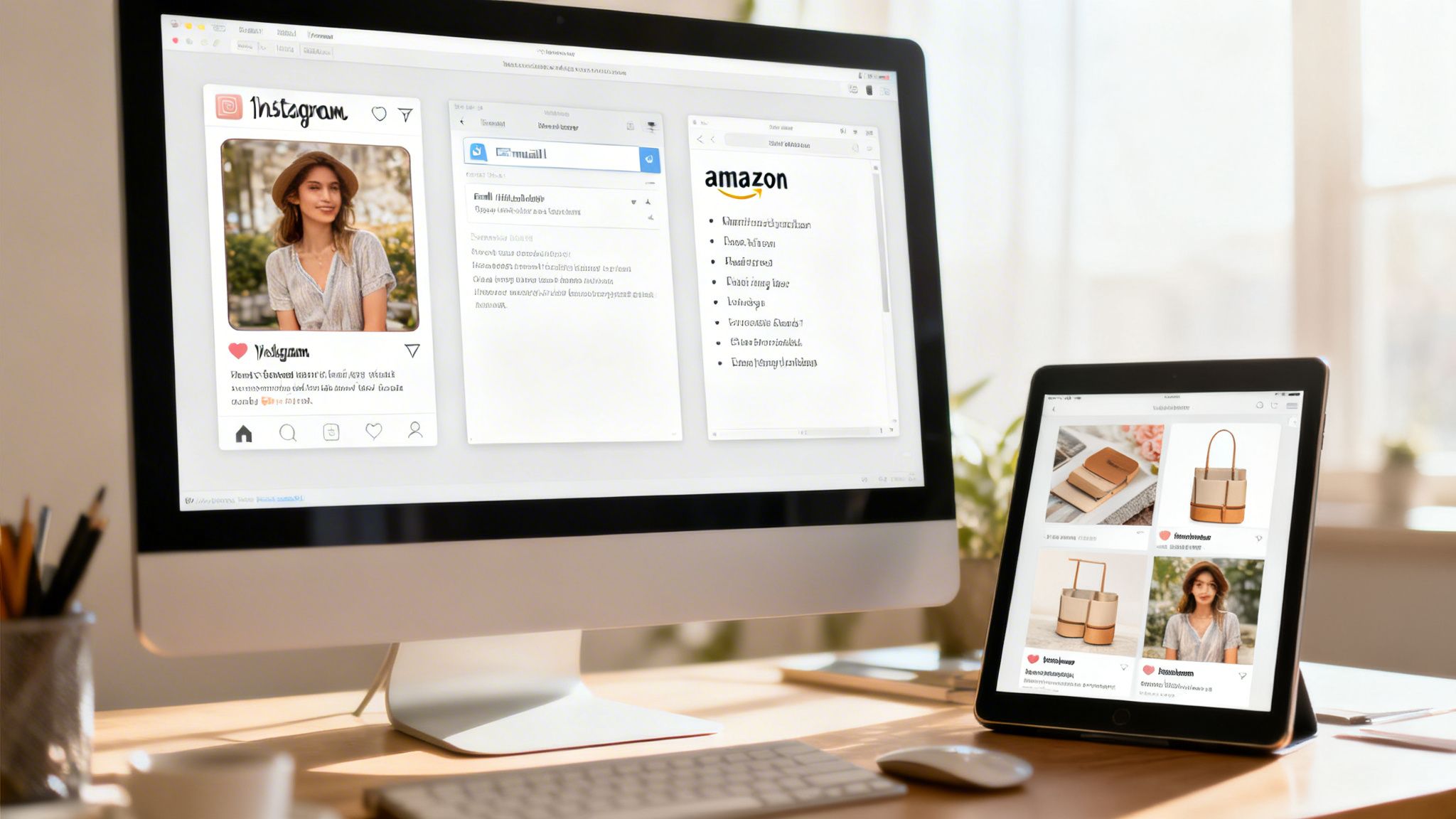
Here's where so many multi-channel campaigns fall flat. Taking a one-size-fits-all approach and just blasting the same content everywhere is a recipe for disaster.
Think about it. A customer doomscrolling on TikTok is in a completely different headspace than someone deep in research mode on Google, comparing product reviews. Your message will get ignored if you do not respect that context.
This is the shift from planning to doing. The goal is not just to show up on a bunch of channels; it's to be effective on each one. That means playing by the rules, understanding the culture, and meeting the audience's expectations. Your content should feel native, not like a clumsy ad crashing the party.
Do not panic, this does not mean you have to create 10 different campaigns from scratch. It’s about working smarter by adapting a core message to fit each specific environment.
Once you have your product data dialed in, you can start spinning that raw info into compelling copy tailored for each channel. This is where a PIM system with AI built-in becomes your secret weapon. You can feed it your core product specs and get back multiple versions, each optimized for a different platform.
Let's say you are launching a new smart coffee maker. From a single set of attributes, like capacity, brew time, and smart features, you can generate completely different pieces of content.
This approach keeps your brand voice consistent while making sure the content itself is a perfect fit for its surroundings. Same core message, custom-fit delivery.
Words are only half the equation. Your visuals, images and videos, demand the same channel-specific treatment. Every platform has its own preferred dimensions, file sizes, and even aesthetic vibes.
That stunning, high-res lifestyle photo from your website homepage? It’s going to get butchered and cropped awkwardly in an Instagram Story. That in-depth product demo for YouTube is way too long for a 15-second TikTok. Getting the format wrong just looks sloppy and unprofessional.
A huge part of running successful multi-channel marketing campaigns is managing a library of visual assets that are tagged and optimized for each channel. A Digital Asset Management (DAM) system is your best friend here.
When you integrate a DAM with your PIM, you can store one "master" image and then let the system automatically generate all the different versions you need for each platform. You can learn more about how AI is transforming digital asset management in our detailed guide. This literally saves your creative team hundreds of hours of mind-numbing manual resizing.
The results speak for themselves. Omnichannel leaders see a 9.5% year-over-year revenue growth, dwarfing the 3.4% seen by companies lagging behind. They also boast customer retention rates that are a staggering 23 times higher. If you want more proof, explore trends in multi-channel marketing and see how top brands are crushing it with this approach.
To keep everything straight, a simple checklist can be a lifesaver. Before you hit "publish" on any channel, just run through these quick questions.
What's the format? Is this a vertical video for Reels, a square image for an Instagram post, or a wide banner for your site? Design for the space.
What's the character limit? Twitter, Google Ads, and Amazon product titles are all notoriously strict. You have to get your point across quickly.
What's the user's mindset? Are they looking to be entertained (TikTok), to research (Google), or to buy right now (Amazon)? Your tone and call-to-action need to align with their intent.
What are the platform's rules? Some channels have very specific rules about ad copy or what kinds of links you can use. Ignoring them is a good way to get your content flagged or your account suspended.
By being thoughtful about how you create and optimize for each channel, you build a much stronger and more cohesive brand experience. This attention to detail is what separates campaigns that just exist from campaigns that actually convert and build a loyal following. It shows your customers that you get them, and the platforms they love.
You’ve built your foundation, planned the journey, and hit “launch.” The campaign is officially live. So, now what? This is the moment you switch from creator to analyst. It’s all about tracking what’s working, understanding why it’s working, and then putting your resources behind the winners.
Too many marketers get hung up on vanity metrics. Things like social media likes or a spike in impressions. They look great in a report and feel good, but they do not tell you if your multi-channel marketing campaigns are actually making the cash register ring.
It's time to get past the surface-level numbers and drill down to the key performance indicators (KPIs) that truly matter, the ones that connect your marketing activity directly to the bottom line.
To get a real pulse on your campaign's health, you need to track metrics that show how customers are moving through your funnel, from their very first click to the final purchase and, hopefully, beyond. These are the KPIs that paint a clear picture of success.
These are the numbers that actually move the needle:
When you focus on these metrics, you can make smarter decisions about your budget. You stop guessing and start making choices backed by real data.
One of the biggest headaches in multi-channel marketing is having your data scattered everywhere. You’ve got a dashboard for Google Ads, another for your email provider, and a third for your social media analytics. It’s a mess.
This siloed view makes it nearly impossible to see the whole story. You cannot easily connect how a customer's interaction on one channel influences what they do on another.
The fix is a unified analytics dashboard. Tools like Google Analytics 4, or more specialized platforms, can pull all your data sources into one central hub. This gives you a single, clear view of your campaign’s performance across every single touchpoint.
Once your data is unified, you can finally connect the dots. You might discover that while Instagram drives a ton of initial awareness, it’s your email follow-ups that actually close most of the sales. That’s a powerful insight you'd completely miss with separate reports.
This also helps solve the attribution puzzle. You can start to understand which channels are doing the heavy lifting at different stages of the customer journey, letting you give credit where it’s due.
Focus on these KPIs to understand the true impact of your multi-channel marketing campaigns across different stages of the customer journey.
This table is not exhaustive, but it's the perfect starting point to move beyond vanity and focus on what truly drives growth.
Once you’ve found a winning formula, a combination of channels, messaging, and offers that consistently delivers results, it's time to scale. But scaling is not just about throwing more money at your ads. If you do it without a plan, things can fall apart. Fast.
This is especially true when you are expanding into new channels or territories. Imagine launching your products in a new country. Suddenly, you need descriptions, specs, and marketing materials in a new language, all with different cultural nuances.
This is where a scalable Product Information Management (PIM) system becomes non-negotiable. A PIM acts as your single source of truth, ensuring that as you grow, your product data remains consistent and accurate everywhere. When you’re ready to expand, you are not starting from scratch. You are just adding a new channel or region to a system already built for growth. The backbone of this scalability is solid data quality. You can learn more by checking out our guide on managing data quality for successful campaigns.
Jumping into multi-channel marketing always stirs up a ton of questions. It's a massive topic with lots of moving parts. Let's clear the air on a few of the most common points of confusion so you can start building campaigns with confidence.
This is the big one. People use these terms interchangeably all the time, but they represent two very different levels of marketing maturity. It's easy to get them mixed up.
Multi-channel marketing is really about presence. You have a website, you post on Instagram, and you run ads on Amazon. Each channel is a separate lane, working on its own to reach customers. They aren’t designed to talk to each other.
Omnichannel marketing, on the other hand, is all about connection. It's weaving those channels together into a single, seamless customer experience. Think about a customer browsing on your app, adding a product to their cart, and then getting a perfectly timed reminder email when they're on their laptop later. The experience follows the customer, not the channel.
The real journey for most brands is not just about adding more channels; it is about evolving from multi-channel to truly omnichannel. You're shifting from simply being present everywhere to making that presence feel completely connected and intelligent.
It’s so tempting to go for a "shock and awe" approach and try to be everywhere at once. I’ve seen it a hundred times, and it’s a classic mistake that almost always backfires. You end up stretching your team and budget way too thin, resulting in a weak, forgettable presence on ten channels instead of a dominant one on two or three.
Start small. Be surgical.
This is all about quality over quantity. It’s far better to be a rockstar on a few key channels than to be a forgotten background singer on all of them.
A Product Information Management (PIM) platform is the central nervous system for any serious multi-channel marketing operation. Honestly, trying to run a modern campaign without one is like trying to manage a warehouse with a paper ledger, it’s just asking for chaos.
Instead of product specs, marketing copy, and images living in a messy web of spreadsheets and shared folders, a PIM centralizes everything. It establishes a single source of truth for every single piece of information about every product you sell.
This is where the magic happens. A PIM lets you automate and streamline the ridiculously time-consuming work of tailoring content for each channel. From that one system, you can automatically generate optimized titles for Amazon, craft benefit-driven copy for your website, and pull key features for Google Shopping ads, all from the same core product data.
It guarantees that every channel always has the most current and accurate information. Trying to do that manually is a recipe for errors, inconsistencies, and a whole lot of wasted time.
Ready to stop juggling spreadsheets and start building powerful, consistent campaigns? NanoPIM gives you the AI-powered command center you need to manage all your product information in one place and deliver optimized content to every channel, every time. Learn more at https://nanopim.com.


