

A customer sees a product in an Instagram post during lunch. They tap through to your site, but the item name is different there, so search returns the wrong results. They call support, and the agent cannot find the campaign they are talking about. Later, they visit a store and finally spot the product, only to learn the price does not match what they saw online.
That is not a marketing problem. It is a data problem that customers experience as friction.
An omni channel experience is what happens when none of those handoffs break. The customer does not care which team owns the website, who updates marketplace listings, or whether your store system talks to your app. They only see one brand. If your systems behave like five brands, they feel it immediately.
That matters because shopper behavior is already cross-channel. In 2025, 73% of shoppers use a mix of online, in-store, and mobile channels to complete purchases, and 85% start on one device and finish on another, according to MoEngage omnichannel marketing statistics.
For growing retail brands, the challenge is not understanding the idea. Many teams already know they should be more connected. The challenge is making that connection without creating more manual work, more duplicate content, and more confusion across channels.
The failure starts small.
A social team launches a campaign with one product title. The ecommerce team uses another. Marketplaces use abbreviated versions because of channel rules. Store associates see an older description in the POS system. Customer support gets no campaign context at all.
From the brand side, these look like separate operational issues. From the shopper side, it feels like your business is not paying attention.

The most common breakpoints are easy to recognize:
These failures are common because many brands still run on channel-first systems. Each team publishes to its own destination. Each destination gets its own copy tweaks, media folder, pricing update, and approval path. Over time, the brand becomes a patchwork.
Customers rarely describe this as “poor channel orchestration.” They say things like “your website was confusing” or “your store told me something different.”
A disconnected setup can still look busy and productive internally. Campaigns go out. Listings get updated. Stores sell. But the customer keeps having to restart the conversation.
That restart is the hidden tax of bad omnichannel execution.
Most confusion starts with one simple mix-up. Multichannel and omnichannel are not the same thing.
Multichannel means you are present in multiple places. You sell on your website, in stores, maybe on Amazon, maybe through an app, maybe through social. That is useful, but presence alone is not enough.
Omnichannel means those places work together as one experience.
Multichannel is like talking to five employees who never compare notes. Every time you switch channels, you repeat yourself.
Omnichannel is like dealing with one informed concierge. The conversation continues no matter where you pick it up.
That distinction matters because many retailers think they are omnichannel when they are distributed. They have more channels, but not more continuity.
A strong omni channel experience feels boring in the best way. The shopper should be able to:
The customer should not have to care which system owns product attributes, where images are stored, or whether one team updated the title and another forgot to update the bullet points.
For omnichannel to work, the business has to unify more than messaging. It needs shared product data, synchronized inventory, compatible workflows, and connected analytics.
That is why the technical layer matters so much. According to BigCommerce on omnichannel retail, true omnichannel retail requires a unified data architecture that consolidates customer touchpoint data into a single source of truth, typically using a PIM and a CDP to keep product information and inventory synchronized across channels.
That phrase, single source of truth, gets overused, but in practice it means something concrete. One approved product title. One current set of attributes. One asset library. One inventory state that downstream systems can trust.
If your teams are copying product data between spreadsheets, channel feeds, shared drives, and ad managers, you do not have an omni channel experience. You have a coordination problem.
The customer-facing part of omnichannel gets all the attention. Important work happens in the operating model behind it.
A customer starts on Instagram, checks specs on your site during lunch, compares color options in your app that night, and walks into a store two days later ready to buy. If pricing, availability, product details, or images conflict at any point, the sale gets harder than it should be. If every channel reflects the same product truth, conversion gets easier.
That is the business case.
Companies with strong omnichannel strategies see 9.5% annual revenue growth, compared with 3.4% for weaker implementations, according to ElectroIQ’s omnichannel statistics roundup. The same source reports 89% customer retention for stronger operators, versus 33% for brands with weaker execution.
Those gains come from fewer avoidable mistakes. Fewer broken journeys. Fewer product mismatches. Fewer moments where the customer has to stop and verify what should have been clear the first time.
Revenue lifts do not come from adding more touchpoints on their own. They come from making each touchpoint useful.
ElectroIQ reports that campaigns using three or more channels achieve a 0.83% order rate, compared with 0.14% for single-channel campaigns. The practical lesson is narrower than the headline. More channels help only when pricing, availability, product attributes, and creative assets stay aligned across each one.
That alignment gets harder as the catalog grows. It gets harder again when AI search, product discovery engines, and generative search experiences start pulling from inconsistent titles, weak attributes, or outdated media. Brands that invest in a modern product and asset foundation give every channel better raw material to sell from. A practical look at AI-powered digital asset management shows why asset control now affects more than creative workflows. It affects discoverability, speed to market, and feed quality.
Customers come back when buying feels reliable.
ElectroIQ also reports that retained omnichannel customers deliver 30% higher lifetime value. That makes sense for any retail brand selling configurable products, seasonal assortments, technical goods, or items where imagery and specs influence conversion. If shoppers see one set of dimensions on the product page, another in a marketplace listing, and a third in store materials, trust drops fast.
Continuity protects margin too. Returns, support contacts, and abandoned carts often trace back to bad or incomplete product data more than weak marketing.
This situation clarifies the economic realities for operators.
ElectroIQ reports that strong omnichannel practitioners reduce cost per contact by 7.5% year over year, compared with 0.2% for weaker ones. Support costs fall when service teams, store associates, ecommerce managers, and marketplace teams work from the same approved product record and media set. Merchandising moves faster when updates flow from a central system instead of getting recreated channel by channel.
That same logic applies to experience decisions on mobile. The right app model affects speed, maintenance effort, and how consistently product content reaches shoppers across devices. Teams weighing that trade-off can review Web Based App vs Native development in the context of their broader channel strategy.
The pattern is consistent:
For a growing retail brand, omnichannel pays off when the operating model is built to support it. The visible experience matters. The system underneath matters more. Without an AI-ready PIM and DAM at the core, growth across channels usually creates more inconsistency, more labor, and more leakage. With that foundation in place, omnichannel becomes easier to scale and easier to measure.
Most omnichannel programs fail because teams jump straight to campaigns. They start with email journeys, paid social, mobile push, or marketplace expansion. Those matter, but they are not the core.
The core is a system with four parts that have to work together.
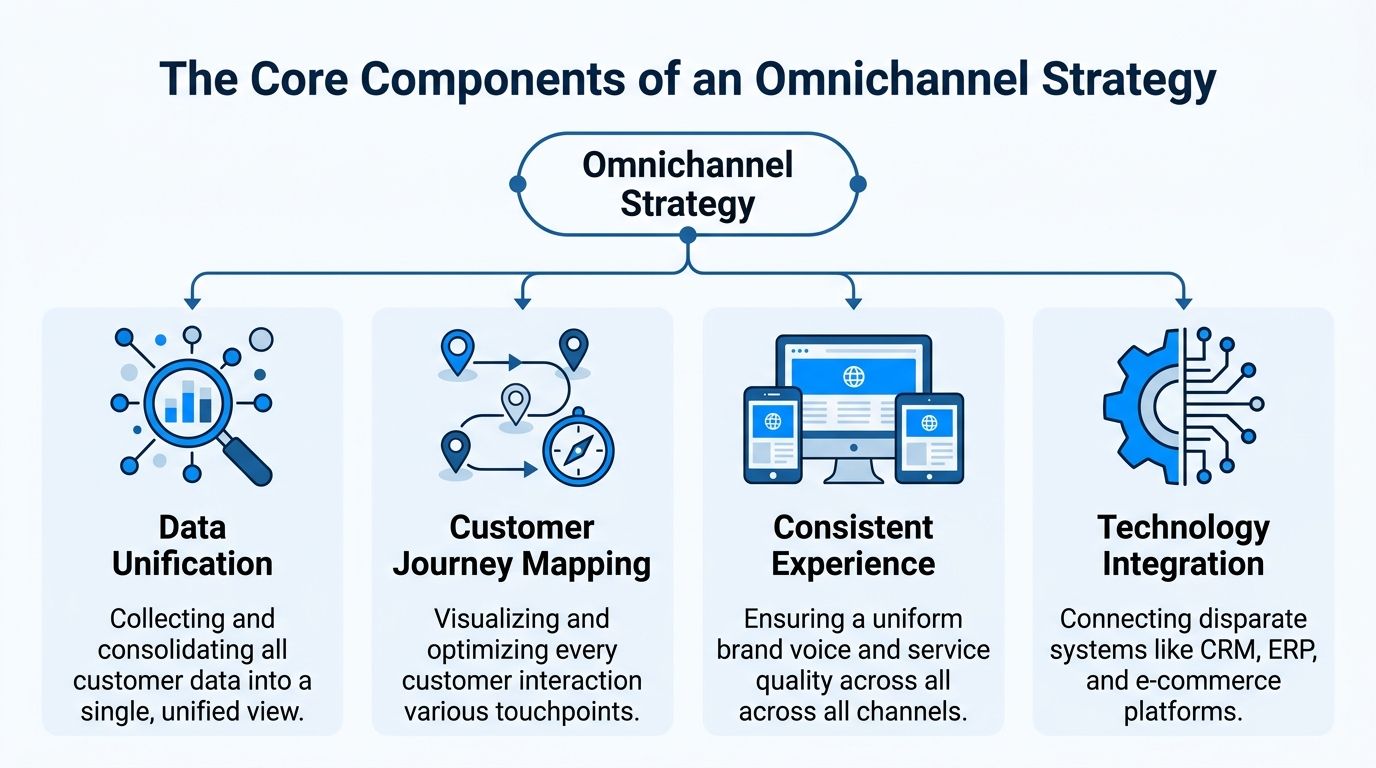
This part is essential.
If customer touchpoints, product records, inventory states, and media assets live in separate systems without strong synchronization, every downstream experience becomes fragile. One team updates the website. Another updates the marketplace feed. A third updates store materials. The channel output may look close enough for a week, then drift starts.
The effective fix is not “better communication.” It is structure.
A modern stack needs a PIM for product truth, a DAM for asset control, and customer systems that can consume trusted data without rewriting it each time. Teams that want a useful primer on media operations can review this look at https://nanopim.com/post/digital-asset-management-ai.
A common mistake is treating all channels like resized versions of the same storefront.
They are not. Amazon, Google, branded ecommerce, mobile app, retail media, email, and store systems all have different constraints. Title length, attribute needs, image rules, merchandising logic, and search behavior vary. Good omnichannel execution keeps the core facts consistent while adapting the presentation.
That is where AI can help, but only if the source data is clean. If you run AI on messy catalogs, it scales inconsistency faster.
Technology choices at the channel level affect how connected the full journey can become. Mobile is the obvious example. A brand deciding between app-heavy engagement and broader browser accessibility should think beyond design preferences. Performance, offline behavior, update control, checkout flow, and feature access all affect continuity. This comparison of Web Based App vs Native development is useful when deciding how your mobile experience should fit the larger omnichannel model.
A channel should not exist just because competitors use it. It should exist because your team can support it with reliable data, coherent content, and measurable orchestration.
This is the piece many teams underestimate.
Orchestration decides what happens when a customer moves from discovery to evaluation to purchase across different touchpoints. It is the logic connecting product availability, campaign timing, customer context, and fulfillment options.
A few practical examples:
Omnichannel gets easier when teams stop asking “what do we publish to each channel?” and start asking “what data and rules should every channel inherit?”
When these four parts line up, execution gets faster. When one is missing, every campaign becomes a manual rescue job.
Retail teams do not need a perfect transformation plan. They need a controlled one.
The best omnichannel work starts smaller than leadership expects. You pick one product segment, one customer journey, or one region. Then you clean the data, align the workflows, and prove that the model works before expanding.
Start with what customers are already doing, not what internal teams think should happen.
Pull together leaders from ecommerce, merchandising, customer support, marketplace operations, retail, and performance marketing. Ask one question: where does the customer have to restart?
Look at a few real paths:
Do not map the ideal journey. Map the messy one.
You will find that the breakpoints are rooted in data ownership. Product titles differ by system. Rich media lives in folders no one trusts. Attribute completeness varies by channel. Promotions are communicated in Slack but not reflected in source records.
A useful starting framework for this kind of work is a formal data operating model. This guide to https://nanopim.com/post/data-management-strategy is a practical reference for teams trying to move from ad hoc fixes to governed data workflows.
At this stage, many projects become too broad. Keep scope disciplined.
You do not need to centralize everything at once. Focus first on the records that affect customer-facing consistency. That means:
The goal is not to create a giant database for its own sake. The goal is to give every downstream channel a trusted source.
A pilot should be commercial enough to matter and narrow enough to control.
Good pilot candidates include a seasonal category, a top-selling collection, or a product line sold through site, store, and one major marketplace. Avoid edge cases. You want a category where inconsistency has visible customer and team impact.
Define success before launch. Not in vague terms like “better alignment.” Use operational and commercial indicators that teams can track.
According to Improvado on omnichannel analytics, success requires moving beyond isolated channel metrics. Strong omnichannel measurement focuses on Cross-Channel ROAS and assisted conversions, which reveal how channels influence each other rather than claiming full credit in isolation.
That matters because a customer may discover on social, compare on your site, and buy in store. If your reporting treats those as separate stories, you will underinvest in the channels that create demand.
Once the pilot works, scale in layers.
Do not expand by adding random channels one by one. Expand by standardizing what worked:
Scaling usually breaks when teams copy the pilot’s visible outputs but skip its governance.
Track a blend of customer, operational, and attribution measures.
If your team only tracks channel-specific sales, you will keep rewarding last-touch performance and miss how the journey works.
| Phase | Action Item | Key Consideration |
|---|---|---|
| Audit | Map real customer journeys across site, app, store, support, and marketplaces | Use actual customer paths, not idealized ones |
| Audit | Identify where product data, pricing, and media diverge | Look for duplicate ownership and manual re-entry |
| Unification | Establish a trusted source for product records and assets | Governance matters as much as technology |
| Unification | Standardize required attributes by channel | Keep core facts fixed, adapt format by destination |
| Pilot | Choose one category or journey with visible friction | Pick something commercially meaningful |
| Pilot | Define shared KPIs before launch | Include assisted conversions and cross-channel measures |
| Scale | Turn pilot workflows into repeatable rules | Document approval paths and sync logic |
| Scale | Expand to new channels only when source data is stable | More channels with bad data creates more failure points |
A practical roadmap is not glamorous. It is careful cleanup, disciplined scope, and better measurement. That is why it works.
Most retail teams do not fail because they lack ambition. They fail because the friction lives in old systems, old habits, and old ownership lines.

This is one of the biggest blockers.
A 2025 Flexera survey found that 65% of IT leaders said emerging technologies no longer fit neatly into on-premises or cloud environments, making it harder to centralize product data for channels like Amazon and Google, as summarized by RRD’s discussion of seamless omnichannel experiences.
That shows up in practical ways. Your ERP may be strong on inventory and weak on content. Your DAM may store files but not govern product relationships. Your commerce platform may be fine for direct-to-consumer and awkward for marketplace syndication.
What works: use integration layers and governed source systems. Decide which platform owns each truth. Then sync outward.
What does not: asking every downstream tool to become the master.
Marketing owns campaigns. Ecommerce owns the site. Retail owns stores. Marketplace teams own feeds. Support owns tickets.
No one wakes up trying to create a bad omni channel experience, but if every group is measured in isolation, they will optimize in isolation too.
What works: shared ownership for a few journey-level outcomes, not just department KPIs.
What does not: weekly meetings where everyone reports channel success while the customer still experiences handoff failures.
This gets worse as catalogs expand.
Every new channel introduces title rules, image requirements, category mappings, and attribute expectations. Add AI-generated content without solid controls and the problem gets bigger fast. You may produce more copy, but not better alignment.
A related challenge appears when brands expand globally. Payment, checkout, and settlement choices influence trust and completion just as much as product content. Teams entering new regions should also review operational issues like how to accept international payments, because a connected experience breaks quickly when local buying expectations are not supported.
Even strong systems fail if store associates, support agents, and merchandisers do not trust the data.
That is why rollout should include simple playbooks. Which field is authoritative. Which asset is approved. What to do when a marketplace record conflicts with site content. Who approves exceptions.
A short visual explainer can help teams align on that reality:
The fastest way to lose momentum is to launch a new omnichannel process that frontline teams immediately work around.
The hurdle is rarely one dramatic failure. It is a collection of small inconsistencies that everybody has learned to tolerate. Clearing them takes process discipline as much as software.
If you strip away the buzzwords, a strong omni channel experience depends on one simple capability. Your business needs a reliable way to create, govern, enrich, approve, and distribute product truth.
That is the job of PIM and DAM.
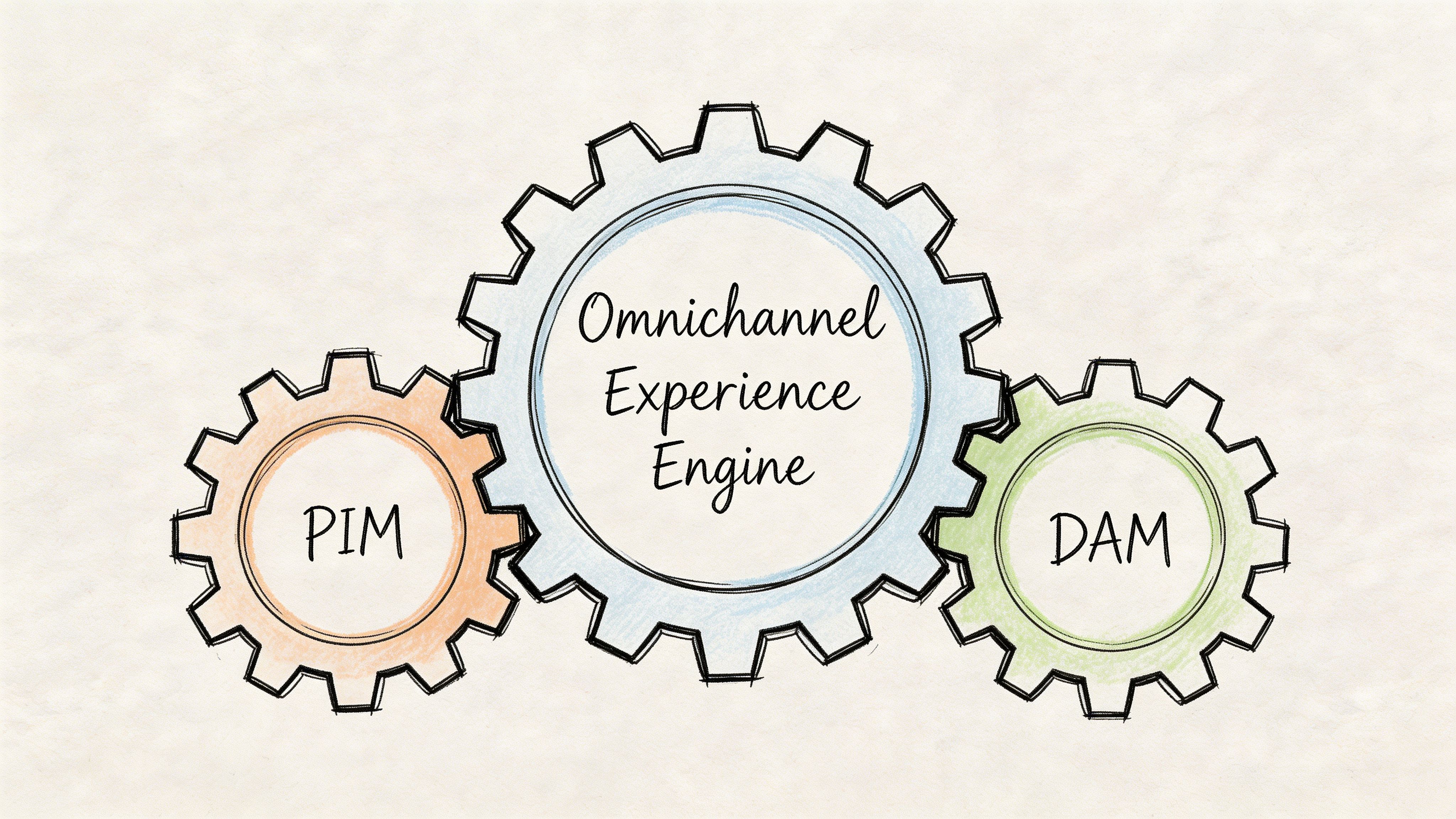
A PIM holds the structured side of the product story.
That includes titles, attributes, dimensions, compatibility details, variants, taxonomy mappings, and channel-specific rules. If your ecommerce platform is where all of that is being manually maintained, you hit a ceiling. The platform can publish products, but it is not designed to govern complex product truth across every destination.
If your team needs a baseline overview, this explainer on https://nanopim.com/post/what-is-a-pim-system covers the role of PIM in straightforward terms.
A DAM handles the media side that causes confusion.
Images, videos, manuals, spec sheets, lifestyle assets, packaging files, and channel-ready crops need more than storage. They need metadata, approval status, reuse rules, and a clear relationship to the right product records.
Without that, teams end up pulling creative from old folders, resizing by hand, and publishing files that no longer match the latest variant or message.
Much current omnichannel advice falls short here.
It is easy to say “use AI to create content at scale.” But AI only helps if the source model is clean and governed. Otherwise, the system produces lots of fluent copy based on inconsistent data, outdated specs, and weak metadata.
A modern product data engine should let teams do three things well:
That last point matters more in the AI search era. Brands are no longer just writing for category pages and ads. They are also preparing content that needs to stay coherent across search surfaces influenced by generative systems. That makes governance more important, not less.
The most durable setup includes:
What does not work is trying to solve omnichannel with spreadsheets, copy-paste workflows, and disconnected plugins.
“Seamless” is the outcome. PIM and DAM are the machinery that makes it repeatable.
When retail brands get this layer right, everything above it gets easier. Merchandising becomes faster. Marketplace expansion gets less chaotic. Creative teams stop hunting for files. Support gets better information. AI becomes useful instead of risky.
The customer stops feeling the internal mess.
If your team is trying to build a real omni channel experience without drowning in spreadsheets, disconnected assets, and manual channel updates, NanoPIM is worth a close look. It gives retail and ecommerce teams one place to manage product data, media, AI-assisted content enrichment, review workflows, and channel-ready outputs for the AI search era.


