

Think about all your company's digital content for a second. It’s probably a chaotic jumble, right? A traditional Digital Asset Management (DAM) system is like hiring a librarian to manually catalog every single file. It's a step up from chaos, but it's slow and entirely dependent on human effort.
Now, imagine a team of super-smart librarians who instantly organize, tag, and understand every image, video, and document the second it arrives. That’s the magic of digital asset management AI.

At its core, AI-powered DAM injects artificial intelligence into a standard DAM. This transforms a simple digital storage locker into a dynamic, intelligent content hub that actively works for you.
A traditional DAM is like a perfectly organized closet. You know where the boxes are supposed to go, but you have to label everything yourself, put it all away, and remember the system you created. It's a passive setup that's only as good as the effort you put in.
An AI-powered DAM, on the other hand, is like having a robotic assistant in that closet. It not only organizes and tags everything for you but even suggests what to use and when. It’s an active partner, not just a passive storage unit.
The biggest problem AI solves is turning your digital mess into valuable, organized assets without the endless hours of manual work. For an e-commerce brand, this isn't just a nice-to-have; it's a competitive lifeline. Every product photo, marketing video, and spec sheet is an asset, but only if you can actually find it and use it when you need it.
AI steps in to handle the tedious tasks that bog your team down. Instead of a marketer spending a whole afternoon tagging a few hundred new product images, AI gets it done in seconds. This shift frees up your creative and marketing teams to focus on strategy and big ideas, not digital housekeeping.
By automating how content is organized and enriched, digital asset management AI makes your entire asset library more searchable, accessible, and ultimately more valuable to every single person in your company.
This automation is fueling some serious growth. The global Digital Asset Management market, supercharged by AI, is on track to jump from $5.5 billion in 2023 to a projected $7.51 billion by 2026.
To give you a clearer picture, here’s a quick side-by-side comparison. It really highlights the key differences between a standard DAM and one that’s been boosted with AI, showing just how much of an advantage it brings to the table.
| Feature | Traditional DAM (The Manual Library) | AI-Powered DAM (The Smart Library) |
|---|---|---|
| Tagging & Metadata | Manual entry only. Relies on users to add tags, keywords, and descriptions. It's often inconsistent and incomplete. | Automated tagging. AI analyzes images and videos to automatically generate relevant tags (e.g., "red dress," "woman smiling," "outdoor setting"). |
| Searching for Assets | Keyword-based. You can only find what you've explicitly tagged. A search for "beach" won't find an image of a "coastline" unless someone tagged it that way. | Visual and concept-based search. You can search for concepts ("happy customer") or even upload an image to find similar ones, even if they aren't tagged. |
| Content Insights | None. The DAM stores assets but offers zero insight into how they perform or which ones are most effective. | Performance analytics. AI can track asset usage and engagement to tell you which images or videos drive the most sales or clicks. |
| Content Creation | Storage only. A simple repository for finished assets. | Generative capabilities. Some systems can create new asset variations, like different backgrounds for a product photo or social media copy. |
| Workflow Efficiency | High manual effort. Requires significant time for uploading, organizing, and finding assets, which slows down marketing campaigns. | Highly automated. Frees up creative teams from administrative work, drastically reducing the time it takes to launch new products or campaigns. |
As you can see, the AI-powered DAM isn't just a better version of the old system. It's a fundamentally different and more powerful tool for your business.
The arrival of AI in DAM systems also fundamentally changes how content gets made and used. To really get a handle on this, it helps to understand what is AI generated content and what it means for creative teams. Modern DAMs are no longer just for storing assets; they're becoming hubs for creating them, too.
For an e-commerce store, this translates into real-world benefits:
Ultimately, an AI-powered DAM provides the intelligent backbone you need to manage content at the speed and scale that modern omnichannel commerce demands. It transforms your asset library from a simple cost center into a strategic engine for growth.

So, what actually makes a DAM "smart"? It's not just a buzzword. It's a set of specific AI-powered tools working behind the scenes to automate the grunt work and unlock new ways to use your content.
Think of these features as a specialized crew, each with a unique skill. Together, they turn your static library of files into a dynamic content engine that understands, organizes, and even helps create your marketing assets. Let's pull back the curtain on the five core AI capabilities that really make a modern DAM tick.
This is the bread and butter of AI in a DAM, and honestly, its most immediate impact. Imagine dropping a folder of 100 new product photos into the system. Instead of a poor soul manually typing tags like "red dress," "summer collection," or "woman smiling," the AI does it in seconds. It looks at each image and automatically applies relevant, searchable keywords.
This is a massive time-saver, sure, but the real magic is in the consistency. An AI tagger applies a uniform logic to every single asset, making your entire library ridiculously easy to search. No more guessing whether a colleague tagged a photo as "ocean" or "beach," the AI understands the context and applies both.
Ever find the perfect image for a campaign and think, "I need more just like this"? That's where similarity search comes in. It’s a complete game-changer. Instead of typing words, you use an image as your search query.
Just drag and drop a photo with a specific mood, color palette, or composition, say, a minimalist product shot on a neutral background. The AI then scans your entire library and pulls up all the assets that are visually similar. For creative teams trying to keep a consistent brand vibe across a campaign, this turns a frustrating keyword-guessing game into a one-click task.
With visual search, you stop searching for what you think an asset is called and start searching for what it actually looks like. This intuitive approach closes the gap between creative vision and asset discovery, speeding up workflows significantly.
A surprising number of your assets probably have text embedded in them, even if they're images. Think product labels, ad copy in a screenshot, or even the text on a model's t-shirt. Optical Character Recognition, or OCR, is the tech that lets the AI "read" that text right off the image.
Once the AI reads it, that text becomes fully searchable. If you need to find every photo featuring a product with a "100% Organic Cotton" label, OCR makes it possible. Suddenly, your visual assets become a deep well of searchable data, unlocking information that was previously trapped inside the pixels.
Basic AI tagging tells you what's in an image. Intelligent metadata enrichment tells you the business context around it. This is where things get really advanced. The AI connects your assets to other business data, layering on valuable information automatically.
Here’s how it works in an e-commerce setting:
This process turns a simple picture into an asset rich with business intelligence.
This is where AI stops being an organizer and becomes a creative partner. Instead of just managing existing content, generative AI can help you create new assets right inside the DAM. It takes the information already attached to an asset and spins up original content from it.
For example, you could select a product photo and have the AI generate 5 different versions of ad copy for Instagram, or 3 compelling email subject lines. It could even create variations of an image with different backgrounds for A/B testing. Your DAM is no longer just a storage closet; it's an active participant in creating on-brand material faster than your team ever could before.
In e-commerce, the distance between a great product idea and a successful launch is paved with frustrating, time-sucking operational roadblocks. This is where the theory behind digital asset management AI gets real. Let’s walk through the story of a growing online store hitting a wall with a classic, infuriating problem.
Their product listings are a total mess. The website images don’t match what’s on Amazon, and both are different from what’s getting posted on social media. It's a brand nightmare that confuses customers and screams amateur hour. The team is burning out putting out fires instead of focusing on growth. This is where an AI-powered DAM steps in, not as a magic bullet, but as a systematic problem-solver.
The first huge win is getting every single asset into one smart, centralized hub. An AI DAM becomes the single source of truth for all product media. When a new batch of photos lands from a shoot, they go straight into the DAM, and the AI immediately clocks in.
Forget manual tagging. The system uses auto-tagging to get every image categorized right, instantly. A photo of a blue sneaker is tagged with "blue," "sneaker," "running shoe," and maybe even "lifestyle" if someone is wearing it. This means when a customer uses the search filter on your site, the right products actually show up. This small detail massively improves the shopping experience and directly impacts sales.
A few weeks later, the marketing team needs to spin up a new campaign with a very specific visual feel. The old way involved hours of scrolling through a labyrinth of folders, just hoping to stumble upon images that looked kind of similar. Now, they use similarity search.
They find that one perfect image, the one that just nails the campaign's vibe, and tell the AI DAM to find everything else that looks just like it.
By finding visually consistent assets in seconds, the marketing team can move faster and with more confidence. They're no longer guessing about brand consistency; the AI-powered DAM makes it a simple, repeatable process.
Let's be real: every sales channel plays by its own rules. Amazon demands one set of image specs, Shopify another, and Instagram something else entirely. Trying to manually create and track all those variations is a recipe for mistakes and wasted weekends.
This is where AI-driven metadata enrichment becomes a superpower. The DAM doesn’t just store an image; it stores all the crucial data tied to it. When it's time to push a product to Amazon, the system automatically grabs the approved, high-res photos and pairs them with SEO-optimized titles and descriptions built specifically for that marketplace.
This guarantees your product details are always accurate and optimized, which has a direct impact on search visibility and sales. For anyone trying to manage the controlled chaos of omnichannel retail, this level of automation isn't a luxury; it's essential. You can dive deeper into building out a successful e-commerce strategy in our detailed guides.
At the end of the day, this whole shift is about tangible outcomes. The online store is no longer just getting by; it's getting ahead.
This isn't a niche trend; it's happening across the board. In the retail and consumer goods sector, the use of AI in DAM is projected to grow at a 16.78% compound annual growth rate. This tech is what connects product data with assets to create the hyper-personalized shopping experiences modern customers expect. While challenges like integrating with legacy systems are real, modern cloud-based solutions have made it easier than ever to scale. You can find more insights on the future of AI in DAM on aprimo.com.
For this online store, digital asset management AI wasn't just another tool. It was a fundamental upgrade to their entire operation, turning chaos into a streamlined, automated engine for growth.
A digital asset management AI system is a powerhouse, but it does its best work as part of a team. It was never meant to be a solo act. Think of it as the creative heart of your e-commerce tech stack, beating in rhythm with your other core business systems.
Let's break down your e-commerce operations into three key players. First, you have your Enterprise Resource Planning (ERP) system. This is the logistical brain, handling the hard numbers like inventory levels, pricing, and financials. It's all about operational facts.
Next up is your Product Information Management (PIM) system. The PIM is your single source of truth for every product detail imaginable, SKUs, dimensions, technical specs, and those all-important marketing descriptions.
And finally, you have your AI-powered DAM, the creative hub. It takes all that raw product data and breathes life into it with approved, high-quality images, videos, and campaign assets. When these three systems are disconnected, teams get stuck in a painful cycle of manually syncing information, which almost always leads to costly errors and inconsistent product pages.
When you connect your AI DAM, PIM, and ERP, something magical happens. They form a single, automated workflow that takes you from a line on a spreadsheet to a beautiful, ready-to-sell product listing. This is where you unlock some serious efficiency.
Picture this: your ERP updates the inventory for a new product. That info instantly syncs to your PIM. At the same time, a fresh batch of photos for that product hits the AI DAM, which immediately tags them and links them to the correct SKU.
Now, your PIM can pull those approved images directly from the DAM, pairing them perfectly with the product descriptions and specs it already holds. The result is a complete, channel-ready product listing, all without a single person having to manually copy-paste files or cross-reference three different systems.
By connecting your core systems, you create a fluid loop of information. The AI DAM doesn't just store assets; it actively enriches your product data, ensuring that every image and video is perfectly synchronized with the logistical and descriptive information from your ERP and PIM.
A connected ecosystem shatters the data silos that slow businesses down. It lets your AI work its magic by automatically enriching product information using details it pulls from the assets themselves.
The flowchart below shows exactly how this integrated approach, starting with AI auto-tagging, builds toward brand consistency and, ultimately, accelerates your time to market.
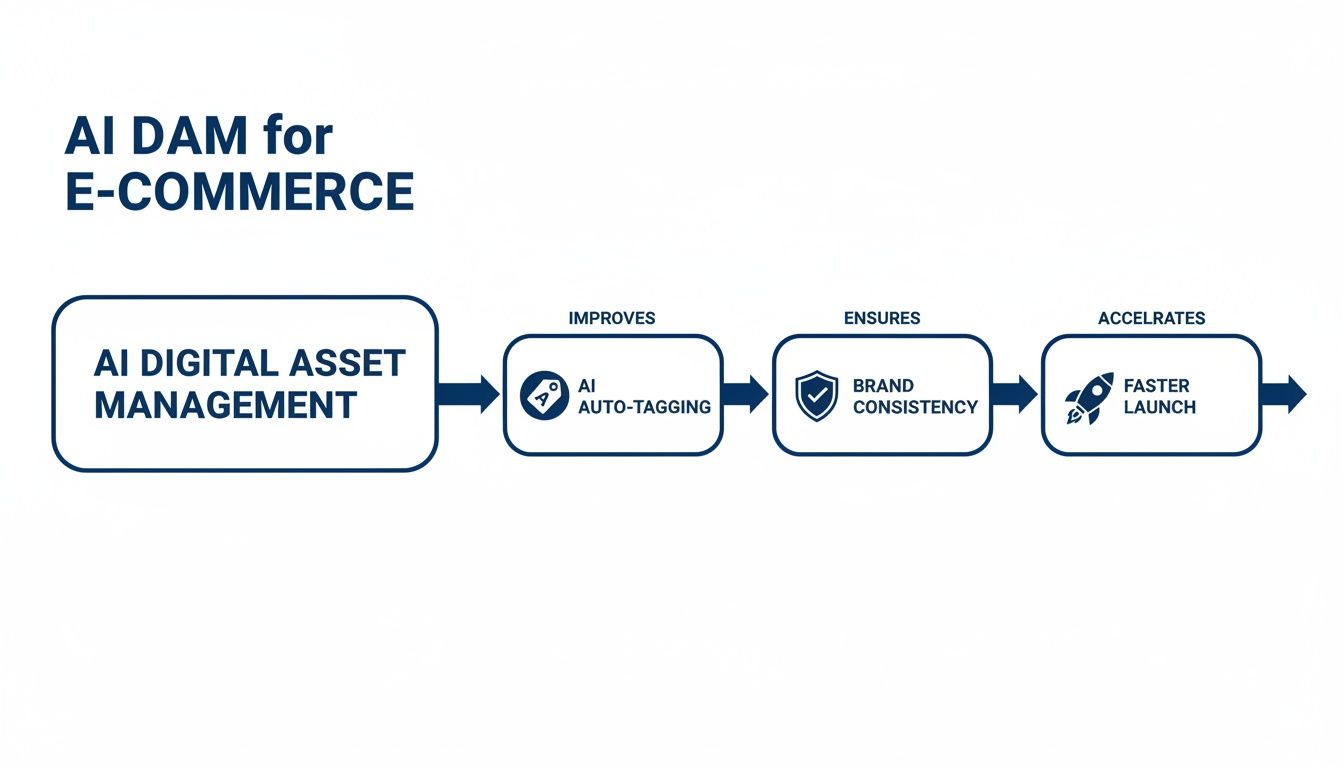
This visual draws a straight line from smart asset organization to real business outcomes, proving that a connected system is the key to faster, more consistent e-commerce operations.
This seamless connection is the core value of modern platforms. For example, you can see how a combined PIM and DAM solution like NanoPIM unifies this workflow to turn raw data into stunning, channel-ready listings. This unified approach helps your team get from raw product specs to a polished Amazon or Shopify page, complete with all the right images and copy, in a single, streamlined process.
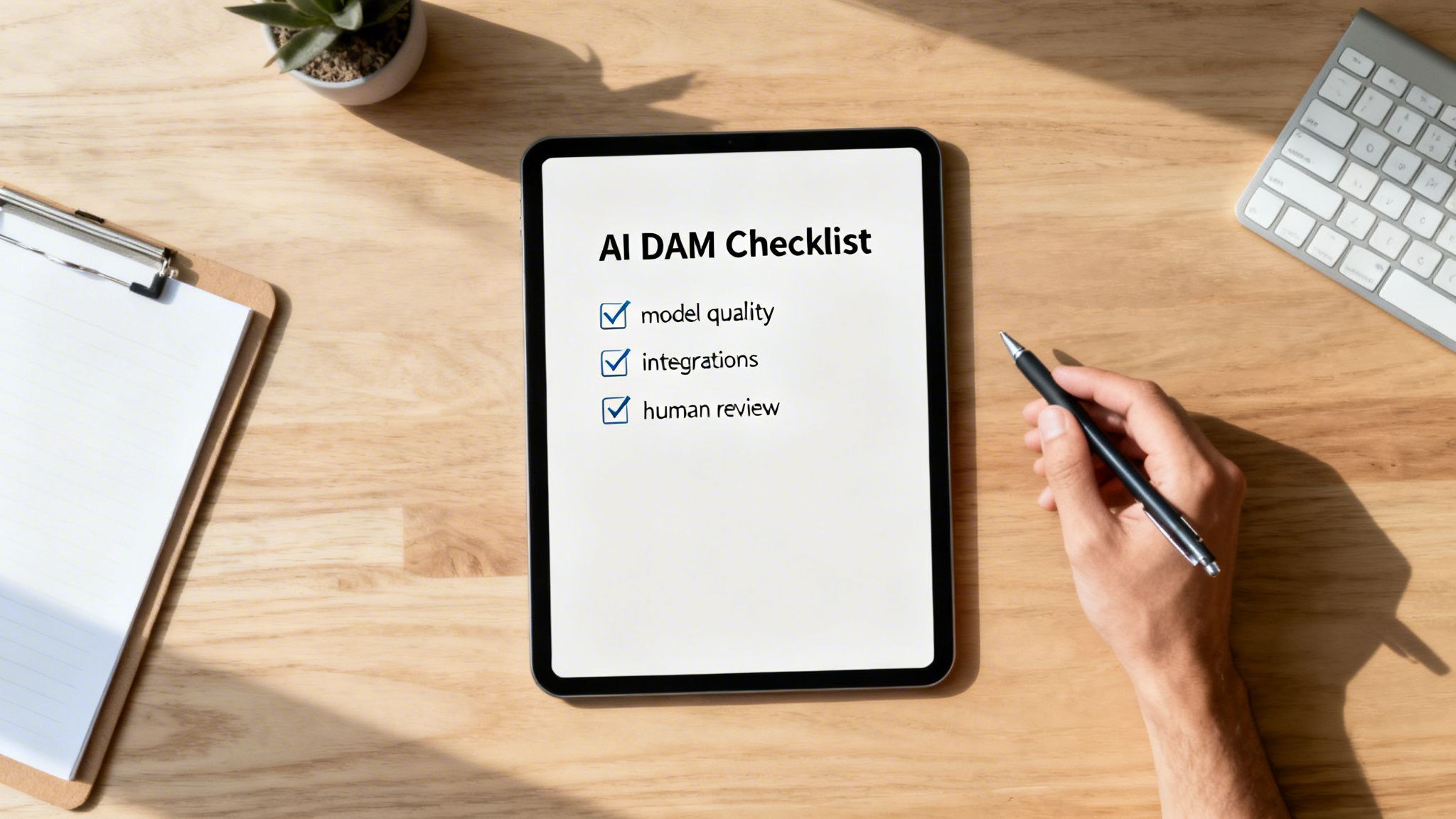
Jumping into the world of digital asset management AI can feel like a huge step, but picking the right platform doesn't have to be a shot in the dark. With the right questions, you can find a tool that doesn’t just store your content but actively helps grow your business. This checklist is your guide to cut through the noise and zero in on what really matters.
A great starting point is to ground your search in established digital asset management best practices. These principles give you a solid framework for evaluating how any potential system will actually perform day-to-day. The whole point is to avoid a costly mistake and get your team set up for success from day one.
Let's be clear: not all AI is created equal. The very first thing you need to dig into is how good the AI models actually are. Don't just take a vendor's word for it. Insist on a demo where you can see the AI working on your own assets.
One of the most critical features to look for is a human-in-the-loop workflow. AI is an incredible assistant for churning out tags, descriptions, and metadata, but you absolutely need the final say. A human on your team must be able to easily review, edit, and approve what the AI suggests. This is non-negotiable for maintaining brand voice and ensuring total accuracy.
An AI DAM without a human review process is like a self-driving car with no steering wheel. It might get you there fast, but you have no control over the final destination. You need a system that blends automation with human oversight.
Your AI DAM should be the central hub for your content, not another disconnected tool. If it can’t talk to the platforms you already use every day, it’s going to create more problems than it solves.
Before you talk to any vendors, make a list of your must-have tools. Then, ask them directly how they connect.
A system that plays well with others kills manual data entry, slashes error rates, and guarantees everyone is working from the most current information.
So, you’ve picked a system and rolled it out. How do you know it’s actually working? You need clear, measurable goals. Forget vague objectives like "improve efficiency" and focus on concrete Key Performance Indicators (KPIs) that prove the DAM is making a real impact.
Key Metrics to Track:
Finally, be ready for the common tripwires. The two biggest mistakes we see are failing to clean up your asset library before migrating and underestimating how much team training is needed. Start with a clean slate and invest in getting everyone comfortable with the new tools. That's how you get the most out of your investment.
Choosing the right platform is about asking the right questions. Use this checklist to evaluate and compare different AI-powered DAM solutions based on what your business truly needs.
| Evaluation Area | Key Questions to Ask | Why It Matters |
|---|---|---|
| AI Quality & Relevance | Can we test the AI with our own assets? How accurate are the auto-tags? Does it recognize our specific products, logos, or brand elements? | Generic AI won't cut it. You need models trained on relevant data that understand your industry and your brand's unique visual language to provide genuinely useful metadata. |
| Human-in-the-Loop | How easy is it for a user to review, edit, and approve AI-generated tags and metadata? Can we set up custom approval workflows? | AI makes mistakes. A seamless review process ensures brand consistency and accuracy, blending the speed of automation with the precision of human oversight. |
| Integration Capability | Does it have pre-built connectors for our PIM, ERP, and e-commerce platforms? How robust is the API for custom integrations? | A DAM should be a central hub, not an isolated silo. Strong integrations eliminate manual work, reduce errors, and create a single source of truth for your content. |
| Usability & Adoption | Is the interface intuitive for non-technical users? What kind of training and support is provided during and after onboarding? | A powerful tool is useless if no one uses it. A clean user experience and solid support are critical for ensuring team-wide adoption and maximizing your ROI. |
| Scalability & Performance | How does the system handle large volumes of assets and high traffic? What are the storage limits and how does pricing scale with our growth? | Your DAM needs to grow with your business. A scalable platform ensures you won't be forced into a costly and disruptive migration in a few years. |
Taking the time to run through these questions will give you a much clearer picture of which solution is the right fit. It moves the conversation beyond marketing fluff and focuses on the practical capabilities that will actually benefit your team.
So far, we’ve talked about how digital asset management AI helps organize the here and now. But its real power lies in how it will anticipate and shape the future of your content. We're already seeing DAM systems evolve from passive digital closets into proactive content engines that actively drive business strategy.
The features we have today, like auto-tagging and similarity search, are just the starting line. The next wave of AI will do more than just react to the content you upload; it's going to start predicting what you need before you even realize it yourself.
Imagine an AI that crunches last year’s sales data, analyzes this year’s market trends, and then tells you exactly what kind of product shots you’ll need for your next holiday campaign. That's where we're headed.
This shift is turning the DAM into an intelligent partner, not just a tool. We're moving toward a future where autonomous AI agents work inside your system, actively keeping your brand strong and your workflows humming along.
Think about agents that could handle tasks like these:
This isn't some far-off sci-fi concept. AI's grip on digital asset management is tightening fast. Research already shows that 66% of large organizations are running generative AI pilots in their content operations. These projects are quickly moving beyond basic tagging and into deploying the kind of autonomous agents that can overhaul entire workflows. For a deeper dive, you can check out the full DAM market analysis on mordorintelligence.com.
For any brand or retailer serious about growth, the signal is crystal clear. Adopting an AI-native platform is no longer a "nice-to-have," it's a baseline requirement for staying in the game. You can also check out our guide on Geo SEO to see how a smart content strategy directly impacts your visibility.
The big takeaway is simple: AI is the engine that will power the next generation of commerce. By embracing it now, you’re setting your team up to work smarter, keep your brand flawlessly consistent, and deliver the kinds of amazing customer experiences that build real, lasting loyalty.
Jumping into the world of digital asset management AI always brings up a few practical questions. It’s a big move, so it’s completely normal to wonder about the real-world impact on your team, budget, and day-to-day work. Let's tackle some of the most common questions we hear from businesses.
This is probably the number one concern, but it's a myth. AI in a DAM isn’t about replacing your creative or marketing teams. It’s about taking over the tedious, soul-crushing tasks that bog them down, like manually tagging thousands of photos or spending hours digging for one specific image.
Think of it as a massive upgrade, not a replacement. By automating the grunt work, AI frees your team to focus on the strategic and creative parts of their jobs. Your graphic designer gets to spend more time actually designing and less time playing file administrator.
The cost can certainly vary, but the more important question is about the return on your investment (ROI). While there’s an initial cost, a smart DAM pays for itself by plugging the costly leaks in your current workflow.
Think about the savings here:
When you factor in the hours saved and the mistakes avoided, the price tag on the system starts to look very different.
Honestly, not much. Modern AI-powered DAMs are built for business users, marketers, salespeople, and designers, not just your IT gurus. The best platforms have clean, intuitive interfaces that make it easy for anyone to find and use what they need without special training.
The whole point of a good AI DAM is to simplify complexity, not add another layer of it. If the system is so clunky that your team avoids it, it has failed. Look for platforms that put the user experience first.
Your team should be able to jump in and start getting value from the AI features almost immediately, with minimal hand-holding. That’s how you get people to actually use the system and start seeing a return on your investment right away.
Ready to see how an AI-native DAM and PIM can genuinely change your e-commerce operations? NanoPIM brings your product data and digital assets into one place, using AI to turn raw specs into perfectly optimized content for every channel. Explore how NanoPIM can streamline your workflow today!


