

A solid data management strategy is the playbook for how your business handles its most critical asset: product information. It’s the single source of truth that guarantees your data is accurate, consistent, and ready for every channel you sell on, from your own storefront to Amazon.
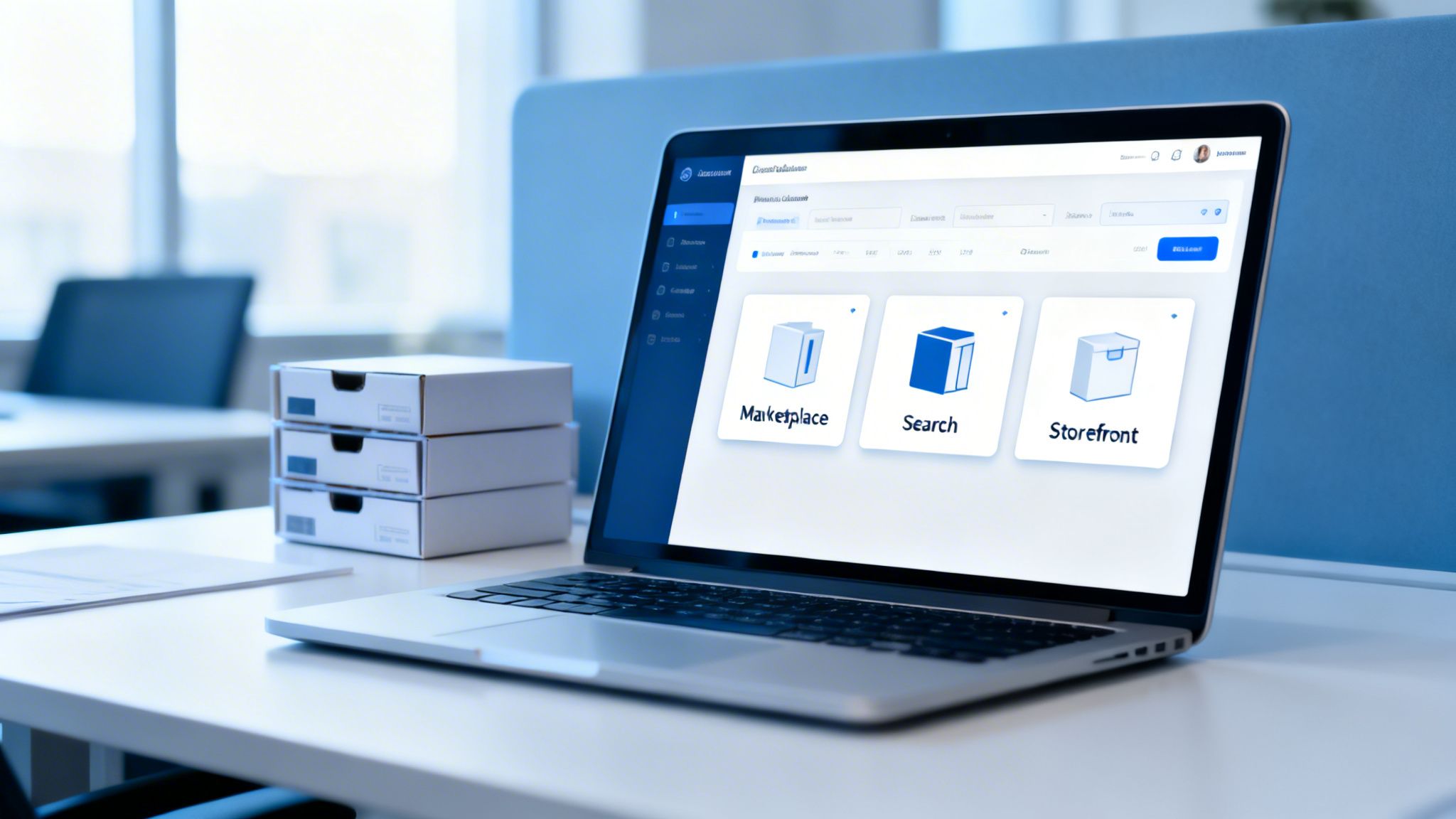
Let’s be real. Managing product data across dozens of channels feels chaotic most of the time. One tiny mistake, like an incorrect price or a missing attribute, is all it takes to get an entire product line suppressed on Amazon, sink your Google Shopping ads, and chip away at the trust you've worked so hard to build.
In omnichannel commerce, a clear data management strategy isn't a luxury anymore. It's a fundamental requirement for survival. Without one, you're almost certainly operating in a state of data chaos. Different teams use conflicting information, and nobody's quite sure which spreadsheet holds the "final" version of the truth.
The consequences of poor data management aren't just abstract IT problems; they hit your bottom line, hard. Think about it from a customer's perspective. They find conflicting product details between your website and a marketplace listing. They hesitate. And that hesitation is a direct path to an abandoned cart.
This isn’t a small issue. It’s a major source of friction that shows up in your analytics as tangible losses.
These problems compound, slowly eroding your brand's reputation and profitability. Every hour your team spends manually fixing data fires is an hour they can't spend growing the business.
To see just how different the outcomes can be, look at the contrast between a business drowning in data chaos and one operating with strategic control.
The table makes it obvious: getting your data in order isn't just an operational task. It's a strategic imperative that directly influences every key performance metric your business tracks.
The good news is you can completely flip this script. A modern data management strategy, especially one built around a central system, turns your data from a constant headache into your most powerful competitive advantage. By establishing a single source of truth for all product information, you eliminate the guesswork and kill the inconsistency.
This is where tools like a Product Information Management (PIM) system become indispensable. There's a reason the market for these platforms is exploding. Recent analysis shows the global PIM market is projected to jump from $18.59 billion to a staggering $47.54 billion by 2030. This growth is fueled by one simple fact: businesses can't compete in modern e-commerce using spreadsheets and brute force. For a deeper dive, check out the detailed PIM market report.
A centralized, AI-driven approach can fundamentally change the game. It’s about connecting your data efforts directly to your bottom line and your customer’s happiness.
Instead of fighting data fires, your team can finally focus on creating rich, compelling product experiences. A strong strategy lets you optimize content for different channels, guarantee accuracy everywhere, and get new products to market in a fraction of the time. This isn't just about getting organized. It's about building a resilient, scalable operation that can actually win in a crowded marketplace.

Alright, let's get into the blueprint for your data strategy. Forget the overly academic jargon for a moment. Data governance is really just about setting the rules of the road for your product information. It answers the simple, critical questions: who can do what, when, and how?
Think of it like setting up a massive warehouse before the first truck of inventory arrives. You wouldn't just tell your team to "start stocking." You'd have a plan. You'd define where specific product types go, who has the authority to move them, and exactly what information needs to be on every label.
A solid data management strategy does the exact same thing for your digital shelf. Without this framework, you're guaranteed to run into the dreaded “garbage in, garbage out” problem. Bad data seeps into your systems and then pollutes every sales channel, creating all the headaches we’ve been talking about.
Your data model is the organizational chart for your information. It’s a map that defines all the different types of data you’ll be handling, like products, variants, collections, and attributes, and shows how they all relate to one another.
The taxonomy is what brings that model to life. It's the classification hierarchy that lets you group "Men's Trail Running Shoes" under "Footwear," which then sits under "Men's." A logical taxonomy is non-negotiable for both your internal teams and, more importantly, for your customers trying to navigate your site.
A few tips from the trenches when building your taxonomy:
A well-designed data model and taxonomy are the unsung heroes of a successful e-commerce operation. They ensure consistency and make it possible to manage 100,000 SKUs as easily as you manage 100.
Building this foundation is a critical first step. For a deeper look at what it takes, DSG.AI's resource on A Modern Data Governance Strategy provides excellent guidance for making your data operations ready for future challenges.
With your structure in place, it's time to define your quality standards. This is where you decide what "good" data actually looks like for your business. Data quality rules are your front line of defense, basically automated checks that prevent bad information from ever getting in.
For example, you can set a rule that a product’s weight attribute must always be a numerical value and can never be left empty. Another rule might require every new clothing item to have color, size, and material attributes assigned before it can even be considered for publication.
These rules aren't just suggestions; they are your automated gatekeepers. We've seen businesses implement these guardrails and report up to a 20% boost in overall data quality. For more ideas on how to craft these, you can also explore our guide on effective data governance policies.
Your governance plan isn't complete until you address the human element. Who is responsible for what? Defining clear roles eliminates confusion, finger-pointing, and creates real accountability.
In most data governance frameworks, you'll see a few common roles:
Once roles are clear, you can build your approval workflows. A workflow is just a sequence of steps a product change must follow before going live. For instance, a junior merchandiser might create a new product, but it has to be reviewed by a data steward and then approved by a category manager before it ever sees the light of day on Amazon. This simple process ensures multiple sets of expert eyes are on your data, catching errors before they ever reach a customer.
Let's be honest, "AI" gets thrown around in meetings so much it's almost lost its meaning. But for omnichannel brands, it's not just a buzzword. It's the secret to scaling up your content without having to scale up your team.
This is where you stop just storing data and start putting it to work. Think about it: you can take a dry, technical spec sheet for a new product and let a Large Language Model (LLM) spin it into compelling descriptions, tailored perfectly for each sales channel.
Imagine feeding an LLM a few bullet points on a new pair of hiking boots. In minutes, you can get back unique, engaging copy for your Amazon page, your own website, and a promotional email. That's the power of automation. By bringing AI into the fold, you can offload the repetitive, soul-crushing tasks from your merchandising and marketing teams. This frees them up for what people do best: strategy, creativity, and making the big calls.
So, how does this actually work? You start by creating prompt templates. These are essentially recipes that tell an LLM exactly how to generate content: the format, the tone, the length. A template for an Amazon A+ Content module will look completely different from one for an eBay listing or an Instagram caption.
This method is a game-changer for a few reasons:
You can even get strategic with it. Use one LLM that’s a creative wordsmith to generate your marketing copy, and another that’s better with structured data to pull key attributes from a supplier’s messy PDF. Smart data management strategies are increasingly focused on leveraging AI and automation in data management to streamline these exact processes. This isn't some far-off fantasy; it's a core part of how modern data operations run.
AI is an incredible assistant, but it's not ready to fly solo. A human-in-the-loop review process isn't just a good idea. It's an absolute necessity. Every single piece of AI-generated content needs a human set of eyes on it before it sees the light of day.
This final check is critical for two reasons:
This hybrid model gives you the best of both worlds: the raw speed and scale of AI, guided by the quality control and expertise of your team. You can learn more about building these kinds of guardrails by managing data quality in all your workflows.
AI doesn't replace your team; it supercharges them. The goal is to automate the 80% of content work that is repetitive, freeing up your experts to perfect the final 20%.
The impact AI is having here is massive and still growing. Retail managers have reported that AI-powered PIM can cut content creation time by up to 70%. This is more important than ever, especially when 75% of consumers are now using AI-powered search to find and buy products. If you want to dig deeper, you can find more insights about the PIM market's AI-driven growth on precedenceresearch.com.
When you put AI to work, you’re not just organizing data anymore. You're building a powerful content engine that directly drives sales.
Your data can't live on an island. After you've set your rules and defined your taxonomy, the next step is building the digital plumbing that connects all your business systems. This is where your data management strategy comes to life, creating a powerful, consistent experience across your entire operation.
The aim is to build a truly unified ecosystem. When it’s done right, your inventory data from your Enterprise Resource Planning (ERP) system, your creative assets from the Digital Asset Management (DAM), and your rich product content from your Product Information Management (PIM) all sync up perfectly.
This is the secret behind real omnichannel consistency. When a customer sees the same price, image, and description on your website, a third-party marketplace, and a social media ad, it's because your systems are all working from the same script.
This flow shows how data can be transformed, automated, and reviewed in a connected system.
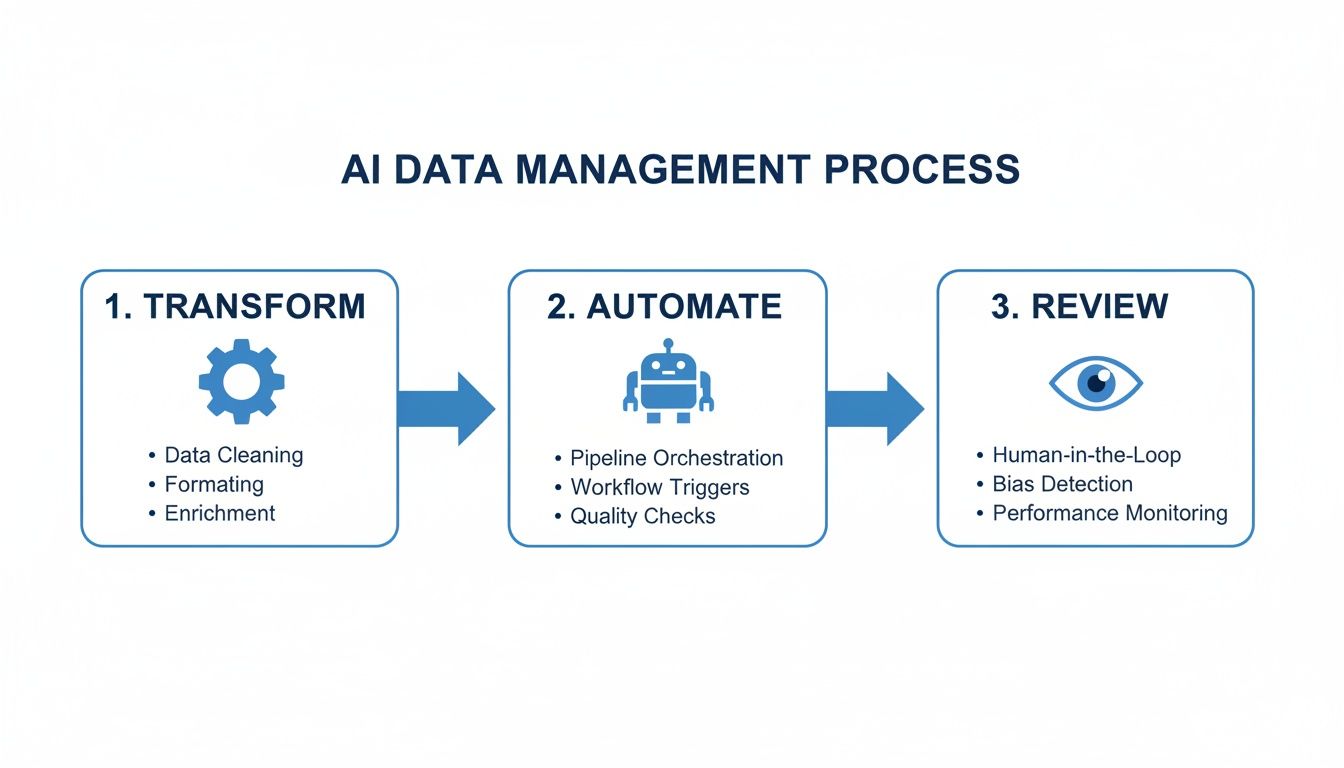
First, raw data gets standardized. Then, automated workflows enrich it. Finally, a human review loop ensures everything is accurate before it goes live.
One of the most powerful patterns I've seen in complex integrations is the Data Holding Bay. Think of it as a secure, isolated staging area, a digital cleanroom where you can import, compare, and merge data from different sources without any risk of polluting your live product catalog.
Let's say a new supplier sends you a massive spreadsheet with thousands of new products. Instead of dumping it straight into your PIM (a recipe for disaster), you load it into the Data Holding Bay first.
Inside this controlled environment, you can run automated checks to:
Only after the data has been scrubbed, approved, and transformed can you confidently merge it into your central system. This approach is an absolute lifesaver for data migrations and onboarding new suppliers. It practically eliminates downtime and prevents catastrophic data loss.
That seamless flow only happens when your core platforms are properly connected. Each system has a specific job, and a smart data strategy makes them work together like a well-oiled machine.
Getting this integration right is why the PIM market is exploding, with forecasts predicting it will hit $32.84 billion by 2030. Businesses are scrambling to centralize their data to stop the fragmentation that happens when you're selling across a dozen channels like Amazon and Google Shopping. It’s why so many companies are adopting these connected, hybrid models to finally get control. You can see more on this market trend on grandviewresearch.com.
By integrating your systems, you're not just moving data around. You're building an automated, resilient operation where a change in one system correctly and instantly updates all others.
This is how you finally escape the endless nightmare of manual updates and reconciliation spreadsheets. For a deeper look at how these systems fit together, check out our guide on solutions for master data management.
A brilliant data management strategy is useless if it just sits in a slide deck. The real value comes when you put it into action and start seeing tangible results.
This is where we shift from planning to doing. It’s all about measuring what matters and executing a rollout so smooth your teams will wonder why you didn't do it sooner. You need to know if your efforts are actually working. Without clear metrics, you're just flying blind.
To measure success, you have to track the right Key Performance Indicators (KPIs). These aren't just vanity metrics; they're the vital signs of your data health and operational efficiency. A good dashboard gives you a real-time pulse on your strategy.
Start with a handful of high-impact KPIs that connect directly to business goals. Here are a few essential ones to get you started:
These metrics are what move data management from being seen as a cost center to a genuine value driver. When you can show leadership that a 10% increase in data completeness led to a 5% drop in cart abandonment, you've made your case.
Your KPIs shouldn't live in a spreadsheet nobody ever looks at. The best way to keep your data strategy on track is to build simple, visual dashboards accessible to everyone from the marketing team to the C-suite.
Think of it like the dashboard in your car. It gives you critical information at a glance, like speed, fuel, and engine temp, without overwhelming you with the complex mechanics underneath. Your data dashboard should do the same.
A great dashboard doesn't just present data; it tells a story. It should instantly answer the question, "Are we winning or losing at our data management goals today?"
This visual feedback loop is key. When a data steward sees the completeness score dip, they can take immediate action. It’s what transforms data management from a reactive, fire-fighting exercise into a proactive, continuous improvement process.
Launching a new data management strategy isn't a "flip the switch" moment. A phased rollout is almost always the smarter approach. It minimizes disruption, lets you learn and adjust, and helps you score early wins to build momentum.
Think of it as a series of controlled launches, not one big bang. Here’s a practical checklist to guide your rollout:
This methodical approach turns a potentially chaotic transition into a managed, predictable process. It allows you to celebrate small victories along the way, which is critical for keeping everyone motivated and invested in the long-term success of your data management strategy.
Even with the best roadmap, you’ll still run into questions when it's time to put your data management strategy into practice. Let's tackle a few of the ones I hear most often.
For a small business, the idea of a massive data management project can be completely paralyzing. My advice? Don't boil the ocean. Start small and attack your single biggest pain point first.
Is it inconsistent product data crashing your marketplace listings? Focus there.
Start by getting your most critical data, usually product info, into one central spot. Honestly, even a well-organized spreadsheet is a massive leap forward. Just document a few basic rules for how data gets entered and updated. This simple first step is the bedrock you'll build on as you grow.
AI is a phenomenal tool, but it's not a silver bullet for data quality. Think of it as a powerful accelerator, not a replacement for good governance and human expertise. AI is fantastic at spotting duplicates, suggesting attribute values from an image, or even generating first-draft descriptions, which cuts down manual work dramatically.
But its output is only ever as good as the data and the rules you give it.
AI is there to enforce your quality rules at scale, not invent them. Your team's expertise is still absolutely crucial for setting the standards and doing the final review to catch things an algorithm would miss, like brand voice or subtle context.
Getting budget for a Product Information Management (PIM) system isn't about geeking out on technical features. It’s about speaking the language of business outcomes: money saved and money earned.
Stop talking about "centralizing data" and start talking about "slashing product returns by 15%" or "launching new collections 50% faster."
You need to build a rock-solid business case that ties the PIM investment directly to tangible results. Show them the real-world cost of your current data chaos, like the wasted payroll hours fixing errors, the lost sales from delisted products, and the damage from negative customer reviews. Frame the PIM as the direct solution to those specific, expensive problems.
Ready to turn data chaos into a competitive advantage? With NanoPIM, you can centralize your product data, automate content creation with AI, and ensure every channel has accurate, compelling information. See how our AI-powered PIM can transform your operations at https://nanopim.com.


