Think of data governance policies as the official rulebook for your company's data. These are the formal documents that lay out the standards for how information gets managed, protected, and used, from the moment it’s created to the day it’s deleted. They make sure everyone knows how to handle data the right way, every single time.

Imagine a city with no traffic laws. Cars would drive wherever they pleased, leading to constant gridlock, accidents, and total chaos. No one could get where they needed to go reliably. Data governance policies are the traffic laws for your company’s information superhighway. They bring much-needed order and prevent data chaos.
These rules aren’t meant to hold your teams back. Quite the opposite, they empower everyone to use data safely, efficiently, and with total confidence. When everyone plays by the same rules, your data transforms into a trustworthy asset that can fuel smarter business moves, from marketing campaigns to supply chain logistics.
This kind of structured approach is non-negotiable today. Good governance is the bedrock for making solid business decisions and building reliable AI systems. Without it, your teams will spend more time second-guessing the data than actually using it to innovate.
Having clear data governance policies creates real, measurable business advantages. When data is managed well, organizations can move faster and make decisions with more conviction. This is especially true for eCommerce managers and data specialists who depend on accurate product information to do their jobs.
For instance, a clear policy ensures a product’s dimensions are entered the same way across the board, preventing expensive shipping mistakes. It also guarantees that every required attribute is filled in before a product goes live on a marketplace, which directly impacts its visibility and sales.
The benefits aren’t just theoretical. Organizations with mature data governance policies often see a 40% higher return on their analytics investments. Why? Because governance boosts data quality and builds trust among stakeholders, which directly fuels better decision-making. And with 62% of data leaders pointing to poor governance as the biggest roadblock to AI, solid policies are no longer a "nice-to-have," they're a competitive must. You can dig into more data-related statistics and their implications to see the full picture.
A data governance policy turns abstract goals like "improving data quality" into concrete actions. It creates a shared understanding of what good data looks like and who is responsible for maintaining it, the first real step toward building a true data culture.
Effective data governance policies bring clarity and cut down on friction between departments. When everyone agrees on the rules of the road, teams can finally work together without stepping on each other's toes.
Here’s how clear policies make a difference:
At the end of the day, data governance policies are about building a reliable data foundation. They help your teams create and maintain the kind of high-quality, trustworthy information needed to thrive, especially when using advanced platforms like NanoPIM to manage complex product catalogs.

Let's be honest, the term "data governance policy" can sound pretty intimidating. It brings to mind massive, dusty binders filled with corporate rules. But it doesn't have to be that way.
Think of a solid policy as a set of blueprints for your data. You wouldn't build a house without one, and you shouldn't run a data-driven business without one, either. By breaking the process down into a few core components, you can build a framework that is both powerful and practical.
Understanding an essential governance policy framework is the first step. Below, we'll dive into the five non-negotiable pillars that form the foundation of any successful data governance strategy.
A well-crafted policy is built on a handful of fundamental concepts. The following table breaks down these critical components, explaining what they cover and why each one is a game-changer for any eCommerce business looking to grow.
Each of these components plays a distinct role, but they all work together to create a system where your data is a reliable asset, not a chaotic liability.
The first question any good policy must answer is simple: Who is responsible for this data? This is the core of data ownership. Every critical dataset, from your master customer list to detailed product specifications, needs a designated owner.
This isn’t about just slapping a name on a spreadsheet. A data owner is usually a subject-matter expert who truly understands the data's purpose and context. For example, the Head of Product might own all technical product specs, while the eCommerce Manager owns the customer-facing marketing descriptions. This clarity eliminates finger-pointing and ensures someone is ultimately on the hook for that data's accuracy.
Next, you need to define what "good" actually looks like. Data quality standards are the specific, measurable rules that set the bar for your data's accuracy, completeness, and consistency. Without them, "improving data quality" is just a vague aspiration.
For an eCommerce brand, these standards get very real, very fast.
These aren't just arbitrary rules; they are preventative measures. They stop marketplace listing errors, incorrect shipping quotes, and frustrated customers in their tracks. Clear standards turn data quality from a wish into a daily reality.
This part of your policy is the digital gatekeeper. It explicitly defines who can see, create, update, or delete your data. Think of it as a keycard system for your information assets, different people get different levels of access based on what their job actually requires.
These rules are absolutely vital for protecting sensitive customer information and staying compliant with regulations like GDPR. For instance, an access rule might state that only the finance team can view customer payment history. A security rule might mandate multi-factor authentication for any user trying to access the central product database.
A strong access policy ensures that employees have the data they need to do their jobs, but nothing more. This "principle of least privilege" is a cornerstone of modern data security and smart governance.
Data isn't static. It's born, it lives a useful life, and eventually, it needs to be retired. Data lifecycle management creates a roadmap for each stage: how data is created, how it's stored and used, when it's archived, and how it's securely destroyed.
This is far more than just digital spring cleaning. Holding onto outdated, irrelevant, or trivial data is a real cost and a significant security risk. A good lifecycle policy might dictate that customer support chats are archived after 12 months and permanently deleted after three years. For product data, it could define a process for archiving discontinued items instead of just deleting them, preserving valuable historical sales data.
Want to see how this fits into the bigger picture? Check out our complete guide to master data governance.
Finally, there’s metadata management. Metadata is simply "data about your data." It's the label on the box that tells you what's inside, who created a file, when it was last updated, or a plain-English definition of a technical attribute.
A solid metadata policy ensures this crucial context is captured consistently across the board. For example, it might require every product photo to be tagged with its usage rights, campaign name, and expiration date. In a PIM, it ensures every single attribute has a clear definition so that everyone knows "W" means width, not weight. This simple discipline is what makes data findable, understandable, and ultimately, governable.
Great data governance policies are useless if they just sit in a folder. You need people, a dedicated team to own them, champion them, and make sure they’re actually followed day-to-day.
Think of it like a professional sports team. You can have the most brilliant playbook ever written, but without talented players in the right positions who know their roles, you’re not winning any games.
This isn’t about building some rigid, top-down bureaucracy that grinds everything to a halt. The goal is to create a collaborative structure where everyone knows their part in protecting and elevating the company’s data. From the C-suite to the specialists on the ground, everyone has a job to do.
At the top, you need the people who set the direction and clear the path. These are the leaders who make sure your governance efforts are tied directly to real business goals and have the resources they need to succeed.
Executive Sponsor: This is a high-level leader, usually a Chief Data Officer (CDO) or another C-suite executive, who becomes the ultimate champion for data governance. They’re the one who secures the budget, knocks down major roadblocks, and sells the program’s value to the rest of the leadership team.
Data Governance Council: Think of this as your strategic coaching staff. It’s a cross-functional group of leaders from key departments like IT, marketing, legal, and operations. They meet regularly to make high-level decisions, sort out conflicts between departments, and give the final approval on major policy changes.
While the council lays out the strategy, the real work happens on the front lines. These are the people closest to the data, the ones who truly understand its quirks, challenges, and practical uses. They’re the players on the field, executing the plays.
The core of this frontline group is made up of Data Owners and Data Stewards. People often mix these two up, but their roles are distinct and designed to work together.
Data governance only works when accountability is crystal clear. By assigning owners and stewards, you turn abstract rules into concrete responsibilities. It guarantees someone is always on the hook for the quality and security of your most critical data assets.
For example, a Data Owner is typically a senior manager or department head who has the ultimate accountability for a specific data domain, like "customer data" or "product data." They don’t manage the data personally, but the buck stops with them. They are answerable for its quality, security, and proper use.
On the other hand, a Data Steward is a subject matter expert who handles the day-to-day management of that data. They’re the ones defining business rules, monitoring data quality, and fixing issues as they pop up. A Product Information Manager, for instance, is the perfect person to be the Data Steward for product data. If you want a deeper dive on this essential role, you can learn more about the meaning of data stewardship in our detailed article.
Finally, you have the technical experts who manage the actual systems where the data lives. These are the "grounds crew" of your team, they maintain the field and the equipment, making sure everything is running smoothly and securely.
By putting this team together, you build a complete structure that covers strategy, daily execution, and technical implementation. This collaborative approach is how you make sure your data governance policies become a living, breathing part of your company culture, not just another document no one reads.
Having a set of data governance policies is one thing. Actually getting your team to follow them is another story entirely. It’s easy to get overwhelmed and try to change everything at once, but that "big bang" approach almost always backfires.
Think of it like building a new highway. You don't just shut down all the old roads and hope for the best. You build one lane, test it, get traffic flowing smoothly, and then start on the next. A phased rollout is manageable, less disruptive, and the only way to make sure your new rules actually stick.
Let's walk through how to get it done.
Before you write a single rule, you have to know your "why." And no, "we need better data" is not a real goal. You need to tie your efforts to a tangible business problem that's costing you money or holding you back.
Are you trying to slash shipping errors caused by wrong product info? Or maybe you need to lock down compliance for a new market you're expanding into.
Starting with a high-impact goal gives the entire project an immediate sense of purpose. It makes getting buy-in a whole lot easier and gives you a clear finish line. For example, a great first goal would be: achieve 99% accuracy on all product dimensions for our top-selling category in the next three months. That's specific, measurable, and directly tied to a business win.
Once you have your goal, you need to get your leadership on board. This isn't just about asking for a budget, it's about finding a champion who can clear roadblocks for you. Use your business case to show them exactly how these new policies will solve a real problem and deliver a return.
With a leader in your corner, you can draw a tight circle around your first project. Don't try to govern all your data at once. It's a recipe for failure. Instead, pick one critical data domain, like product data, or even a tiny subset, like the "new product onboarding" process. A narrow scope makes the project feel achievable and lets your team learn the ropes before you take on bigger challenges.
This flow chart nails the process for getting your team and initial project off the ground.
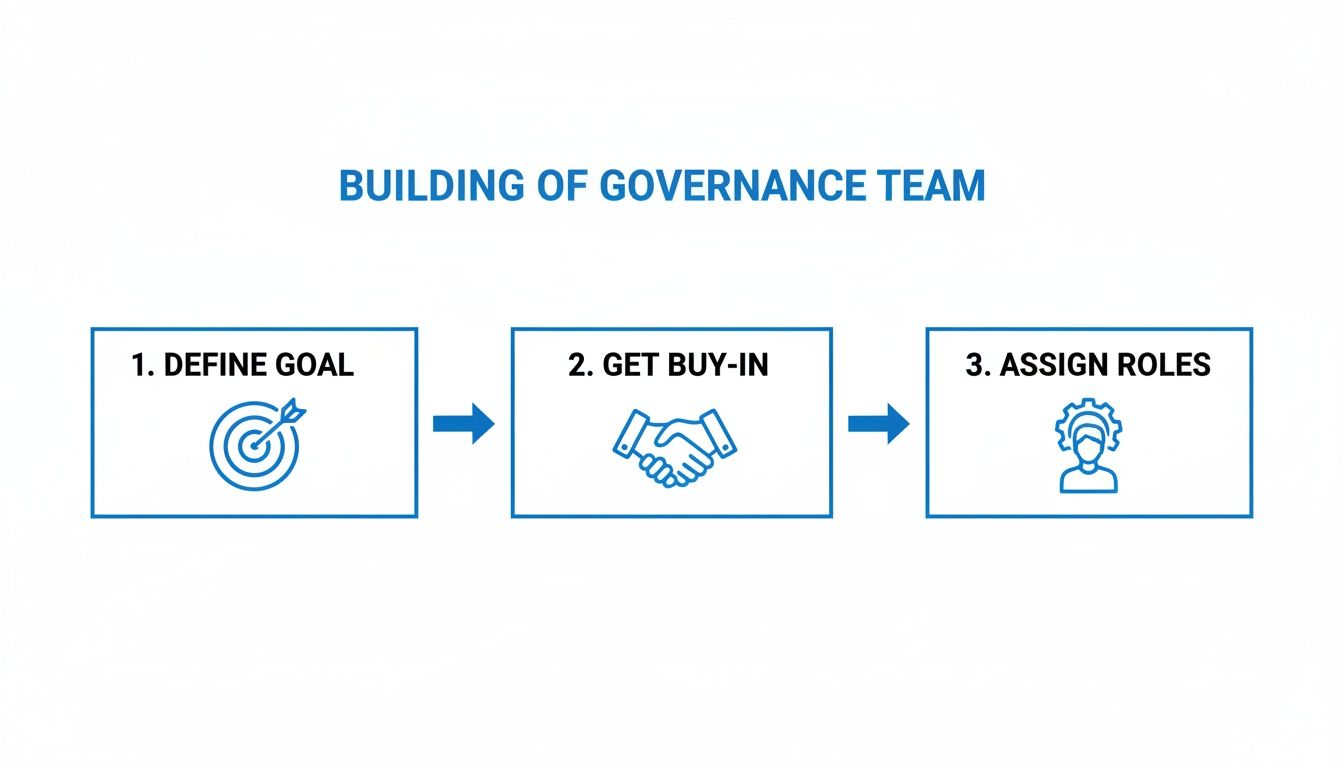
Notice how defining a concrete goal is the first move, happening before you rally support or assign roles. This keeps your governance efforts laser-focused on business priorities right from the start.
Now you’re ready to draft the actual policies for your chosen scope. Keep them dead simple, practical, and write them in plain English. If your goal is to clean up product data, your first policies might just cover mandatory attributes, image upload standards, and the approval workflow. That's it.
Once the rules are written, communication is everything. You can't just email out a PDF and expect people's behavior to change. You need to hold training sessions, explain the why behind the rules, and show people how this will ultimately make their jobs easier, not harder.
A policy that nobody understands is a policy that nobody will follow. Focus on clear communication and practical training to turn your documented rules into everyday habits for your team.
This is more important than ever as AI gets folded into business operations. A staggering 52% of organizations list compliance as their top barrier to adopting AI. With new regulations popping up constantly, solid governance is the only way to build systems you can trust. Yet somehow, only 36% of data leaders are currently prioritizing governance for their analytics. That's a massive gap, and a huge opportunity. You can learn more about how data governance practices drive ROI in the Alation blog.
Finally, rolling out data governance isn’t a one-and-done project. It's a continuous cycle: monitor, measure, and improve. You have to track whether the policies are actually being followed and if they’re delivering the results you aimed for.
This is where a modern PIM system like NanoPIM becomes your secret weapon, with tools that make monitoring almost automatic.
Using tools like these lets you monitor compliance in real-time and prove the value of your work with hard data. This feedback loop is what allows you to tweak your policies, celebrate wins, and confidently plan your next move.
So you’ve created your data governance policies. That’s a massive win, but the real test is getting people to follow them. The word "enforcement" often brings up images of micromanagers and rule police, but that’s not what this is about.
Think of it less as policing and more as coaching. The goal is to make it easy for everyone to do the right thing, protecting the company while helping your team succeed. After all, a policy gathering dust on a server is useless.
Getting this wrong isn't just an internal problem, it can be incredibly expensive. Regulatory fines are hitting all-time highs. In 2026 alone, nearly 1,000 enforcement actions were tracked, resulting in over $3.5 billion in penalties. You can read more about the global crackdown on data privacy on aoSphere. A proactive approach isn't just better; it's essential.
Trying to manually check every product description or image file for compliance is a recipe for burnout. It’s slow, error-prone, and simply doesn't scale as your business grows. This is where your tools become your best friend.
Modern PIM and DAM platforms, like NanoPIM, have smart monitoring features built right in. You can set up dashboards that give you a live view of your data health.
When you automate these checks, the whole dynamic shifts. You’re no longer playing "gotcha." Instead, you’re giving your team a helpful guide that works alongside them, making compliance just another part of a smooth workflow.
Data governance policies aren't meant to be written in stone. Your business will change, new regulations will pop up, and you’ll find better ways of working. Your policies need to keep up.
Setting up a regular review cycle, maybe once a quarter or twice a year, is crucial. This is when your Data Governance Council and key stewards should get together to ask the big questions:
These reviews keep your governance program from becoming stale. They help you adapt to change instead of being blindsided by it.
An audit shouldn't feel like an interrogation. It’s a collaborative health check for your data, a chance to spot opportunities for improvement and celebrate what’s going right.
Sooner or later, someone’s going to break a rule. It happens. Your reaction in that moment will define your data culture.
If you jump straight to punishment, you’ll create a culture of fear where people hide their mistakes. That’s the last thing you want. A constructive approach is always the better move. When you spot an issue, the first step is to figure out why it happened.
Was the person not trained properly? Is the official process confusing? Is the software making it hard to follow the rules?
More often than not, non-compliance is a symptom of a flawed process, not a rebellious employee. As you enforce your governance policies, it’s critical to clearly define and manage your access control policies to prevent many issues from the start. By digging for the root cause, you solve the problem for good and empower your team to get it right the next time.

So far, we've talked about what data governance policies are and the teams that bring them to life. Now, it's time to get practical and connect that theory to the tools your teams use every single day. The best policies don’t just live in a binder on a shelf; they're woven directly into your workflows, making it easy for everyone to get it right.
This is where your Product Information Management (PIM) and Digital Asset Management (DAM) systems become the engines for your governance program. Instead of asking people to constantly remember a long list of rules, you make the system enforce them automatically. It turns compliance into the path of least resistance.
Think about it. A solid PIM platform can physically prevent a new product from being pushed to your website until every single required field is filled out. This simple, automated check makes your "data completeness" policy a reality, and no one has to manually review every item.
Your PIM or DAM should act like a smart assistant that guides your team to follow the rules without even thinking about it. By configuring the system correctly, you can embed your data governance policies directly into daily tasks, making them invisible but incredibly effective.
Here’s how you can make that happen:
Enforce Consistency with Templates: Use product templates to define which attributes are mandatory for different product types. This ensures every new "shirt" has a size and color, while every new "sofa" has dimensions and a fabric type, no exceptions.
Set Up Approval Workflows: Create multi-step approval processes that have to be completed before any data goes live. A junior marketer might enrich product copy, but it can’t be published until a senior merchandiser or data steward gives it the final green light.
Automate Alerts for Bad Data: Configure your system to automatically flag data that violates your standards. If a product weight is entered in pounds instead of kilograms, the system can send an alert to the user instantly, allowing for a quick fix before it ever becomes a problem.
The goal is to make doing the right thing the easiest option. When your PIM system handles the tedious checks, your team can focus on creating great product experiences, confident that the underlying data is solid.
Modern platforms like NanoPIM are built from the ground up to support this kind of embedded governance. The platform offers a whole suite of features that make it simple to turn your documented data governance policies into concrete, automated actions that just work.
For a deeper dive into how these systems operate, you might be interested in our guide on product information management.
With the right tools, governance stops being a theoretical exercise and becomes a practical, integrated part of how your business runs. It shifts the entire focus from policing mistakes to preventing them in the first place, building a foundation of trustworthy data that everyone in the company can rely on.
Of course. Here is the rewritten section, adopting the specified human-like writing style and adhering to all formatting and content requirements.
Stepping into the world of data governance can feel like a massive project, and it's completely normal for some tough questions to pop up. Let's get right into the most common concerns we hear from teams on the ground.
This is the big one. The good news is you don't need a huge team or a blank check. The trick is to forget about boiling the ocean and just focus on putting out one fire, the one that's causing the most damage.
What’s the single data problem that gives everyone a headache? Maybe it's inaccurate product dimensions that lead to costly shipping errors and returns.
Start right there. Your very first data governance policy could be a simple, one-page document focused entirely on how product dimensions are entered, validated, and approved. This gives you a quick, tangible win. It proves the value of governance and builds momentum for bigger things without a massive upfront investment.
It’s a fair question. In the very short term, yes, there might be a small adjustment period as people learn the new ropes. But the long-term payoff is a huge boost in speed and efficiency.
Think about all the time your team currently burns hunting for the right data, double-checking reports, or fixing the same errors over and over again. Good data governance policies are designed to eliminate that friction entirely.
When data is trustworthy and easy to find, you’re not just cleaning up spreadsheets. You’re liberating your team from tedious, low-value work so they can focus on tasks that actually move the needle.
Measuring the ROI of governance isn't about fuzzy metrics. It’s about tying your policies directly to real-world business outcomes. You start by taking a hard look at the costs of your "before" state and then tracking how those numbers change.
The ROI of data governance isn't just a number on a spreadsheet. It's the cost of shipping errors eliminated, the hours of manual data validation saved, and the newfound confidence your teams have when making decisions.
Here are a few practical things you can track to prove the value:
Ready to build a solid foundation with data you can actually trust? NanoPIM embeds your governance rules directly into your workflows, turning policies into automated actions. Learn more about NanoPIM and see how easy governance can be.