

Data stewardship is the hands-on responsibility for making sure your company's data is accurate, accessible, and trustworthy. Think of it less like a stuffy, technical job and more like having a master librarian for your products. This person or team makes sure every last piece of information is correct, easy to find, and genuinely useful for everyone who needs it.

Let's be honest, "data stewardship" sounds a bit corporate and complicated. But in a retail or eCommerce business, it’s one of the most practical and strategic things you can do. It's the daily practice of managing your data so it stays valuable and usable from the day it's created to the day it's archived.
Imagine launching a hot new product. Without good stewardship, you might end up with conflicting prices on different websites, missing product dimensions, or grainy, low-quality images. These little errors add up fast, creating a messy customer experience that costs you sales. The real data stewardship meaning in this context is simple: someone is accountable for stopping those mistakes before they happen.
In an era of AI-driven search and endless online shopping channels, the quality of your product data is everything. Customers expect consistent, detailed information whether they’re shopping on your website, a marketplace like Amazon, or a social media shop.
Data stewardship is the bridge between having raw, messy data and having valuable data. It isn't just about storing information; it's about actively managing it so that every team, from marketing to logistics, can rely on it with absolute confidence.
When your data is solid, great things happen:
The core idea is to transform data from a messy, often-ignored liability into a well-organized strategic asset. It’s about building a culture where everyone takes ownership of data quality because they understand its direct impact on the bottom line.
This hands-on approach is what makes data management truly effective. While high-level rules and governance policies are important, stewardship ensures those rules are actually followed day-to-day. It’s the difference between having the city's blueprints and having engineers on the ground making sure the roads are built correctly.
For retailers, this means sweating the small stuff, ensuring every product detail, from a 'color' attribute to an inventory count, is perfect across the board. You can learn more about how this works by reading our article on the harmonization of data. This is how you set the stage for building a team of true data champions.
So, who are these data stewards, and what do they actually do all day? Thinking about the data stewardship meaning in practice means moving past abstract ideas and into the real world. It’s about giving specific people the authority and responsibility to care for your most valuable asset: your data.
A data steward’s mission is to be the hands-on guardian of a particular dataset, like product information or customer records. They aren't just tidying up spreadsheets; they're the ones making critical decisions that ensure data is trustworthy, consistent, and ready to use across the entire business.
In a retail team, for example, a data steward is the person who makes sure all "color" attributes use a standard list. Think "Navy Blue" instead of "Dk. Blue." They're also the ones who check that every new product has a high-res image and complete dimensions before it can ever go live on your website.
To really get a handle on stewardship, it helps to see how all the pieces fit together. So many companies get tangled up trying to distinguish between stewards, custodians, and trustees because the terms sound alike. But each one has a distinct and vital part to play in a healthy data ecosystem.
The very existence of these different roles shows how much more seriously businesses are taking data as a strategic asset. You have the technical experts (custodians), the business-focused decision-makers (stewards), and the high-level overseers (trustees). Research from the DAMA Dictionary of Data Management defines data stewardship as 'the most common label to describe accountability and responsibility for data and processes that ensure effective control and use of data assets'. You can explore how these roles are defined in various educational frameworks to see how they might apply to your own business.
Let’s break it down.
Key Takeaway: Think of it like building a house. The trustee is the homeowner who sets the budget and vision. The steward is the architect who designs the blueprints and ensures they meet building codes. The custodian is the builder who physically constructs the house according to those plans.
This separation of duties is a built-in safety net. It prevents any single person or team from having unchecked control, creating a system of checks and balances that protects your data's integrity. The steward makes the "what" and "why" decisions, while the custodian handles the "how" and "where" of data storage and security.
To make this even clearer, let’s look at how their focus and responsibilities stack up side-by-side. Nailing these differences is the first step toward building an effective data stewardship program that actually works.
As you can see, these roles are designed to work together, not compete. A steward can't enforce a rule without a custodian to implement it in the system. Likewise, a custodian lacks the business context to create meaningful rules on their own. This partnership is what turns high-level policies into tangible, trustworthy data that powers your entire retail operation.
If you’ve spent any time in the data world, you’ve probably heard data stewardship, data governance, and data management used in the same breath. It’s easy for these terms to get jumbled up, leaving a lot of confusion about who actually does what. The best way to really get what data stewardship means is to see where it fits into the bigger picture.
Let's use a simple city planning analogy to straighten this out.
Imagine you're building a brand-new city. You need a master plan, you need roads and power grids, and you need people on the ground making sure everything runs smoothly day-to-day. These three needs line up perfectly with governance, management, and stewardship.
First, you need a plan. Data governance is like creating the city's zoning laws, building codes, and overall master plan. It sets the high-level rules and policies that keep everything orderly and safe.
Governance is all about answering the big questions:
Think of governance as the strategic, rule-making body. It creates the framework but doesn’t get its hands dirty with the construction.
Next up, you have to build the city's infrastructure. Data management is the process of building the roads, power grids, and water systems that make the whole thing work. It’s the technical foundation that supports the entire city.
This is where the hands-on technical work happens, like setting up databases, making sure data can flow between systems, and putting security measures in place. Data management provides the tools and systems needed to store, move, and secure data according to the rules set by governance.
Finally, once the city is built, you need a team on the ground to make sure it all functions correctly, every single day. This is data stewardship. Stewards are your city planners, building inspectors, and civil engineers who ensure the laws are followed and the infrastructure is used correctly.
They are the hands-on heroes turning the grand vision of governance into reality.
When a new building (or a new dataset) is proposed, the steward is the one who reviews the plans, checks for compliance with the city's codes, and gives the green light. If a road (a data pipeline) is broken, they’re the ones reporting it and overseeing the repairs.
This infographic breaks down the key roles and how they connect.
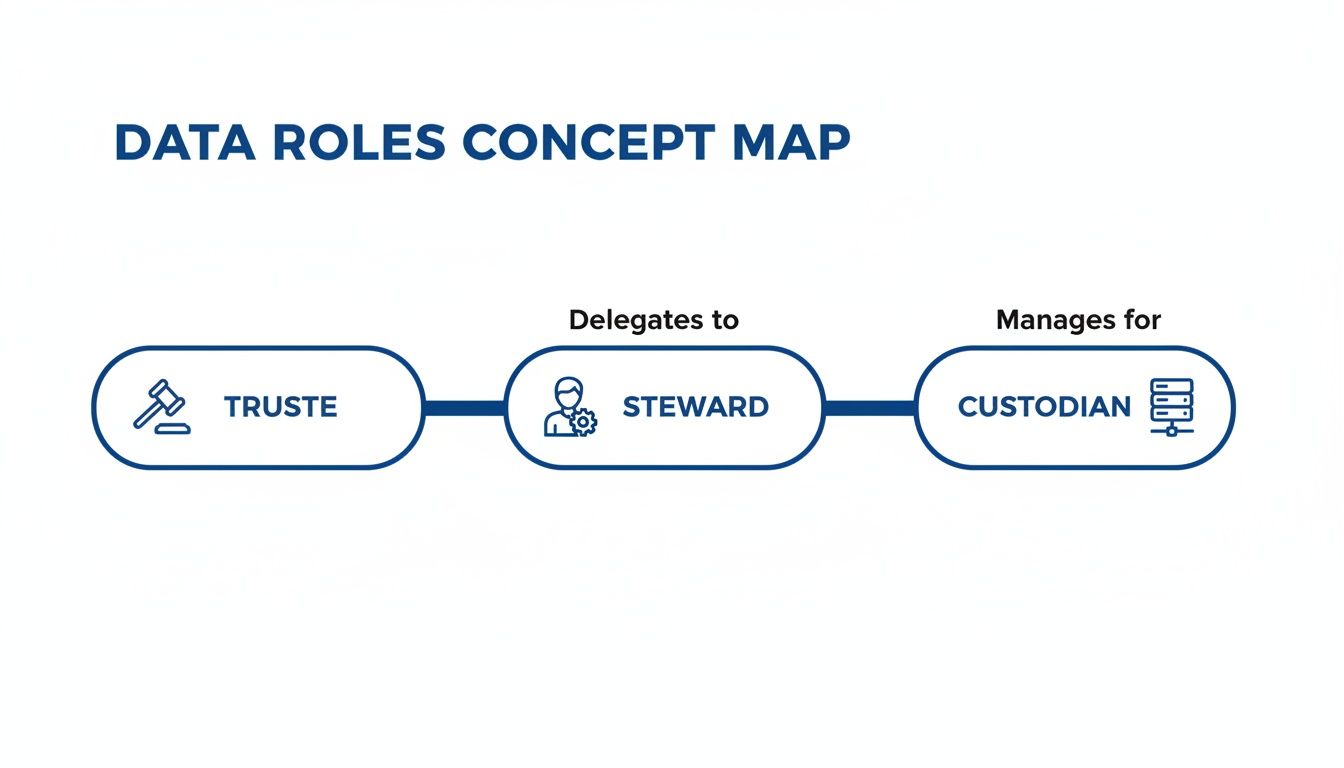
This simple flow shows how high-level authority (the Trustee) delegates to the hands-on decision-makers (the Stewards), who then oversee the technical implementation (the Custodian).
This distinction is absolutely vital for operations managers who need to know exactly where their responsibilities begin and end. Without stewards, governance policies are just documents gathering dust on a shelf. Stewards make governance real by applying the rules to daily work, turning abstract policies into trusted, high-quality data.
If this sounds like it plugs directly into the world of master data, you're on the right track. You can explore our guide on implementing master data management to see how all these concepts snap together.
Knowing what data stewardship is and actually putting it into practice are two very different things. The good news? You don’t need a massive, budget-draining overhaul to get started. The best way to launch a program that actually sticks is with a realistic, step-by-step roadmap that won’t overwhelm your team.
The secret is to start small. Forget trying to fix all your data at once; that’s a surefire recipe for burnout. Instead, focus on scoring a quick win that proves the value of stewardship, then build from there.
Let's walk through a phased approach that works for any retail or eCommerce business.
Before you can assign stewards or track metrics, you have to figure out what data matters most. Because let’s be honest, not all data is created equal. For a retailer, some datasets have a much bigger impact on the bottom line than others.
Just ask yourself: "If this data were wrong, where would it hurt us the most?"
For most eCommerce businesses, that list of critical data will probably include:
Pick just one of these to start, ideally for a single, high-value product category. Keeping the scope this focused makes your first project manageable and its success easy to measure.
Once you've zeroed in on your target data, it's time to assign ownership. A data steward doesn't need to be a new hire with a fancy title. More often than not, the perfect steward is someone already on your team who’s a true subject matter expert.
Look for a team member who:
Appoint one or two of these people as the official stewards for your pilot project. Make it a recognized part of their role, even if it's just for a few hours a week. Their job is to define the rules for your chosen dataset and be the final authority on its quality.
Your new stewards need clear guidelines to be effective. For your initial product category, have them define a handful of simple rules. For example, they might decide that all "color" attributes must come from a predefined dropdown list, or that every new product must have at least three high-resolution images before it can go live.
The goal here isn't to create a hundred-page policy document. It’s to establish a few clear, easy-to-follow standards that solve an immediate problem.
Next, figure out how you'll measure success. A few simple KPIs will do the trick:
A solid data stewardship program should also tie into your broader information management strategies to truly maximize its impact. This ensures your tactical wins contribute to a bigger, more organized plan, helping you turn raw data into smart decisions. By starting small, proving the value, and then expanding, you build a sustainable culture of data ownership that pays for itself.
So, you’ve embraced data stewardship and have a program in motion. That’s great. But how do you prove it’s actually working? To get buy-in from leadership and show real value, you have to connect your team's efforts to tangible business results.
This isn't about tracking vague, feel-good metrics. It’s about focusing on the specific Key Performance Indicators (KPIs) that a retail or eCommerce manager genuinely cares about. Let's skip the generic stuff and get right to what truly demonstrates the power of great data stewardship.
One of the fastest ways to see the impact of stewardship is to watch errors simply disappear. Bad data, like incorrect dimensions or mismatched SKUs, creates absolute chaos downstream, leading to costly shipping mistakes and frustrated warehouse teams.
In retail, speed is everything. Every day a new product isn't live on your website or marketplaces is a day of lost sales. More often than not, the biggest bottleneck holding things up is incomplete or inaccurate product information.
A dedicated steward makes sure all the required data, from images and descriptions to compliance info, is ready to go from the very start. This simple act of preparation can dramatically speed up your entire launch process.
Key Insight: Effective data stewardship transforms product onboarding from a frantic, reactive scramble into a smooth, predictable workflow. You're not just organizing data; you're building a faster path to revenue.
This KPI directly shows how good data practices make the entire business more agile. If you want to dial in your processes, you might be interested in our guide on managing data quality, which offers practical tips that sync up perfectly with these goals.
Your product data is only as good as it is complete. Marketplaces like Amazon and even your own site's search filters depend on having all the right attributes filled out. If information is missing, your products won't show up in filtered searches, making them practically invisible to potential buyers.
Finally, take a hard look at your customer support queue. How many tickets are coming from customers who received the wrong item, were confused by a product description, or had to ask for information that should have been on the product page in the first place?
Every single one of those tickets is a symptom of a data problem.
When stewardship improves the accuracy and detail of your product information, customer confusion plummets, and so do support requests. This frees up your support team to handle more complex issues and directly improves customer satisfaction. It's solid proof that data stewardship isn't just some internal process; it's a customer-facing win.

Defining data stewardship meaning for your business is one thing. Giving your stewards the right tools to actually succeed is something else entirely. Even the most brilliant strategy will crumble if your team is stuck wrangling clunky spreadsheets and disconnected systems.
A modern Product Information Management (PIM) platform like NanoPIM is built to turn your stewardship goals into an operational reality.
Instead of just storing data, NanoPIM provides the guardrails and workflows that make a steward’s job manageable and repeatable. It’s designed to solve their biggest daily headaches, from enforcing data standards to approving changes with total confidence. The right platform transforms stewardship from a frustrating manual chore into an efficient, controlled process.
A core task for any data steward is setting the rules of the road for your data. But without a system to back them up, those rules are just suggestions. NanoPIM offers powerful features that make these standards non-negotiable.
Prototypes act as blueprints for your product categories. A steward can create a prototype for "Men's Jackets" that requires specific attributes like material, sleeve_length, and closure_type. From that point on, any new jacket created must have these fields filled out, ensuring consistency from the very start.
This is supercharged by cascading attributes. A steward can set a rule at a high level, and it automatically applies to all sub-categories. For instance, if they decide all "Apparel" must have a country_of_origin, that rule instantly cascades down to jackets, shirts, and pants, with no extra work required.
Trust is built on accountability. Data stewards need to know who changed what, when, and why. NanoPIM provides the tools for complete transparency and control.
Human-in-the-loop review flows allow stewards to create approval processes for any data change. If a junior merchandiser tries to update a product’s price, the change can be automatically routed to the right steward for review before it ever goes live. This simple step prevents unauthorized or accidental changes from causing chaos downstream.
Key Takeaway: Audit trails are a steward's best friend. They provide a permanent, unchangeable record of every single action taken on a product. If a customer complains about an incorrect description, a steward can instantly trace the change back to its source, providing a clear path for correction and training.
This combination of features gives stewards the confidence to delegate data entry without losing control. They can empower their teams to contribute while knowing every critical change is validated.
As product catalogs grow, the sheer volume of data can overwhelm even the most dedicated steward. This is where AI becomes a powerful ally, acting as a force multiplier for your stewardship team.
AI can take raw, unstructured data, like a supplier’s messy spreadsheet, and automatically map it to your product prototypes, enriching it with structured attributes. It can also score content quality, flagging products with weak descriptions or missing information so stewards can focus their efforts where they matter most.
For example, an AI assistant can:
This allows your stewards to shift from doing repetitive, manual work to performing high-value oversight. They manage the rules and review the outputs, letting AI handle the heavy lifting and scaling their impact across the entire catalog.
We've covered a lot of ground on what data stewardship means, but let's be honest, turning theory into reality is where the real questions pop up. As teams start to sketch out a plan, a few common "what ifs" and "how tos" always surface.
This is your go-to guide for clearing up those lingering doubts. Think of it as a quick chat to get your data stewardship journey started on the right foot.
Absolutely. Data stewardship isn't some massive, expensive corporate initiative reserved for Fortune 500 companies. For a small business, it can start with one person.
Seriously. It could be someone from your product or ops team who already knows the catalog inside and out, dedicating just a slice of their time to it.
The trick is to start small and be smart about it. Forget about cleaning up everything at once, as that’s a recipe for burnout. Instead, pick one high-value product category and focus on making its data perfect. The goal here is progress, not perfection on day one.
For small teams, the real magic happens when you use tools that do the heavy lifting. Modern platforms can automate the grunt work of checking data, letting one person make a huge impact without getting buried in spreadsheets.
This approach scores you a quick, tangible win. It proves the value of stewardship right away, building the momentum you need to get buy-in for doing more down the road.
The best data stewards are almost never data scientists. You're not looking for a technical guru; you're looking for a subject matter expert. Who on your team lives and breathes your products? That's your person.
They need to have a deep, almost instinctual understanding of your catalog and how that product data gets used by marketing, sales, and customer service.
Look for someone who is:
Your ideal steward is the guardian of business context, not the keeper of the technical keys. They’re the one who can confidently say, "No, that's not what that attribute means," and be right every time.
If you do only one thing, do this: identify and focus on your most critical data asset. Don't try to boil the ocean. For most retailers, this is a no-brainer, since it’s the product data for your top-selling category.
Why this laser-focused approach?
Once you’ve made the data for that single category spotless, clean, complete, and consistent, you'll have a powerful success story. It’s the proof you need to show the value of your work and build the support to roll out your data stewardship program across the entire business.
Ready to give your data stewards the power to turn your product information into your biggest advantage? NanoPIM offers the AI-powered tools, automated workflows, and human-in-the-loop controls that make data stewardship a reality for retailers. See how you can build a single source of truth and scale your content operations by visiting https://nanopim.com.


