

Data harmonization is the process of taking information from all your different sources and getting it to speak the same language. It’s about creating one single, reliable version of the truth from a whole lot of messy, varied inputs.

Imagine trying to build a complex LEGO set, but every bag of bricks comes from a different knock-off brand. Some pieces are measured in inches, others in centimeters. Colors like "sky blue" and "ocean blue" are labeled differently, and the connection points just don't quite line up.
That frustrating mess is exactly what retail and eCommerce managers face every single day without data harmonization.
You’re constantly getting product information from dozens of suppliers, various internal departments, and a handful of third-party systems. Each one has its own format, its own naming conventions, and its own structure. The result? A chaotic jumble of information that causes very real business problems.
When your data is a mess, the consequences ripple across the entire organization. Inconsistent product specs cause confusion for your customer support team, making ticket times longer. Mismatched inventory numbers between your warehouse and your online store lead to overselling, which is a fast track to angry customers.
This chaos hits your bottom line directly through:
Ultimately, understanding data harmonization boils down to the critical need to improve data quality. When your data is clean, the insights you pull from it are actually reliable.
The end game for data harmonization is to build a single source of truth (SSOT). Think of it as a central, trusted library where all your product information is clean, consistent, and correct. It’s your universal instruction manual for every single product you sell.
You can learn more about how this works in our comprehensive guide to https://nanopim.com/post/product-information-management.
A single source of truth eliminates the guesswork. It ensures that every team, from marketing to logistics, is working from the same playbook. That’s not a luxury; it’s essential for efficiency and growth.
In an age of AI-driven search and shopping, having an SSOT is no longer just a nice-to-have. It’s a competitive necessity. It’s what powers better search rankings, personalized customer experiences, and genuinely smarter business decisions.
Knowing what data harmonization is and why it matters is one thing. But let's get down to brass tacks: what does it actually do for your business? When your product data is clean, consistent, and reliable, it isn't just a matter of having a neater spreadsheet. It fuels real, tangible results that ripple through every part of your operation, from the warehouse floor to your bottom line.
Imagine a small online shop, "Cozy Threads," selling handcrafted apparel. They started out listing products on their own website, then expanded to Etsy and Amazon. Each sales channel had its own messy spreadsheet. Product descriptions were written on the fly, and the sizing charts were just a little bit different everywhere. This chaos meant their team was constantly putting out fires, customers were confused about sizing, and keeping track of inventory was a nightmare.
By embracing the harmonization of data, Cozy Threads built a single, authoritative record for every product. Suddenly, updating a sweater's description in their central system automatically fixed it everywhere else. This is where the magic happens and the true value becomes crystal clear.
The first and most immediate win you'll see from harmonized data is a massive jump in operational efficiency. When your people aren't stuck in a loop of manually entering, correcting, and then re-entering the same information across a dozen systems, they can finally focus on work that grows the business.
This isn't a minor time-saver. For many teams, wrangling messy data eats up a shocking amount of the workday. Harmonization automates those soul-crushing, repetitive tasks. It frees up your experts to analyze performance, dream up new products, or craft better marketing campaigns. It flips the script from reactive problem-solving to proactive, strategic growth.
In fact, some studies show that just getting data organized can save tech teams up to 80% of their working time. This isn't about cutting costs. It's about reallocating your most precious resource, your team's brainpower, to activities that actually make you money.
Today’s shoppers expect a smooth, consistent experience. They might discover your product on Instagram, research it on your website, and finally buy it from Amazon. If the product title, images, or specs are different at each step, you create friction. That inconsistency plants a seed of doubt.
Harmonized data ensures that no matter where a customer bumps into your brand, they get the same accurate, trustworthy information. This builds confidence, and confidence is what turns browsers into buyers. A clear and consistent product data sheet is the bedrock of that trust.
This is where data harmonization becomes a secret weapon for growth. Search engines like Google, and the new AI models driving them, absolutely love clean, structured data. When your product information is consistent and well-organized, it's a piece of cake for them to understand exactly what you're selling.
This translates into a few huge advantages:
This isn't just a retail trend; it's a seismic shift happening across every industry. Global spending on big data and analytics is on track to hit $420 billion by 2026 as companies race to unify their information for smarter decisions and AI-driven insights.

Getting all your data to play nicely together might sound like a massive technical headache, but it really boils down to a handful of core techniques. These are the practical, hands-on methods you’ll use to turn a chaotic mess of information into a clean, trustworthy asset.
Think of it like cooking: you can't just throw mismatched ingredients in a pot and hope for the best. You need a recipe with specific steps. Each technique tackles a different kind of data inconsistency, and once you know what they are and when to use them, you're on your way to building a rock-solid product information strategy.
Let's break them down.
Before anything else, you have to get your different systems to understand each other. That’s where schema mapping comes in. It’s essentially a translation service. Your warehouse system might call a product ID a "SKU," while a supplier's spreadsheet calls it an "Item_ID." Schema mapping simply draws a line between the two, telling your PIM they mean the same thing.
You are literally creating a map that connects the data fields from all your sources, such as supplier files, your ERP, and your marketing tools, to your own master data model. This ensures that when new information comes in, it lands in the right spot every single time. No more manual guesswork.
For an eCommerce store, this is a daily grind. A new shipment of jackets arrives, and the supplier's file has a column named "Product_Title." Your Shopify store, however, needs that information in a field called "Product Name." Schema mapping is the simple rule you set: "Take whatever is in 'Product_Title' and put it into my 'Product Name' field." Simple, but absolutely critical.
Once your data fields are mapped, the next job is to standardize what’s inside those fields. This is called normalization. It’s all about enforcing a consistent format for your attributes so that everything is uniform across the board.
This process is what kills the tiny, frustrating variations that break your website’s filters, skew your analytics, and make searching for products a nightmare. It’s the difference between a clean, predictable dataset and a digital free-for-all.
A few classic examples of normalization in action:
Normalization is what makes your product filters actually work. When a customer filters for a TV with a "55-inch" screen, they won't miss the one that was accidentally entered as "55 in." It’s a small detail that creates a huge impact on user experience.
Now for the detective work. Entity resolution is the process of figuring out when different records are actually talking about the very same real-world thing, or "entity." This is the key to creating a genuine single source of truth.
It’s incredibly common for systems to have multiple entries for what is obviously one product. Think "Apple iPhone 15 Pro," "iPhone 15 Pro - Apple," and "iPhone15Pro." To a dumb machine, those are three different items. To a human, they're the same phone. Entity resolution bridges that gap.
This process uses smart rules and sometimes AI to match records based on various attributes, bringing all related information under a single, unified product record. If you’re curious about the AI side of this, our guide on AI in digital asset management dives into how modern tools automate this heavy lifting.
The final piece of this puzzle is deduplication. This is the action you take after entity resolution. Once you’ve identified that five records all refer to the same pair of sneakers, deduplication merges them into one master record and archives the rest. It's the final cleanup that guarantees you don’t have redundant, conflicting data cluttering your system.
To pull it all together, here’s a quick-glance table that breaks down these core methods, what they do, and how they apply directly to an eCommerce business.
Each of these techniques plays a distinct but connected role. You can’t just do one and call it a day. A truly harmonized data ecosystem relies on applying all of them together to build a reliable foundation for your entire business.
The real magic of data harmonization isn’t in a one-off cleanup project. It’s in building a reliable, ongoing system that keeps your information clean as your business grows. Creating this system, a workflow, is about moving from frantic, reactive data fixes to a calm, predictable process.
This isn’t about adding a bunch of complicated steps. It's about setting up smart, repeatable rules that guard the quality of your product data from the moment it enters your world.
The first move is to define what "good" data actually looks like for your business. This is where a canonical data model comes in. Think of it as the single, master blueprint for all your product information.
This blueprint sets the official standard for every single piece of data. It dictates which fields are required (like SKU and Product Name), what format they must be in (e.g., all weights must be in "kg"), and what values are even allowed (like a "Color" field that only accepts pre-approved color names).
Once this blueprint is locked in, you have a clear yardstick to measure all incoming data against. It’s no longer a matter of opinion; it's a simple check. Does this new data from a supplier fit the blueprint? If not, it gets corrected before it ever gets near your customers.
You wouldn't let a new shipment of products go straight to the sales floor without checking it first, right? The same logic applies to your data. A critical piece of a strong harmonization of data workflow is having a safe import area, sometimes called a data holding bay.
This is a digital quarantine zone where new data from suppliers or other systems lands first. Here, it can be automatically checked against your canonical data model. The system flags any information that doesn’t meet your standards, like missing images or incorrect units of measure.
This simple step delivers two massive benefits:
Your data holding bay is your quality control checkpoint. It ensures only data that meets your high standards makes it into your core system, stopping costly downstream errors before they even happen.
While automation can do the heavy lifting, some decisions still need an expert’s eye. A review workflow creates a clear, step-by-step process for your team to approve changes and handle exceptions the system flags.
For example, if the system flags a product description for being too short, it can automatically assign a task to a copywriter to review and punch it up. To get a feel for how this works, it’s worth exploring some workflow automation examples that show how to streamline these kinds of repetitive tasks.
This human-in-the-loop approach means a real person signs off on important data before it goes live. That’s crucial for maintaining both quality and accountability. When you pair this with features like versioning (which tracks every single change) and audit trails (which show who changed what and when), you create a transparent, dependable system for managing your most valuable asset.
Jumping into data harmonization can feel like a monster project, but it doesn't have to be. The secret is to stop thinking of it as one giant leap and start seeing it as a series of small, logical steps. With the right plan, you can finally ditch those messy spreadsheets and build a data foundation you can actually trust, without burning out your team.
This plan is built to be actionable, not abstract. It’s a roadmap from the initial audit all the way to ongoing monitoring, designed to create momentum with quick wins and prove the value of your work at every stage.
Before you can fix the mess, you have to know just how big the mess is. Your first job is to conduct a no-holds-barred audit of every single one of your data sources. Where does your product information actually live right now?
Start mapping it all out. And I don't just mean the obvious spreadsheets. Dig deeper.
This audit gives you a clear, honest picture of what you’re up against. It’s not just about finding problems; it’s about prioritizing them so you can tackle the ones that will deliver the most immediate relief.
Once you know what's broken, you can design the fix. This is where you create your canonical data model. This is the master blueprint that defines what perfect, clean product data looks like for your business.
This blueprint sets the rules of the road. You’ll decide which attributes are mandatory for every single product, the exact format for each field (e.g., all dimensions must be in centimeters), and the official, locked-in names for categories and brands. This becomes the single source of truth that all incoming data gets measured against.
Think of it as writing the constitution for your product data. It’s the foundational document that brings order to the chaos and guarantees every piece of information plays by the same high-quality rules.
With your blueprint ready, it's time to get the right tools for the job. You could try to do this manually, but a dedicated PIM platform like NanoPIM is built to make this process dramatically faster and more reliable. A good PIM gives you a data holding bay and automated validation rules that do all the heavy lifting for you.
But don't try to boil the ocean. Instead of harmonizing everything at once, start small. Pick a single product category or one sales channel for a pilot project. This focused approach lets you prove the concept, work out the kinks on a manageable scale, and get a quick win. A successful pilot builds incredible momentum and makes getting buy-in for a full rollout a whole lot easier.
This simple workflow is exactly what you'll be putting into practice, moving data from import, through review, to a state of solid governance.
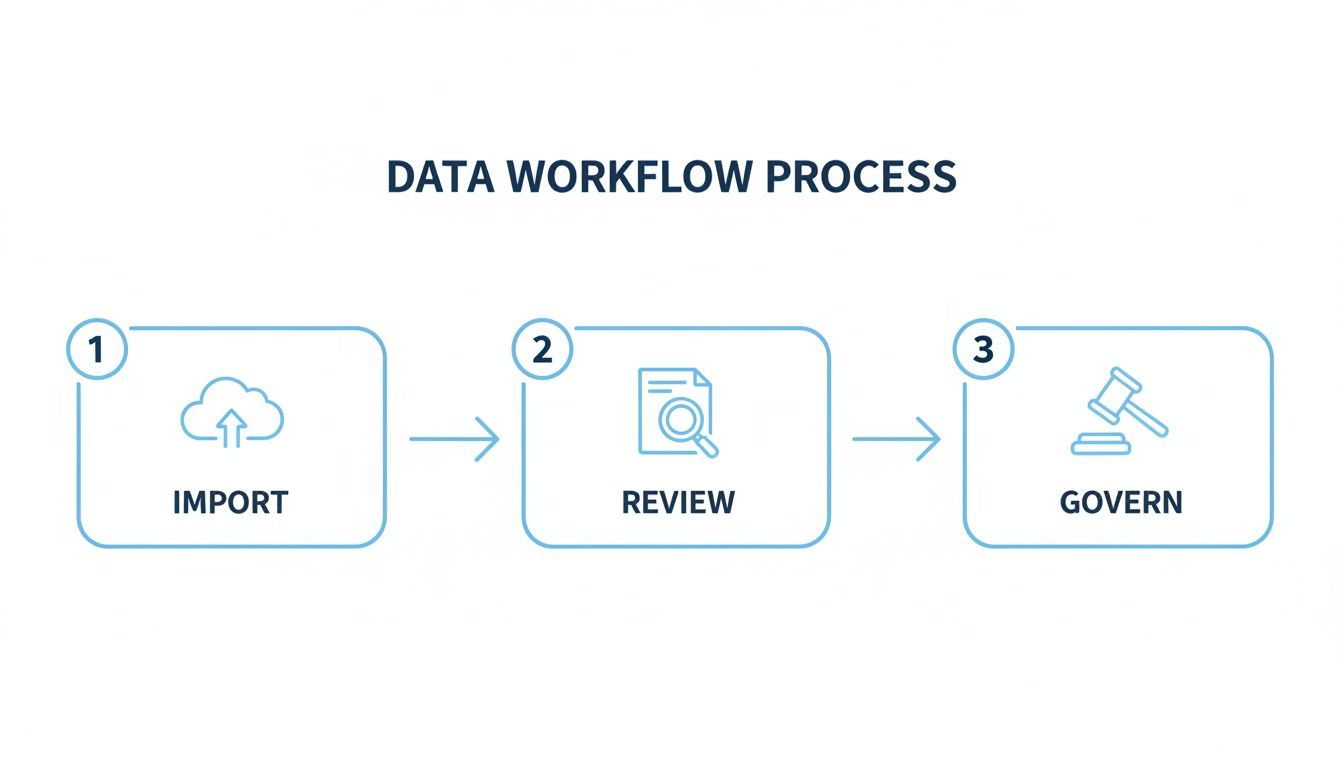
This shows that great data isn’t a one-time cleanup. It's an ongoing process of quality control.
Once your pilot is a success, you can start the methodical rollout across your other product categories and data sources. Move step-by-step, applying the lessons you learned from the pilot to make each new stage even smoother.
But the work isn't done when the data is clean. You have to make sure it stays clean. That means setting up simple monitoring routines to track the health of your data over time.
You can build simple dashboards to keep an eye on a few key metrics:
Watching these numbers tells you that your harmonization of data efforts are actually sticking. It’s how you build a lasting system that supports your business instead of holding it back.
Here's the rewritten section, crafted to sound like it was written by an experienced human expert.
Committing to data harmonization is a big step, but how do you actually prove it’s working? You can’t just feel the improvement; you need to measure it. The only way to connect your data cleanup efforts to the real-world business results your leadership team actually cares about is by tracking the right key performance indicators (KPIs).
These aren’t abstract technical metrics. We’re talking about tangible numbers that show up in your bottom line, in your team's day-to-day productivity, and in your customers' happiness. By focusing on a few critical, business-focused KPIs, you can build a clear, compelling case for the value of your work.
One of the first and most powerful metrics to watch is your Time to Market for New Products. Seriously, how long does it currently take for a new item to go from initial data entry to being live and purchasable on all your sales channels? For too many companies, this process is painfully slow, bogged down by manual data checks and endless back-and-forth corrections.
Once you have a solid data harmonization workflow in place, this number should drop dramatically. Clean, standardized data flows through your systems without all that friction, cutting out days or even weeks of manual labor. You can track this by simply measuring the average time from a product's creation in your PIM to its "live" date on your storefront.
A big cut in time to market isn't just an efficiency gain. It's a real competitive advantage, letting you react faster to trends and get new products in front of customers before your competition even gets started.
Your customer support team is on the front lines, and they're usually the first to feel the pain of bad data. A fantastic way to measure the impact of harmonization is by tracking the Reduction in Data-Related Support Tickets. These are all those customer emails and calls that come in because of incorrect product specs, confusing descriptions, or mismatched images.
Team up with your support lead to create a specific tag or category for these types of tickets. As your data becomes more consistent and accurate across every channel, you should see a clear downward trend in these inquiries. This is direct proof that clean data reduces customer confusion and frustration, freeing up your support team to handle more complex problems.
At the end of the day, every business effort has to connect back to revenue. By tracking the Increase in Conversion Rate on your product pages, you can draw a direct line from data quality right to sales. When customers land on a page with complete, accurate, and consistent information, their confidence goes up, and they are far more likely to click "add to cart."
It’s easy enough to measure this by comparing conversion rates for product categories before and after your harmonization project kicks off. Many businesses see a measurable lift as they eliminate those little data discrepancies that cause buyer hesitation. Setting up a dashboard in your analytics tool can automate this tracking, showing a clear return on investment and proving that data harmonization is a powerful sales driver, not just a cleanup task.
Still have a few questions? You’re not alone. When you're staring down a mountain of messy data, it's natural to have a few things you need to iron out.
Here are some of the most common questions we hear, with straight-to-the-point answers.
This is a classic, and for good reason. Think of it like a kitchen renovation.
Data integration is the plumbing work. It’s about connecting all the pipes from the sink, the dishwasher, and the refrigerator's ice maker so that water can flow to one central place. Integration gets all your data from different sources, such as your ERP, supplier spreadsheets, and e-commerce platform, into one system. It's the essential first step.
Data harmonization, on the other hand, is the water filtration system. It takes the water from all those different pipes and makes sure it's clean, consistent, and drinkable. Harmonization makes sure that "Blue," "blue," and "BLU" all become the same standardized color attribute.
You need both. Integration builds the pipes, but harmonization of data is what makes the end result actually usable.
Honestly, it depends on the scale of the mess. A small business with a few hundred products and relatively clean data might see a pilot project up and running in a matter of weeks.
But for a large enterprise wrestling with thousands of products, legacy systems, and data from dozens of suppliers? You could be looking at a multi-month implementation.
The smartest way to tackle it is to not boil the ocean. Start with a single, high-impact product category to score a quick win. Show the value, build momentum, and then expand. Using a purpose-built PIM platform will dramatically cut down that timeline.
AI is a game-changer here, no doubt. It's brilliant at automating the soul-crushing, repetitive tasks, like flagging potential duplicates, suggesting attribute mappings, and standardizing values across thousands of SKUs. It can do in minutes what used to take a team weeks.
But it's not a "set it and forget it" solution.
The best results come from a partnership between AI and your team. You still need human experts to define the business rules, establish the master data model, and make the final call on the tricky edge cases that require real-world context.
Think of AI as your incredibly powerful and fast assistant. It does the heavy lifting, but your team provides the strategic direction and critical oversight. This "human-in-the-loop" approach gives you the perfect blend of speed and accuracy.
Ready to finally get your product data in order? NanoPIM gives you the tools to build a single source of truth, automate your data harmonization workflow, and get your products to market faster. See how our AI-powered PIM can transform your operations.


