

If your Google Shopping strategy is just to export product data from your store and hope for the best, I've got some bad news. You're not just leaving money on the table, you're actively paying to lose it.
Google Shopping feed optimization isn't some nice-to-have marketing task. It’s the foundational work of making your products attractive to both Google's algorithm and the real people ready to buy. It's the difference between showing up and getting completely ignored.
Let's cut to the chase. An unoptimized product feed is more than just an underperformer; it's a financial black hole for your ad budget. Every dollar you push towards ads with weak titles, blurry images, or missing product details is a dollar you might as well have set on fire. You're paying for clicks that have almost no chance of converting.
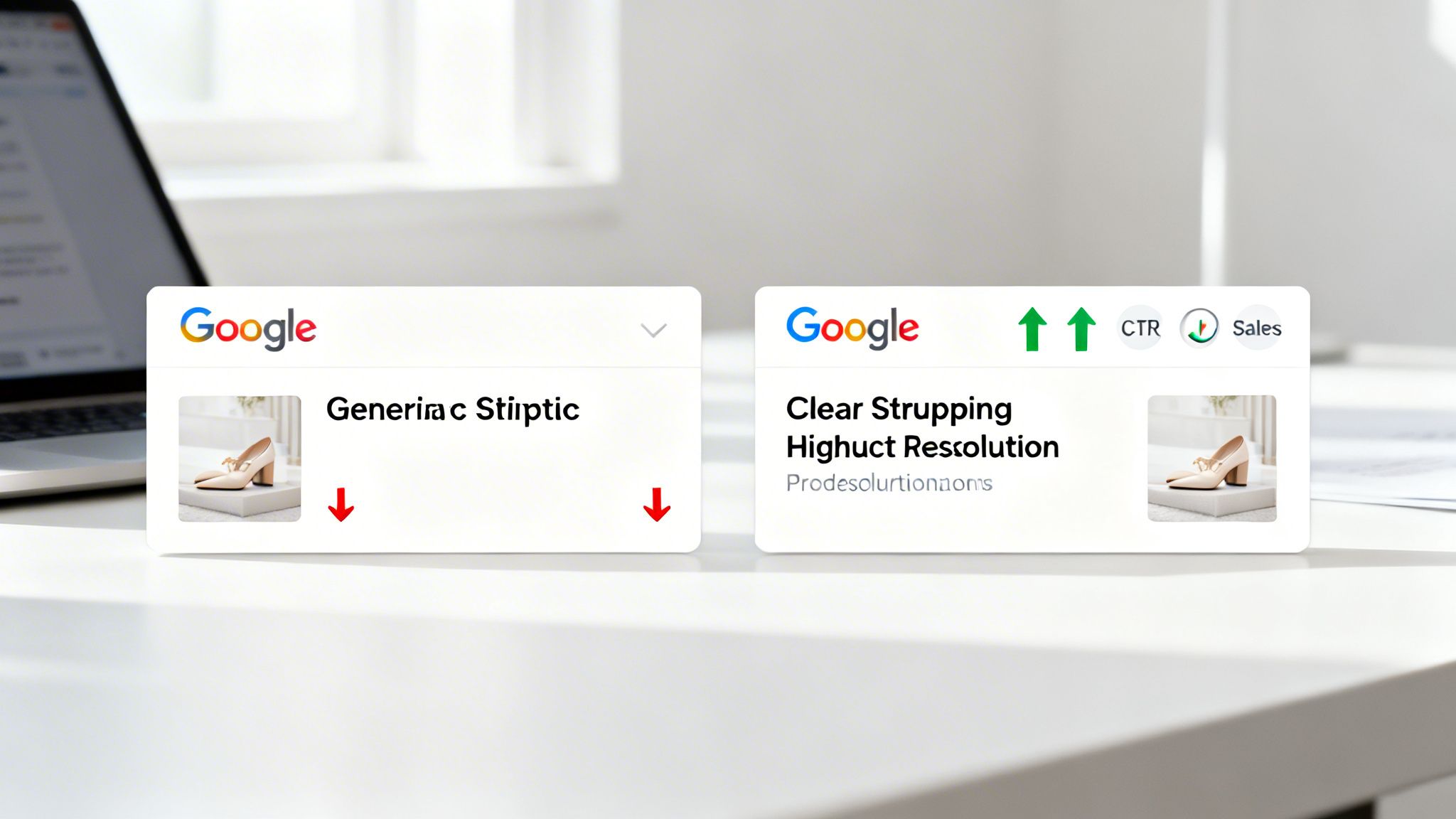
Think about it from Google's perspective. Its job is to serve up the most relevant product for a search. If your feed gives it vague, incomplete data, it can't confidently match your product to a high-intent shopper. So, it shows your competitor's product instead, the one with the fully detailed feed. They get the click, you get nothing.
This isn't just about missing out on a few sales. You're actively paying for a stream of unqualified traffic that tanks your performance metrics and makes it impossible to see what’s actually working.
A basic feed, one that just checks the boxes to avoid errors in Google Merchant Center, is the absolute bare minimum. It’s the starting line, not the finish line. Just because your feed isn't broken doesn't mean it's built to win.
The hidden costs of a "good enough" feed are painfully real and show up in your reports:
A big piece of preventing wasted spend is filtering out irrelevant searches. Mastering your negatives is non-negotiable, and this ultimate guide to Google Ads negative keywords is the best I've found for getting it right.
The performance gap between a generic data export and a strategically optimized feed is massive. To put some numbers on it, take a look at the kind of impact we see when we take over a neglected feed.
The table below shows a typical before-and-after scenario from one of our clients. They had a decent product but a completely unoptimized feed, leading to wasted spend and minimal returns.
After optimizing just the top 40 products, focusing on titles, images, and attributes, their CTR almost quadrupled, and their ROAS went from barely breaking even to highly profitable, all while keeping the ad spend virtually the same.
The data doesn't lie. In fact, our 2026 analysis showed that professionally optimized product feeds consistently delivered a 25% to 40% higher CTR than the default feeds spit out by e-commerce apps.
This proves that google shopping feed optimization isn't an expense. It's one of the highest-leverage activities you can perform to directly boost your return on ad spend. In this playbook, we’ll walk through the exact steps to turn your feed from a liability into your most powerful sales driver.
If your product feed is the engine for your Shopping campaigns, your attributes are the high-performance parts. This is where the real work of google shopping feed optimization happens. It's how you turn a generic listing into one that Google actively wants to show to shoppers ready to buy.
This isn't about just filling in boxes. It’s about being strategic with every single piece of data you push to Google. Of course, before you can optimize anything, you need to get your products into the system. If you're just starting out, this guide on how to add your products to Google Shopping is a great place to begin. Once you have that foundation, it's time to refine the attributes that actually move the needle.
Let's be clear: your product title is probably the single most important attribute in your entire feed. It’s the first thing a shopper sees, and it’s a massive signal for Google’s algorithm. Just exporting the standard product name from your website isn't going to cut it.
A high-performing title needs to be built with the user’s search query in mind.
We've found a simple formula that works wonders:
Brand + Product Type + Key Features (like Color, Size, or Material)
Let’s look at a real-world example.
Classic TeeEverlane Men's Organic Cotton Crew Tee White MThe second title tells Google exactly what it needs to know to match the product with specific searches like "men's white cotton t-shirt" or "Everlane crew neck size medium." It’s descriptive, packed with searchable terms, and leaves nothing to chance.
You have a 150-character limit for your title, but don't forget that only the first 70 characters or so will show on a mobile screen. Always front-load the most critical information so it doesn’t get chopped off.
The product description is your sales pitch, but it’s for Google as much as it is for people. Google gives you a generous 5,000 characters, but let's be honest, nobody is going to read an essay. The sweet spot is almost always between 500 and 1,000 characters.
Your goal here is to blend benefit-driven copy that persuades a human with the right keywords for the algorithm. Whatever you do, don't just copy-paste the description from your product page. Tailor it for the Shopping ad experience.
A few quick tips for writing better descriptions:
Think of the description as a supporting player to your title. It fills in the details and provides that extra context that helps Google place your ad in front of more specific, long-tail searches.
Okay, let's get technical for a moment and talk about product identifiers. These are the barcodes and codes that uniquely identify your product across the globe. The two you absolutely need to know are the GTIN (Global Trade Item Number) and MPN (Manufacturer Part Number).
For almost any new, branded product, providing a GTIN isn't optional, it's a requirement. It’s how Google knows that your "Nike Air Force 1 Size 10" is the exact same product another retailer is selling.
Why does this matter so much?
If you sell custom-made goods or one-of-a-kind items that truly don't have a GTIN, you can use the identifier_exists attribute and set it to no. But if a GTIN exists for your product, you must provide it. Trying to get around this will cripple your product's visibility. Keeping this information accurate in a detailed product data sheet is fundamental to a healthy, high-performing feed.
If you've dialed in your titles and descriptions but still aren't hitting your ROAS goals, it’s time to move beyond the basics. This is where the real magic happens, the small, strategic tweaks that separate the top 1% of advertisers from everyone else.
It's not about just checking boxes for Google. It's about giving the algorithm sharper signals, segmenting your products like a pro, and making your listings impossible to ignore.
Think about it. Your product image is the very first thing a shopper sees. In a crowded grid of nearly identical items, a crisp, compelling image is your only shot at stopping their scroll.
Google’s official recommendation is 800 x 800 pixels. I tell every single client to ignore that. You should be aiming for 1500 x 1500 pixels or larger. This isn't just about looking good; it's about looking professional and trustworthy on any high-resolution screen.
But one great image isn't enough. You need to tell a story.
Pro Tip: When you upload at least three high-quality, distinct images, Google can sometimes automatically stitch them into a 360-degree view. It's a massive engagement boost that costs you nothing extra.
Google requires you to use their google_product_category. It's rigid and often too broad. But the product_type attribute? That's your playground.
This is your chance to build a custom product hierarchy that actually matches how you organize your store. It lets you get incredibly granular.
For example, Google's category might just be: Apparel & Accessories > Clothing > Outerwear > Coats & Jackets.
Your product_type can go so much deeper: Men's Outerwear > Insulated Jackets > Down Puffer Coats.
This feeds Google hyper-specific information, which helps your products show up for those long-tail, high-intent searches. You're no longer just selling a "jacket"; you're selling exactly what the most motivated buyers are looking for.
This is where a PIM like NanoPIM becomes invaluable. Instead of wrestling with a spreadsheet, you can build this detailed taxonomy once and have it automatically pushed to your feed, ensuring everything stays consistent.
If you're running ads, especially Performance Max, you know that not all products are equal. You've got your best-sellers, your high-margin heroes, and your seasonal duds. Bidding the same for all of them is just burning money.
This is exactly what custom_labels were made for.
You get five of them (custom_label_0 through custom_label_4), and you can use them for literally anything. They are blank tags for you to organize your products based on what matters to your business.
Here's how we typically set them up for clients:
Once these are in your feed, you can slice and dice your campaigns inside Google Ads. You can create product groups to bid way more aggressively on your "high-margin bestsellers" while pulling back on "low-margin clearance" items.
Without custom labels, you're flying blind. With them, you can finally align your ad spend directly with your business goals. Setting up rules in a PIM to automate this (e.g., if sales are X and margin is Y, label as 'bestseller') is a complete game-changer.
Trying to manage a product feed by hand is a one-way ticket to burnout and expensive mistakes. If you're dealing with hundreds, let alone thousands, of SKUs, keeping every title, description, and attribute perfectly aligned is a massive headache. This is where a Product Information Management (PIM) system isn't just helpful, it's a total game-changer.
Think of a PIM as the single source of truth for your entire product catalog. It’s a central hub where all your data lives, from technical specs and marketing copy to assets like images and videos. Instead of juggling messy spreadsheets or digging through five different systems, everything is organized in one spot.
The real beauty of this is consistency. When your product data is centralized, you crush the risk of showing different information on your website, your Google Shopping feed, and your Amazon listings. This consistency is a huge trust signal for both customers and Google’s algorithms.
At first, updating a spreadsheet feels doable. But as your business grows, the cracks start to show. You add new products, run promotions, and expand to new marketplaces. All of a sudden, that "simple" spreadsheet is a tangled mess of outdated prices, wrong stock levels, and mismatched product details.
This manual approach always leads to the same old problems:
A PIM fixes this by creating a structured, automated workflow. You can get the full rundown on the basics in our complete guide to product information management and see how it builds a rock-solid foundation for your data.
This diagram breaks down the kind of advanced feed work a PIM can automate, from optimizing images and labels to structuring your entire product taxonomy.

The key takeaway is that winning on Google Shopping is a process. A PIM helps you nail every step, making sure each element is perfectly optimized before it ever gets sent to Google.
Once your data is clean and enriched inside your PIM, you have to get it to Google. You really have two main options here, and each comes with its own trade-offs.
1. Scheduled Fetches
This is the old-school, most common method. You give Google Merchant Center a URL to your feed file (like an XML or TSV file). Google then "fetches" or downloads this file on a schedule, usually once a day.
2. The Content API
The Content API is a direct, powerful connection to Google. Instead of waiting for Google to pull a file, your PIM can push updates directly to Google in near real-time.
For most growing eCommerce businesses, the Content API is the clear winner. The ability to sync price and inventory changes almost instantly prevents a massive number of Merchant Center errors and gives shoppers a much better experience.
Modern PIMs, like NanoPIM, do more than just store data. They have AI tools built right in that can put your google shopping feed optimization on autopilot. Imagine setting a rule that automatically rewrites all your product titles to follow the Brand + Product Type + Key Features formula you know works best.
You can set up workflows to:
color or material by pulling that info from the title or description.This isn't just about saving time. It's about creating a higher-quality, more competitive feed. It ensures every single product you list is perfectly optimized to meet Google's strict standards and attract the right customers, all without the soul-crushing manual work.
That sea of red and yellow in your Google Merchant Center diagnostics tab? Yeah, it can be intimidating. At first glance, it looks like your entire operation is on fire.
But that page is your single best tool for keeping your shopping feed healthy. It’s a real-time report card telling you exactly what to fix before it snowballs into a major account suspension or a massive drain on your ad budget.
Getting a handle on these common errors, and more importantly, their root causes, is what separates the pros from the amateurs.
After you've managed a few feeds, you start to see the same issues pop up again and again. Don't fall into the trap of playing whack-a-mole, fixing them one by one. The real win is understanding why they happen and fixing the problem at the source.
Here are the usual suspects we see all the time:
A solid foundation is your best defense against these problems. As we've covered before, actively managing data quality is the first step to preventing these errors from ever happening.
Nothing kills a sale faster than a customer clicking an ad for a $50 product only to land on a page where it's $75 or, even worse, out of stock. Google hates this, and they penalize it hard.
These mismatches are almost always a symptom of latency. Your store starts a flash sale, but your product feed won't update for another 12 hours. Every click you pay for in that window is based on bad info, a terrible user experience and completely wasted money.
A study found that stores with excellent scores for things like shipping and returns are more likely to rank higher in search results. This same principle applies to data accuracy. Consistent and correct information builds trust with Google's algorithm.
The most reliable solution here is automation. At a minimum, enable "automatic item updates" in Merchant Center. This gives Google permission to crawl your site and temporarily fix small price or availability errors it finds, buying you time to fix the root data without getting your products disapproved.
Policy violations are the errors that should give you pause. They can get your entire account suspended. Unlike a simple data error, a policy violation suggests you're breaking Google's fundamental advertising rules.
They can be triggered by the product itself (like weapons or tobacco) or even just the words you use in your description.
Here’s a quick-and-dirty guide to staying out of trouble:
The best way to handle this is to be proactive. A PIM like NanoPIM lets you create rules that automatically flag or even block products with risky keywords before they're ever sent to Google. It's a powerful safety net for your account's long-term health.
Over the years, the same questions about Google Shopping feeds pop up again and again. I've seen countless businesses struggle with the same handful of issues, so let's tackle the big ones head-on.
Here are the answers to the questions I get asked most often.
Your feed is a live snapshot of your store. If it's stale, you're in trouble.
For almost everyone, a daily update should be your absolute minimum. This simple habit keeps your pricing and stock levels accurate, which is the easiest way to prevent a whole class of Google Merchant Center disapprovals. More importantly, it gives shoppers the right information.
But what if your inventory is more dynamic? If you're running flash sales or your stock turns over multiple times a day, a daily fetch isn't enough. You need to be using the Content API for near real-time updates. This is how you kill those dreaded price and availability mismatch errors before they can hurt your account health.
Of course, using a PIM to automate these daily or real-time syncs means you can just set it and forget it.
It’s not even close. The most common and costly mistake is using lazy, generic product titles. Just exporting the default product name straight from your eCommerce platform is a massive, unforced error.
You have to think like a shopper. What words would they actually type into the search bar? Your title needs to match that.
The title formula that consistently wins is: Brand + Product Type + Key Details (Gender/Size) + Color. An amazing title like 'Nike Air Max 90 Mens Sneaker Size 10 White' will blow a generic 'Air Max 90' out of the water every single time. This one change can have the biggest impact on your visibility and clicks.
You can, but you really have to know the rules. For the vast majority of new, branded products sold by more than one retailer, Google requires a valid GTIN (like a UPC or EAN). It's not optional. It’s the primary way the algorithm knows your product is the exact same one your competitor is selling.
The exception is if you are the manufacturer of a truly custom, handmade, or one-of-a-kind product. In that case, you can set the identifier_exists attribute to 'no'. But don't try to game this.
Failing to provide a GTIN when one actually exists will get your products disapproved and tank their visibility. Think of it this way: a GTIN is a trust signal. It helps Google identify your product with confidence and show it to the right people. If you have one, use it.
Ready to stop wrestling with spreadsheets and automate your Google Shopping feed optimization? NanoPIM centralizes your product data and uses AI to enrich, structure, and optimize your listings for maximum performance. See how it works at https://nanopim.com.


