

Let's be honest, most businesses are drowning in a sea of messy data. It's a problem that quietly sabotages everything from marketing campaigns to customer service. Master Data Management (MDM) is how you build a life raft. It’s the intentional process of creating one single, trustworthy record for every critical piece of your business information, be it a customer, a product, or a supplier.
Think of it as the ultimate source of truth that every single department can finally rely on.
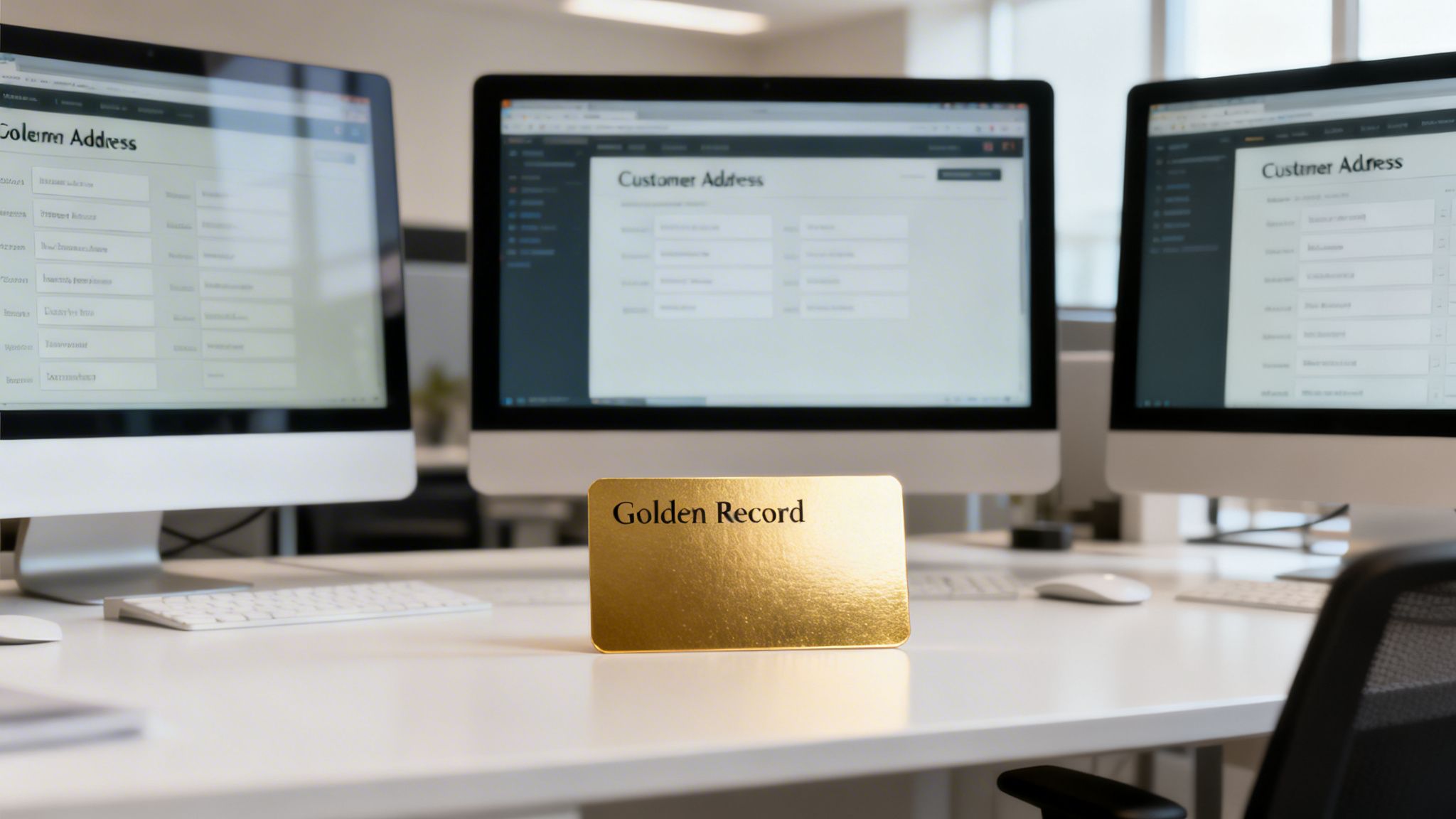
Let's cut through the corporate-speak. Picture this: your sales system says a customer lives on "Main St.," your shipping platform has them on "Main Street," and your marketing database lists "Main Avenue." Which one is right? This isn't a hypothetical. It's a daily data nightmare for countless companies, leading to returned packages, angry customers, and marketing dollars thrown down the drain.
MDM is the company-wide strategy for cleaning up that mess for good. It's a combination of processes and tools designed to create and maintain one definitive, authoritative record for your most critical data. This master record is often called a "golden record" or a "single source of truth" that every other system plugs into.
And this isn’t just some technical project for your IT team. It's a foundational business move that directly impacts your bottom line. With a solid MDM solution, you stop shipping products to the wrong address, you build better customer relationships, and you start making decisions based on data you can actually trust.
Without an MDM strategy, departments naturally create their own data silos. Each team ends up with its own separate and often conflicting version of the same information. This chaos creates very real problems:
MDM systematically breaks down these silos. It establishes clear rules for how master data is created, updated, and shared across the entire organization. Now, when a customer updates their address in one place, that change populates everywhere, instantly. This ensures everyone from sales to support has the most current and accurate information. For a deeper dive, we explore the importance of the harmonization of data in another article.
Creating a single source of truth isn't just about cleaning up old messes. It's about preparing your business to scale effectively. To get there, it’s essential to understand modern approaches like unifying customer data with platforms such as Salesforce Data Cloud.
A strong MDM foundation allows your organization to move faster and with more confidence. You can launch new products more efficiently, enter new markets with reliable data, and deliver the kind of personalized experiences that modern customers expect.
As the business world becomes more data-driven, getting your master data right is quickly becoming non-negotiable. The companies that master their data are the ones who will have a massive competitive advantage in the years ahead.

When you peek under the hood of a solution master data management platform, you won’t find a single, mysterious black box. What you’ll see is a system of core parts working in concert, each with a very specific job. Getting to know these components demystifies how MDM actually builds and protects that "golden record" for your entire business.
Think about creating the perfect customer profile from scratch. First, you need a blueprint. That’s exactly what data modeling is.
Data modeling is ground zero for any MDM initiative. It’s the process of defining what your ideal, perfect master record should look like. You get to decide which pieces of information are non-negotiable and how they should be structured.
For a customer record, your blueprint might include fields for:
This model becomes the gold standard that all incoming data from your different systems is measured against. It’s the foundational design for your single source of truth. With this blueprint in hand, the next job is to make sure every piece of data conforms to these high standards.
This is where the real work begins. Data quality management acts as an industrial-strength cleaning crew for all your information. It’s an automated engine that takes the messy, inconsistent data from your various applications and whips it into shape.
An effective MDM solution automatically cleanses, standardizes, and validates incoming data. It’s like having an always-on spellchecker and fact-checker for your entire business, ensuring everything from addresses to product specs is accurate.
This component handles the tedious tasks, like correcting "Main St." to "Main Street," getting rid of duplicate customer entries, and flagging incomplete product information. By enforcing the rules laid out in your data model, it guarantees only clean, reliable data makes it into your master record.
This meticulous process is becoming mission-critical as businesses scramble to get their data house in order. The global MDM market, valued at US$30.3 billion in 2026, is projected to skyrocket to US$81.2 billion by 2033, a surge fueled by rapid digitalization. You can learn more about the MDM market growth on persistencemarketresearch.com. This growth is a clear signal of just how crucial data quality has become.
Once your data is spotless, you need rules to keep it that way. Data governance establishes the policies and controls for who can create, view, or change master data. It’s the rulebook that prevents your clean data from getting messy again over time.
Finally, integration is the delivery network. It’s how your MDM solution shares its perfected data with the rest of your company. It connects to your eCommerce platform, ERP, and marketing tools, making sure they all receive the same, up-to-date information from that single source of truth. This seamless flow of trusted data is what makes a solution master data management strategy so powerful.

This is where the theory behind solution master data management hits the road and starts impacting your bottom line. For any business in the fast-moving world of retail and eCommerce, MDM isn't just a technical exercise in data cleanup. It's a strategic tool for driving sales, slashing operational costs, and earning genuine customer loyalty.
The most powerful win, right out of the gate, is achieving a true 360-degree customer view. Imagine knowing a customer's entire journey with your brand, from their first click on a social media ad to their most recent in-store return. This complete picture is the key to unlocking real personalization. It’s how you graduate from generic email blasts to sending genuinely helpful, tailored recommendations that make people want to shop with you again.
Mastering customer data is so critical that it's expected to dominate the MDM market, commanding a massive 41.35% market share by 2025. This isn't surprising when you consider how quickly a messy omnichannel experience, fueled by fragmented data, can cause customer satisfaction to plummet by 15-25%. For more on this, check out the MDM market share analysis on mordorintelligence.com.
Another huge benefit of a solution master data management platform is the ability to create one perfect, unimpeachable source of truth for all your product information. Just think about all the places your product data has to live: your website, your mobile app, Amazon, Google Shopping, and countless social media marketplaces.
Without MDM, a simple price change can turn into a frantic, error-prone scramble across a dozen systems. With MDM, you create one definitive "golden record" for every single product. This guarantees that every listing is consistent, accurate, and compelling, no matter where a customer finds it.
This directly tackles one of the biggest profit killers in retail: product returns. When what a customer receives in the mail is an exact match to what they saw online, return rates drop. On top of that, rich, consistent product data gives your SEO a serious boost, helping you climb the rankings in search results. A well-oiled product catalog is non-negotiable, a topic we cover in our guide to product catalog management software.
MDM’s value doesn’t stop at the digital storefront; it reaches deep into your operations. It’s also about making sure your supplier and material data is flawless. When you have a single, trusted source for vendor information, lead times, and material specs, the entire operational side of your business just runs better.
This immediately translates to tangible wins:
A well-implemented MDM solution acts as the central nervous system for retail operations. It connects the dots between what customers want, what products you offer, and how efficiently you can deliver them.
Ultimately, MDM takes the most common retail headaches and turns data chaos into operational clarity. The result isn't just cleaner data. It's higher sales, lower costs, and much, much happier customers who trust your brand.
The table below draws a straight line from specific MDM features to the business outcomes they create.
This table shows the direct connection between MDM features and the business benefits they deliver for online retailers.
As you can see, each feature is designed to solve a very real, and often costly, business problem.
If you’re in retail or eCommerce, your world is probably filled with an alphabet soup of systems: MDM, PIM, DAM. They sound similar, but each one has a very specific job. The real magic happens when you get them to work together, creating the kind of powerful, consistent product experiences that customers remember.
Let’s break it down with a simple analogy. Imagine your entire data universe is one massive, well-organized library.
MDM (Master Data Management) is the library itself. It’s the foundational structure, holding the definitive, master records for everything including customers, suppliers, partners, and even your physical store locations. It's the ultimate source of truth for all your core business data.
PIM (Product Information Management) is a specialized wing inside that library, laser-focused on one thing: products. This is where all the detailed attributes, technical specs, marketing copy, and categorizations for every single item you sell are managed.
DAM (Digital Asset Management) is the library’s media archive. This is where all the high-quality product photos, lifestyle images, how-to videos, and spec-sheet PDFs are stored, organized, and tagged for easy access.
When these systems are left to operate on their own, you get data silos, which are pockets of isolated information that quickly become outdated and inconsistent. But when you connect them? You get a single, powerful, unified view of every product you sell.
A modern solution master data management strategy doesn't try to replace your PIM or DAM. Instead, it acts as the conductor, making sure every instrument plays in perfect harmony. The MDM provides the foundational "golden record" for core entities, while the PIM and DAM enrich that data with specialized, product-focused content.
Here’s a practical example: Your MDM holds the master record for one of your key suppliers, including their official business name, address, and payment terms. Your PIM then links its product data to that supplier record, pulling in the authoritative vendor information automatically. Now, if that supplier ever updates their details, the change is made once in the MDM and reflects everywhere. No more manual updates across a dozen spreadsheets.
This integration is what turns a basic product listing into a rich, compelling story. It combines the structured data from the PIM with the engaging visuals from the DAM, all governed by the master data principles of the MDM.
This setup is absolutely essential for building a complete product record that’s ready for any sales channel. Making it all work relies on solid enterprise application integration best practices to ensure a seamless flow of data between systems.
For any retail business, the goal is to present a consistent and compelling product story, no matter where a customer finds you. Integrating your systems is what makes this possible by creating a single, reliable pipeline for all your product content.
This integrated approach brings some serious advantages:
Think of it this way: a great PIM is the central hub for all things product-related. To see how that piece of the puzzle works, it's worth understanding what Product Information Management truly involves and why it's a cornerstone of modern commerce.
Ultimately, a solution master data management strategy that properly integrates with specialized tools like a PIM and DAM ensures your product stories are not just accurate, but also engaging and consistent across your entire business.
Moving from theory to action with a solution master data management platform requires a smart plan. A successful rollout isn’t about just plugging in new software. Think of it as a strategic business project that demands clear vision, teamwork, and a well-defined finish line.
The first, and most critical, step is getting your leadership on board. Don't frame it as a technical upgrade. Build a rock-solid business case that directly connects clean data to real financial benefits, like slashing operational costs or boosting sales through better personalization.
Show them the money. Once you have executive buy-in, you can start drawing the map.
One of the most common traps is trying to fix every single piece of data in the company at once. This "boil the ocean" approach is slow, wildly expensive, and almost always fails to show results before people lose interest.
A much smarter strategy? Start small and score a quick, visible win.
Pick one, high-impact data area to tackle first. For most retail and eCommerce businesses, product data is the perfect starting point. Getting this right cleans up your website, improves marketplace listings, and can cut down on costly returns almost immediately.
This phased approach delivers real value step-by-step, building the momentum and confidence you need for the bigger stages of your MDM journey.
An MDM project is a team sport, and it’s definitely not just for the IT department. To get this right, you need a diverse team with voices from across the business, people who understand the real-world impact of the data.
Your implementation team should include representatives from:
This collaborative model ensures the final solution master data management setup actually works for everyone, not just the tech folks. With your team in place, it’s time to establish the rules of the road for your data.
A successful MDM implementation is built on a foundation of clear data governance. Before you start cleansing data, you must define the rules, set ownership, and establish quality standards that everyone agrees on.
This map shows how a central MDM solution acts as the definitive source for other key data systems.
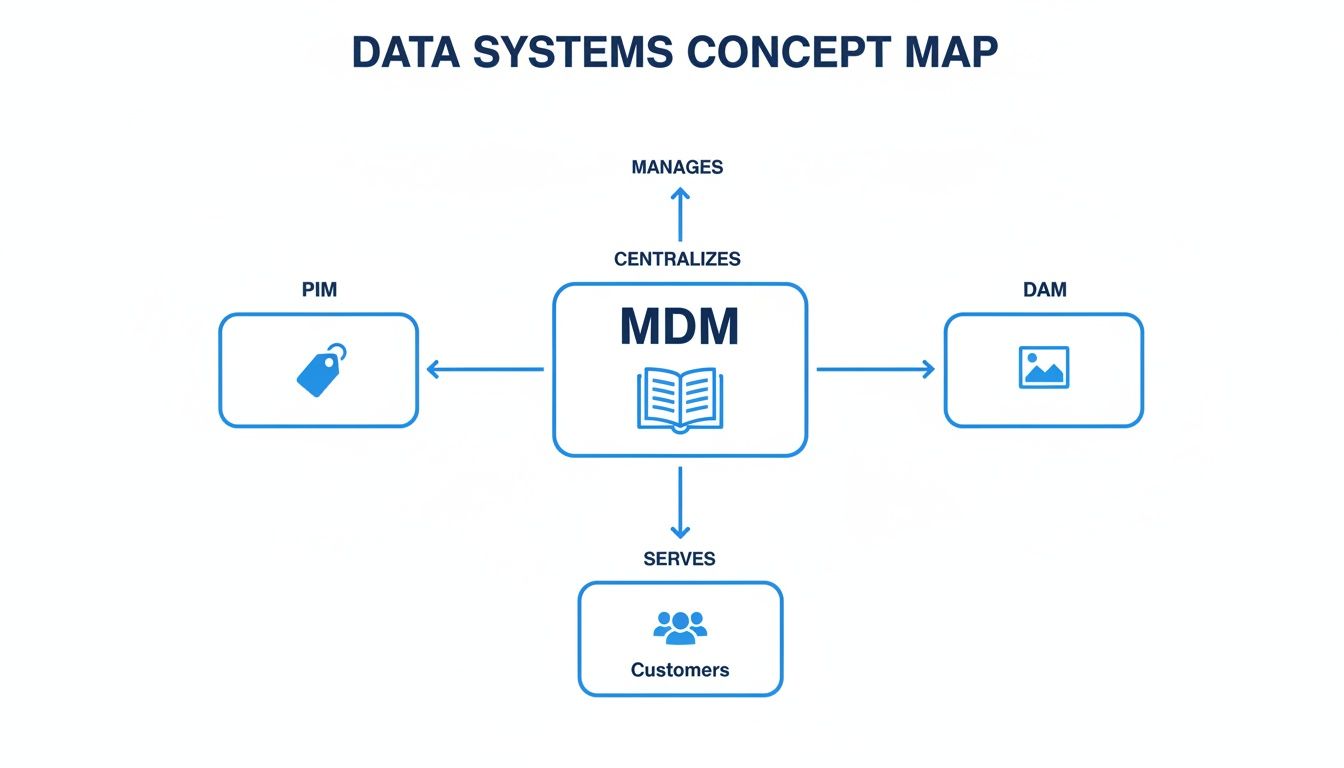
It’s the single source of truth that feeds your PIM, DAM, and customer-facing platforms, ensuring everyone is working from the same playbook.
To help structure your project, we've put together a simple planner outlining the essential phases of an MDM rollout.
Following a structured plan like this prevents scope creep and keeps the team focused on delivering measurable results at each stage.
Data governance is the set of policies that dictates who can create, edit, and approve master data. It’s your rulebook for keeping data clean over the long haul. Deciding who "owns" product data versus customer data is a critical step that prevents chaos and confusion down the line.
Finally, you need to choose the right technology partner to bring this vision to life. Look for a vendor who deeply understands your industry and offers a flexible platform that can grow with you.
This strategic approach is especially important in mature markets. For instance, North America is on track to capture 42% of the global MDM market by 2025. With nearly 65% of enterprises battling data inconsistencies that inflate retail costs by 12-18%, a well-planned implementation isn't just a good idea. It's essential for survival. You can explore more data on the MDM market trends at snsinsider.com.
Even with a solid game plan, diving into master data management always brings up a few questions. It’s a big topic, after all. Here are some of the most common ones we hear, with straightforward answers to help you connect the dots.
The easiest way to think about it is this: master data represents the core "nouns" of your business. These are the fundamental entities like your customers, your products, your stores, or your suppliers. This information is pretty stable and doesn't change on a whim.
Transactional data, on the other hand, is all about the "verbs" or the events. A purchase, a shipment, a return, or a payment are all transactions. They're time-stamped and capture a specific action. For instance, "Customer Jane Smith bought Product ABC on Tuesday" is a transaction. MDM's job is to make sure the nouns in that sentence (Jane Smith and Product ABC) are correct everywhere they appear.
This is a classic "it depends" question, but the answer really hinges on your approach. One of the biggest mistakes we see is companies trying to boil the ocean, attempting to fix all their data across every department at once. That kind of mega-project can easily drag on for more than a year and often loses steam before it delivers any real value.
A much smarter way to go is to start with a single, high-impact data domain, like product data. A focused project can start delivering tangible, measurable results in as little as 4 to 6 months. The key is to deliver value in stages. For most retailers and eCommerce brands, mastering product data first offers the fastest and biggest bang for your buck.
A phased implementation proves the value of MDM quickly. By tackling one domain at a time, you build momentum and secure organizational buy-in for future stages, turning a daunting project into a series of achievable wins.
For a lot of eCommerce and retail businesses, the answer is a resounding yes. A robust Product Information Management (PIM) system is literally built to be the single source of truth for all things product-related. It can absolutely serve as your MDM for that critical domain.
While a massive, enterprise-wide MDM platform also wrangles customer and supplier data, many companies find that nailing their product data with a PIM is the most urgent first step. It’s where you’ll see the most immediate and visible impact on sales, customer experience, and operational efficiency.
Ready to build a single source of truth for your product data? NanoPIM offers an AI-powered PIM and DAM platform that centralizes your product information, enriches it for every sales channel, and ensures your data is always accurate and consistent. Take control of your product story by visiting https://nanopim.com.


