

Let's cut right to the chase. Master data governance is the official rulebook, and the referee, for your company's most vital information. We're talking product specs, customer details, supplier lists, and more. It's the system that keeps this data clean, consistent, and trustworthy across your entire business.

Think of your business as a massive library and your "master data" as every single book on the shelves. Without a librarian and a cataloging system, chaos takes over. Books get shelved in random places, titles are abbreviated differently, and soon, nobody can find anything. This is what happens inside businesses every single day.
One team calls a product "Men's Blue Running Shoe," but the warehouse system lists it as "SHOE, RUN, M, BLU." When a customer calls for help, the service agent can't find it. A shopper on your website sees conflicting details. Just like that, a sale is lost. This looks like a data problem, but it's really a rules problem.
Master data governance is that cataloging system. It's the collection of policies, standards, and defined roles that ensures every bit of information is managed consistently. It answers the tough but essential questions:
The entire point is to establish a "single source of truth." This is one, and only one, authoritative place where everyone in the company can go for the right information, every time.
In a world where your products are sold on your site, Amazon, social media, and beyond, inconsistent data is a killer. Even small errors get amplified across every channel, eroding customer trust and wrecking your search rankings. Good governance stops this chaos before it starts.
A single source of truth isn't about being tidy; it's the bedrock for scaling your ecommerce operations. It’s what lets you improve the customer experience and make smarter decisions. It turns your data from a messy liability into your most powerful asset.
This is exactly why master data governance isn't some "nice-to-have" luxury for giant corporations anymore. The global Master Data Management (MDM) market, the tech that powers governance, is set to explode from US$30.3 billion in 2026 to US$81.2 billion by 2033. Studies show poor governance can slash operational efficiency by 20-30% in businesses selling across multiple channels.
When you get this right, you create a massive competitive edge. Businesses that have their data under control can launch products faster, offer far better customer service, and pivot quickly when the market shifts. They stop wasting time fixing mistakes and start spending time growing.
If you want to dig into the tools that make this happen, check out our guide on Master Data Management solutions. Next, we'll break down exactly how to build this framework with the right people, processes, and rules.
A solid master data governance program doesn't just run on software. It is powered by people with clear jobs and guided by a practical set of rules. Think of it like building a house: you need skilled workers (your people) and a detailed blueprint (your rules) to make sure everything comes together correctly.
Without clear roles, accountability gets fuzzy fast. When a data error inevitably pops up, teams start pointing fingers because no one truly owns the problem. A well-defined framework turns that confusion into order by making it crystal clear who is responsible for what.
Effective governance is a team sport, with distinct roles that cover everything from high-level strategy to the day-to-day grind of data quality. Getting these roles right is the first step.
Here’s a look at the essential roles that make up a strong governance team, what they do, and why they matter.
This structure creates a clear chain of command for data decisions, from the person entering the data all the way up to the executive team. This is a core part of effective data stewardship and an absolute must for long-term success.
Once you have your team in place, you need to define the rules they'll play by. A common mistake here is to write a hundred-page policy document that collects dust on a virtual shelf. Nobody reads it, and nothing changes.
Your goal isn't to create bureaucracy. It's to define simple, non-negotiable rules that prevent the most common and costly data errors. These rules should be so clear that anyone in the company can understand and follow them.
Think about the daily frustrations your teams face. Do product names look different on your website versus in your ERP? Are you constantly finding products with missing images? Start right there.
Your policies and standards become your playbook for data consistency. These rules don’t need to be complicated, in fact, the simpler, the better.
Here are a few examples of practical rules an eCommerce team might create:
[Category Code]-[Brand Code]-[Unique ID].By defining these simple rules, you codify best practices and make them official. This moves your organization away from relying on tribal knowledge and gets everyone operating from a shared, consistent playbook.
So, you’ve got the right people and the right rules. The next logical question is: how does data actually move through your system in a controlled way?
This is where a practical governance workflow comes in. Think of it as a structured path that takes data from its raw, often messy, state to a final, approved version that’s ready for your customers. This isn’t about adding bureaucracy for the sake of it. It’s about building intelligent checkpoints.
I like to compare it to a professional kitchen preparing its signature dish. Raw ingredients (your data) arrive from suppliers, go through strict quality checks and prep, and are finally assembled by a chef before a manager gives the final nod to send it to the customer. Every single step has a purpose, ensuring nothing substandard ever leaves the kitchen.
The entire process kicks off at the ingest phase. This is the moment new data shows up, whether it’s from a supplier’s spreadsheet, an update from your ERP system, or a manual entry by someone on your team. The goal here is simple: get this data into a controlled environment before it can contaminate your live systems.
A tool like NanoPIM's Data Holding Bay is perfect for this. It acts as a safe, temporary quarantine zone. Instead of new data directly overwriting existing product records, it’s held separately, giving you a chance to review and compare it without any risk.
For example, imagine a supplier sends you an updated price list for 500 products. The last thing you want is for that file to automatically update your live site. The ingest workflow places that new file in the holding bay, where you can see exactly what’s changed before committing to anything.
Once the data is safely inside your holding area, the validation and enrichment phase begins. This is where your meticulously crafted governance rules spring to life, powered by automation with a little help from AI. The system automatically scans the incoming data and checks it against your predefined standards.
These checks might include:
This diagram shows how the different governance roles interact throughout the process.
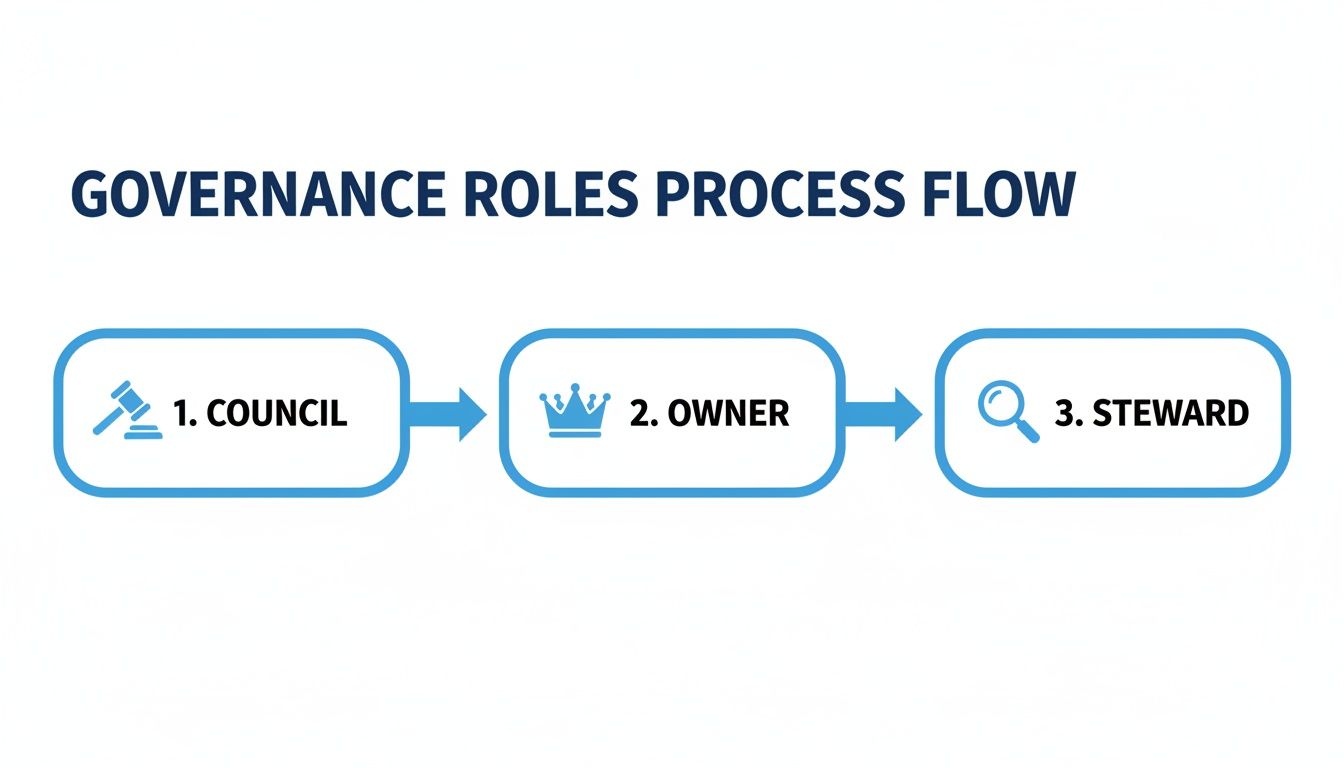
As you can see, the strategic decisions from the Council guide the Owner's accountability, which in turn directs the hands-on data work performed by the Steward.
This automated first pass is a massive time-saver. It catches up to 80% of common errors without any human intervention, freeing up your Data Stewards to focus on the more nuanced issues that truly need their expertise.
After the initial validation, AI-powered enrichment tools can step in. They might suggest better product descriptions, generate relevant keywords based on technical specs, or even flag low-quality images for replacement.
The final and most crucial stage is versioning and approval. No change should ever go live without a human giving the final sign-off. Period. A solid workflow maintains a version history of every single change, so you can always see what a product record looked like last week, last month, or last year.
Let’s walk through a real-world scenario. You're launching a new line of winter coats.
Only after that final approval does the data become part of the "single source of truth" and get published to your website and other sales channels. This human-in-the-loop process is the ultimate safety net. It perfectly balances the speed of automation with the wisdom of human oversight, creating a resilient system that prevents costly errors and ensures every detail is perfect before a customer ever sees it.
Your master data governance strategy is only as good as the tools you use to enforce it. While policies and people set the direction, technology is what turns your plan from a document into an active, automated part of your daily operations. This is where your core business systems finally come together.

Think of your tech stack as a specialized leadership team. Your Enterprise Resource Planning (ERP) is the no-nonsense operations manager, obsessed with logistics like stock levels, costs, and supplier codes. Your Digital Asset Management (DAM) is the creative director, guarding all your stunning product photos, videos, and brand guidelines.
Left on their own, these two "specialists" don't really speak the same language. That’s where a Product Information Management (PIM) system steps in to act as the general manager, creating harmony and getting everyone on the same page.
A PIM like NanoPIM is purpose-built to be the central hub for all your product master data. It doesn't replace your other systems; it orchestrates them. A PIM pulls raw operational data from your ERP, like inventory counts and base pricing, and marries it with rich marketing content and media from your DAM.
This is the key to finally breaking down the data silos that cause so many headaches. Instead of product information scattered across different departments and platforms, everything lives in one unified place. This creates that all-important single source of truth that governance is all about.
Of course, when connecting these powerful systems, it's wise to anticipate common data integration challenges. A well-planned integration prevents the bottlenecks and data conflicts that can completely derail your governance efforts.
The real magic happens when this integrated stack starts enforcing your governance rules automatically. Suddenly, your policies aren't just suggestions in a shared drive, they become active, automated checks built right into the system.
For example, you can set up rules that:
This automated enforcement makes it incredibly easy for everyone to follow the rules. The system does the heavy lifting, guiding users to create high-quality, compliant data without them needing to memorize a complex policy document. It makes the right way the easiest way.
This shift is supercharging the entire field. The Master Data Management (MDM) market, valued at USD 19.24 billion in 2025, is projected to hit USD 94.08 billion by 2035. For eCommerce managers, the stakes are high, as up to 60% of data is duplicated without proper governance, inflating costs by 12-18% annually. By creating a unified hub, businesses can join the 90% of digital leaders who achieve a 20% faster time-to-market. You can discover more insights about the growing importance of MDM on Precedence Research.
NanoPIM's ability to connect these disparate systems is what breathes life into your governance framework. The workflows and approval processes you designed are built directly into the platform. A new product update from a supplier doesn't just go live; it enters a holding bay, gets validated, is reviewed by a Data Steward, and is finally approved by a Data Owner, all within one seamless interface.
By connecting your ERP, DAM, and PIM, you create a powerful ecosystem that not only stores your data but actively governs it. To see how a PIM sits at the center of this strategy, check out our deep dive on Product Information Management. This integration turns master data governance from a theoretical concept into a practical, automated reality.
So, you’ve launched your master data governance program. Is it actually working? If your answer is a shrug or a vague "I think so," you're missing the entire point. Gut feelings don't justify the investment in people and technology, hard numbers do.
The only way to prove the value of your efforts is to measure them. This is where you stop talking about abstract goals and start tracking tangible results.
Think of it as a health check for your company's data. You wouldn't start a new fitness plan without tracking your progress, and the same logic applies here. Key performance indicators (KPIs) give you a clear, objective report card on how your governance framework is performing, turning fuzzy concepts like "better data" into real metrics.
At the end of the day, master data governance is all about improving the quality of the data that runs your business. You can get a solid baseline by tracking a few fundamental metrics that show the health of your product info, customer records, or other critical domains.
Data Completeness: This is the percentage of your records that have all the required fields filled out. For an eCommerce team, this translates to questions like, "What percentage of our products have at least 3 high-res images, 5 key features, and a full description?" A high completeness score means your customers are getting the info they need.
Data Accuracy: This tracks the number of errors found in your master data over time. You can monitor this by counting data-related customer support tickets, corrections logged by Data Stewards, or errors caught in audits. Watching this number go down is a direct sign of better operational efficiency.
Data Timeliness: This metric is all about speed. For many businesses, a critical KPI is "time-to-market" for new products. By measuring how long it takes for a new item to go from initial setup to being live on all channels, you can prove how governance is actually speeding up your launch process, not slowing it down.
Once you've got a handle on the basics, you can graduate to more sophisticated metrics. These show the wider impact of your governance program and offer deeper insights into the maturity of your entire data ecosystem.
A great starting point for this is the table below, which outlines some of the most impactful KPIs you can track.
Key metrics to track the effectiveness and impact of your data governance initiatives on business operations.
These metrics move you beyond simply checking for empty fields and into understanding how data governance truly drives business performance.
The real goal of tracking metrics isn't just to build fancy dashboards. It’s to create a feedback loop for constant improvement, showing you exactly where your processes are weak so you can fix them.
For example, tracking data lineage is huge. This is your ability to trace any piece of data all the way back to its source, seeing every touchpoint and change along the way. In a system like NanoPIM, this audit trail is built-in, giving you total transparency and accountability with zero extra effort.
Another powerful metric is how well you stick to Service Level Agreements (SLAs). You might set an SLA that all critical product updates must be approved within 24 hours. Tracking your team's performance against this proves your governance workflow is both reliable and responsive.
Using real-time dashboards and alerts, like those inside NanoPIM, means you can stop waiting for a monthly report to tell you there's a problem. You get an immediate heads-up when completeness drops or an SLA is at risk. This is what separates a world-class governance program from an average one: you have the hard data to prove ROI and the insight to keep getting better.
In an era of ever-tightening data privacy rules and industry regulations, compliance isn’t just a good idea, it's a non-negotiable part of doing business. Solid master data governance is your best defense against costly compliance blunders and damaging data breaches. It gives you the framework to manage data responsibly and, just as importantly, prove you’re doing it.
A huge piece of that puzzle is the audit trail. Think of it as a meticulous, unchangeable logbook for every piece of your master data. It records the complete history of every change, answering the all-important questions: who changed it, what exactly did they change, and when did it happen?
This kind of detailed tracking is the bedrock of accountability. For any company dealing with regulations like GDPR or specific material disclosure requirements, having an ironclad record of data handling isn't optional anymore.
Looking backward is one thing, but you also need to control what happens next. This is where change control processes come into play. These are simply structured workflows that make sure any update to your master data is properly managed, reviewed, and formally signed off on before it ever goes live.
This process is your shield against the all-too-common mistakes that create chaos. We've all seen it happen, accidental data overwrites, incorrect product information being pushed to a live site, or a pricing error that cascades across channels. For a brand selling on both Amazon and eBay, or a manufacturer trying to centralize sensitive product specs, this control is absolutely critical. A single unapproved price change or an incorrect material spec can have massive, immediate consequences.
A well-defined change management process turns compliance from a constant headache into a predictable, well-managed operation. It builds a safety net that catches errors before they can impact your customers or your bottom line.
If your master data includes sensitive customer information, demonstrating this level of control is paramount. For a deep dive into building trust and formalizing these processes, it's worth understanding what goes into achieving SOC 2 certification. This kind of certification is a powerful signal that you take data security and process integrity seriously.
The need for this level of control is only getting more urgent. The data governance market is projected to explode to USD 24.07 billion by 2034, with compliance management being a massive driver of that growth. The stakes are already sky-high; poor governance has exposed companies to an average GDPR fine of $4.45 million per violation since 2018. You can see the full research on the booming data governance market for more details on this trend.
By implementing robust audit trails and change control, you’re not just dodging fines, you're actively mitigating risk. The benefits ripple outwards, protecting your brand's reputation, earning customer trust, and creating a far more stable operational environment. And when you use a system like NanoPIM, these controls aren't a chore; they’re built right into your daily workflows, making governance a seamless and natural part of how your team gets work done.
Even with the best strategy laid out, a few questions always seem to pop up once you start digging into master data governance. Let's tackle the big ones I hear all the time so you can get your bearings and move ahead.
This is a classic point of confusion, but the distinction is actually pretty simple. Think of Master Data Management (MDM) as the tools and the mechanics, the "what" and the "how." It's the software, the databases, and the processes you use to build that single source of truth.
Master data governance, on the other hand, is the human element, the "who" and the "why." It's the framework of rules, roles, and responsibilities that directs the entire effort. Governance is about setting the quality standards, deciding who owns which data, and making sure everyone is accountable.
You can't have one without the other. MDM is the car, but governance is the person in the driver's seat with a map and a deep understanding of the rules of the road.
You don’t need an enterprise-sized team to get this right. The key is to start small and focus on what moves the needle. For almost every eCommerce brand, that means starting with product data.
First, anoint someone as the "Data Steward" for products. It doesn't have to be their full-time job, just an official part of their role. Then, forget about writing a 50-page policy document. Just define three to five simple, high-impact rules.
For instance:
The secret isn't a massive, complex system. It's about starting small, focusing on the data that directly drives sales, and using a simple, centralized tool to enforce your rules. A PIM like NanoPIM or even a well-managed spreadsheet is all you need to get started and build from there.
Search engines like Google are machines that crave structure, consistency, and accuracy. When your master data governance ensures every product title, description, attribute, and spec is uniform and correct across your entire site, you're speaking their language.
That consistency builds algorithmic trust, which translates directly into better search rankings. And it's even more critical for the new wave of AI search. The old saying "garbage in, garbage out" has never been more true. Governance is what ensures you're feeding generative AI engines the premium fuel they need to create accurate, compelling answers and summaries about your products.
Ready to turn governance from a policy document into an automated reality? NanoPIM is an AI-powered PIM that centralizes your product data and embeds your governance rules directly into workflows. See how NanoPIM can help you build a single source of truth.


