

Ever found yourself wondering, what is AI copywriting, really?
Let's cut through the noise. In its simplest form, AI copywriting is using artificial intelligence to write content for you, things like product descriptions, ads, and emails. Think of it as a super-fast writing assistant that can spin up hundreds of text variations in the time it takes to brew a coffee.
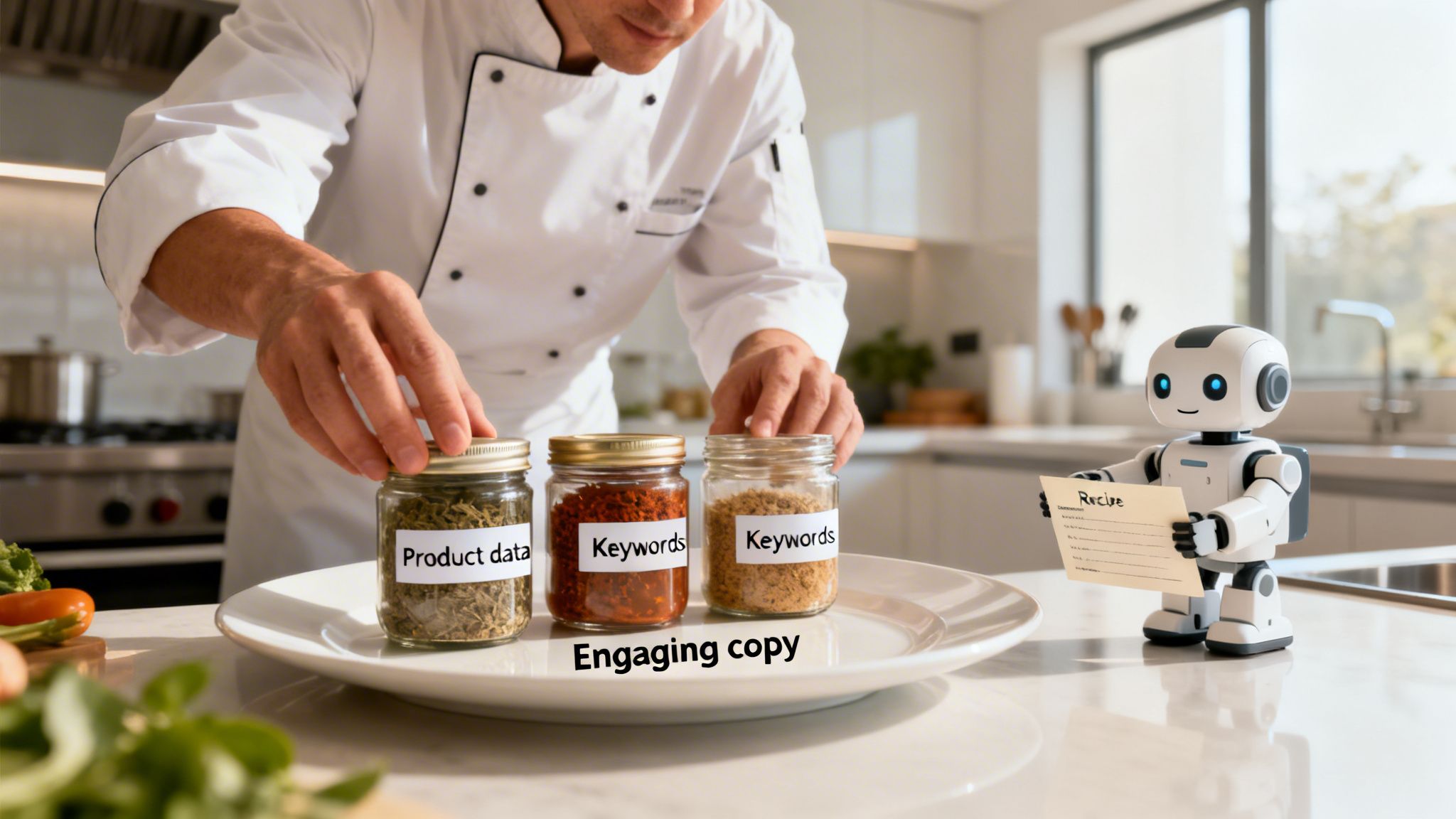
Forget the buzzwords for a second. The best way to think about AI copywriting is to picture a skilled chef. You bring the raw ingredients, your product data, some keywords, and a profile of your target audience. The AI then follows a "recipe" you provide (your specific instructions) to cook up compelling, ready-to-serve copy.
So, instead of staring at a blank page, you feed the AI basic facts like product dimensions, materials, and key selling points. The tool gets to work, turning that raw data into engaging stories, benefit-driven bullet points, and SEO-friendly titles built to grab attention on Amazon or Google.
It's a process that's quickly becoming essential. The market for these tools was valued at $1.1 billion in 2023 and is on track to hit $1.9 billion by 2030, growing at a staggering 45.2% rate. That kind of growth tells you everything you need to know about the demand for creating high-quality content, fast.
The point isn't to replace your writers. It's about automating the most repetitive, soul-crushing parts of content creation. This frees up your team to focus on the big picture: strategy, creativity, and adding that final human polish.
For a quick overview, this table breaks down the essentials of AI copywriting.
This at-a-glance view shows just how practical these tools are for modern business needs, especially in eCommerce.
To really get it, you have to understand that AI copywriting is more than just hitting a "generate" button. It’s a partnership between human direction and machine speed.
Here are the components that actually matter:
This tech is what allows brands to maintain a consistent voice and level of quality across every single product listing. To go deeper, a founder's guide on What Is AI Copywriting? explains it from a no-nonsense, practical viewpoint.
It’s not about losing the human touch. It’s about finally being able to amplify it at scale.
So, what’s actually happening in the background when an AI writes your product description? It might feel like magic, but the process is surprisingly logical. It all starts with something called a Large Language Model, or LLM.
Think of an LLM as a brilliant apprentice that has spent its entire existence reading nearly everything on the public internet. It’s consumed billions of articles, books, product pages, and customer reviews. Through that massive training, it's learned to spot patterns in how words and ideas connect, allowing it to predict the next logical word in a sentence.
This vast knowledge is the engine. But an engine can't get you anywhere without a driver telling it where to go. That’s your job.
The basic flow is simple: you provide the data and the instructions, and the AI generates an output based on them.
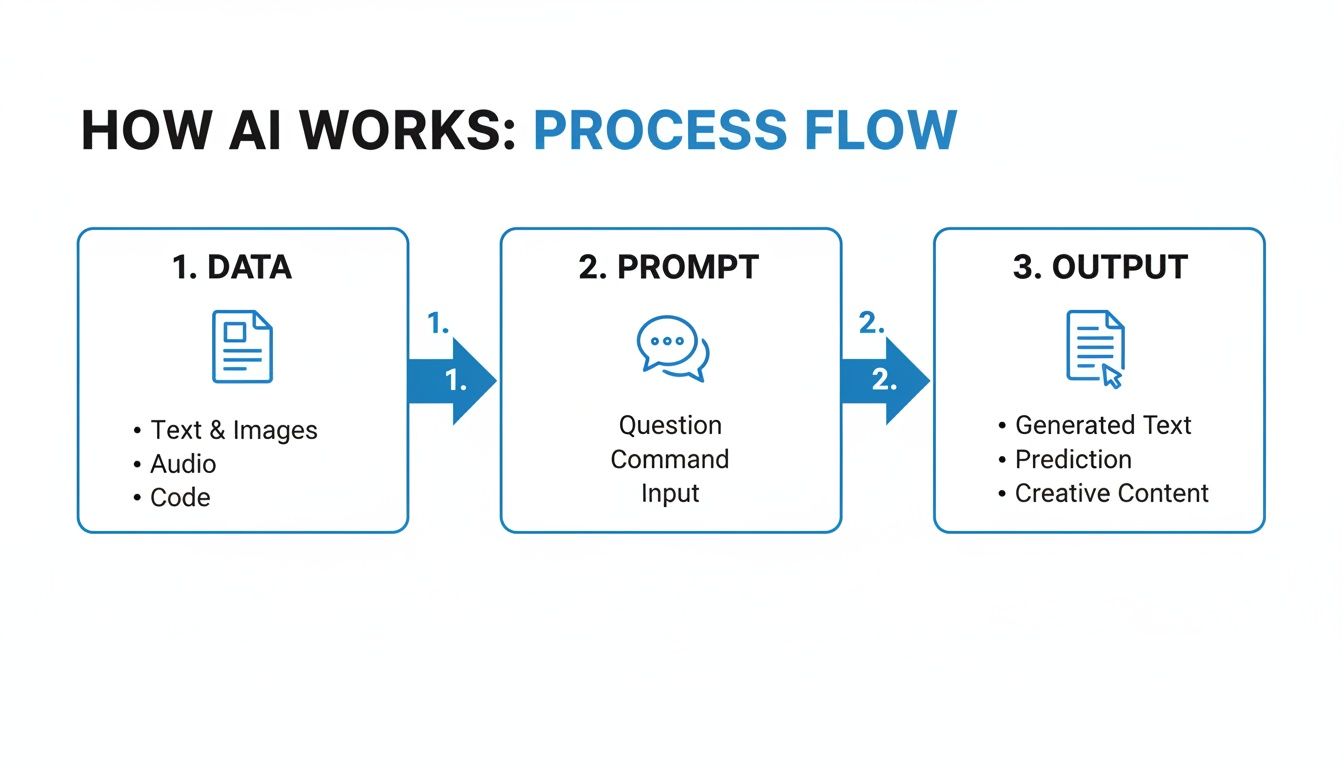
The key takeaway here is that the AI isn't truly "creating" from nothing. It’s responding directly to the quality of the raw materials and instructions you give it.
Those instructions are called prompts. A prompt is simply the command or question you feed the model. The quality of your prompt is the single biggest factor in the quality of the result you get back.
It’s the difference between telling a chef to "make some food" versus handing them a detailed recipe. The first approach gets you a random dish; the second gets you exactly what you were craving.
This is precisely why generic prompts result in bland, soulless copy.
A classic mistake is using a vague prompt like, "write a product description for a water bottle." The AI has no real context. It doesn't know your brand, who you're selling to, or what makes your bottle different from the thousands of others online.
To get compelling copy, you have to give the AI a solid creative brief. The better your brief, the better the final draft.
Great prompting is part art, part science. You need to give the AI enough context to guide it, but not so many constraints that you stifle its ability to sound natural. For a product description, a strong prompt might include:
Providing this level of detail transforms the AI from a simple word generator into a focused, effective copywriting assistant.
Crafting a detailed prompt for one product is one thing. Doing it for thousands is another challenge entirely. This is where dedicated platforms like NanoPIM come in. They build smart systems that sit on top of these powerful LLMs.
Instead of you manually writing a complex prompt for every single SKU, these systems do the heavy lifting. They use smart templates that automatically pull in your product data, apply your brand guidelines, and follow channel-specific rules.
This structured, systematic approach ensures that every piece of AI-generated content is:
These platforms essentially productize the art of prompt engineering, making it possible to create high-quality, on-brand copy at a scale that would be impossible for a human team to match. It’s how you get all the power of AI without needing a data science degree to use it.
Okay, let's talk about what really matters: how this AI stuff actually helps your business. Knowing the tech is one thing, but seeing how it can genuinely grow your eCommerce operation is where things get exciting.
For any product or marketing team, the benefits go way beyond just writing faster. It’s about driving real, measurable results.
Think about it. We’ve all been there. Maybe you’re a retail manager who spends weeks every quarter trying to manually update thousands of product descriptions for Amazon, your own site, and Google Shopping. It's a slow, soul-crushing process that eats up time better spent on actually growing the business.
Now, imagine that same task, which used to take weeks, is done in a few hours. That's not just about saving time. It's about what that new freedom allows you to do.
AI copywriting gives you the power to break free from the manual content grind. Suddenly, launching new products, expanding to new markets, and running A/B tests on your descriptions goes from a massive project to a simple afternoon task.
In eCommerce, time is money. Period. The faster you can get a new product listed and live across all your channels, the sooner you start making sales. AI copywriting completely slashes the time it takes to go from a product concept to a fully merchandised, ready-to-sell listing.
Instead of sitting around waiting for someone to manually write copy for hundreds of new SKUs, you can generate everything almost instantly.
This means you get:
This speed isn't just a convenience; it's a massive competitive advantage. While your competitors are still stuck in the writing phase, you're already selling.
Does your brand sound adventurous and bold on your website but dry and technical on your Amazon listings? That kind of inconsistent messaging confuses customers and chips away at your brand's identity.
AI is the perfect tool to solve this problem at scale.
You can set up brand voice guidelines and templates once, ensuring every single piece of content the AI generates sounds like it came from the same person. It doesn't matter if it's for your 10th product or your 10,000th, the tone, style, and core messaging stay perfectly aligned. That consistency is what builds trust and makes your brand instantly recognizable.
The broader copywriting market, supercharged by AI, is projected to hit $45.24 billion by 2031. This isn't about replacing writers. It's about amplifying their impact, with businesses saving an average of 2.2 hours weekly per employee. That time goes right back to your team for more strategic, high-value work.
Great copy doesn't just describe a product; it sells it. Modern AI tools are built from the ground up to create content that performs better on search engines and marketplaces, directly leading to more traffic and higher conversion rates.
Because you can easily generate unique content for each platform, you can optimize for their specific algorithms. This could mean generating titles with the perfect keyword density for Google or crafting benefit-rich bullet points that Amazon's A9 search algorithm absolutely loves.
Better optimization leads to better rankings, which means more eyeballs on your products. Simple as that. If you want to go deeper on this, check out our guide on Generative Engine Optimization strategies.
By automating the creation of high-quality, optimized copy, you can:
Ultimately, AI copywriting removes one of the biggest bottlenecks to growth. It empowers your team to work smarter, not harder, and focus their human creativity where it truly matters most.
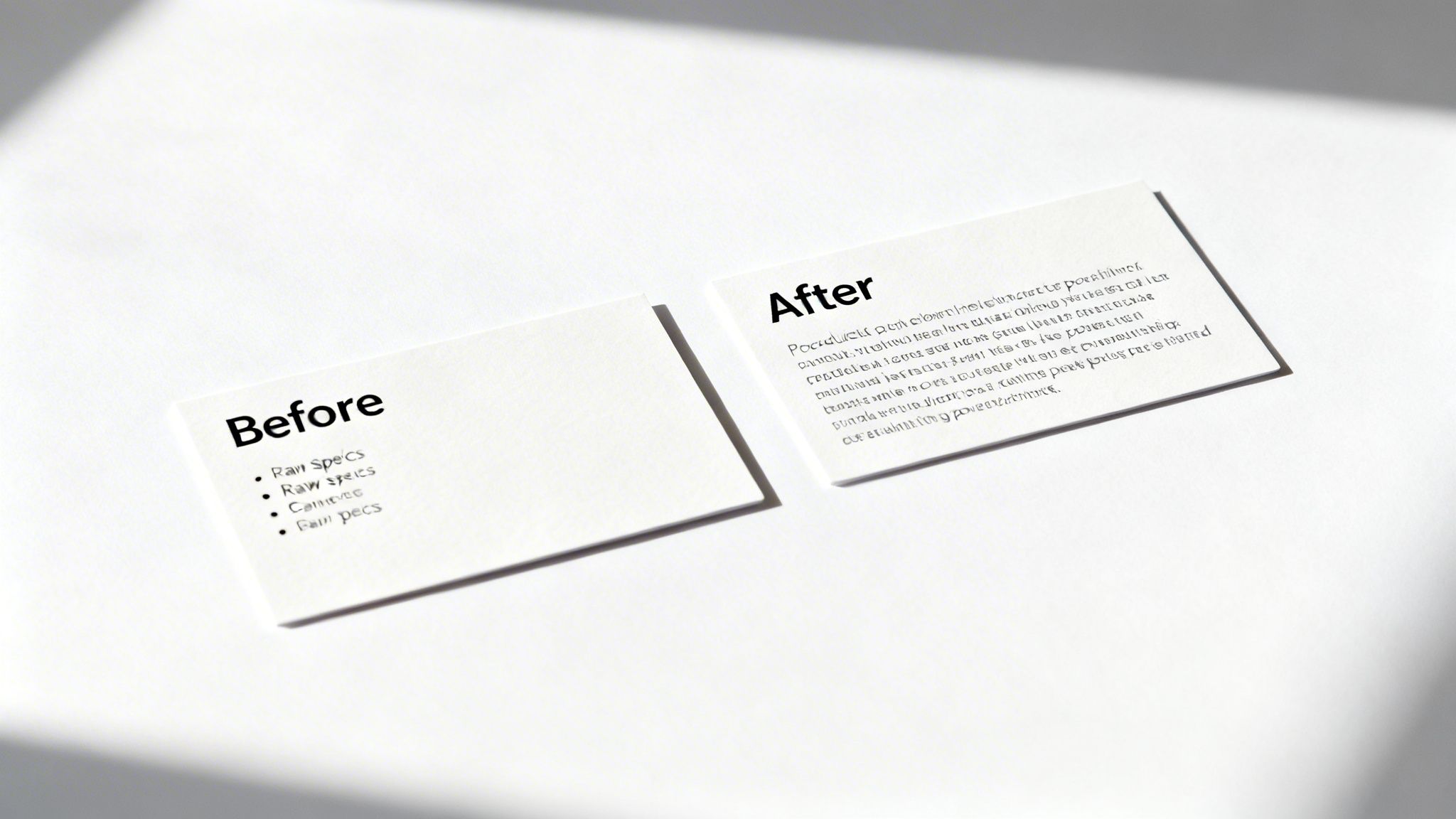
The theory is one thing, but seeing AI copywriting in action is where it really clicks. Let's get practical and show you how AI can spin raw product data into polished, channel-specific content that actually sells.
We'll run through a few before-and-after examples for a simple product, showing how the AI adapts its writing style and format for the completely different rules of Amazon, Google, and eBay.
Imagine your team is launching a new "Aqua-Trekker" stainless steel water bottle. The product information management (PIM) system contains all the basic facts.
Before AI: The Raw Product Data
- Product Name: Aqua-Trekker Bottle
- Material: 18/8 food-grade stainless steel
- Capacity: 32 oz
- Features: Double-wall vacuum insulation, leak-proof flex cap, powder-coat finish, BPA-free, wide mouth opening.
- Colors: Ocean Blue, Forest Green, Slate Gray
This is our starting point. It's accurate, sure, but it's dry and has zero personality. Now, let's feed this into an AI and see what it produces for each major marketplace.
For Amazon, it's all about discoverability and conversion. We need a title loaded with keywords to show up in search, and bullet points that scream "buy me!" by focusing on the benefits. The tone needs to be confident and punchy to grab a shopper who’s comparing ten other bottles at the same time.
After AI: Amazon-Optimized Content
Product Title:
Aqua-Trekker 32 oz Insulated Water Bottle with Leak-Proof Flex Cap - 18/8 Stainless Steel, Double Wall Vacuum Insulated for Hot & Cold Drinks, BPA-Free, Wide Mouth - Ocean Blue
Key Product Features (Bullet Points):
See the difference? The AI didn't just list the specs; it translated "double-wall vacuum insulation" into a tangible benefit: "keeps your drinks ice-cold for up to 24 hours." That's what convinces a customer to click "Add to Cart."
Google Shopping is a different game. The title needs to be clean and direct for quick scanning in a crowded search results page. The description's main job is to feed Google's algorithm the right keywords so it can match your product to the right shoppers.
After AI: Google Shopping-Optimized Content
Product Title:
Aqua-Trekker 32 oz Stainless Steel Water Bottle - Ocean Blue
Product Description:
Stay hydrated on any adventure with the Aqua-Trekker 32 oz Insulated Water Bottle. Crafted from durable 18/8 food-grade stainless steel, this reusable water bottle features double-wall vacuum insulation to keep drinks cold for 24 hours or hot for 12. The leak-proof flex cap gives you peace of mind on the go. Its BPA-free construction ensures a clean taste, while the wide mouth is perfect for adding ice. Finished with a rugged powder-coat grip. Ideal for hiking, gym, and daily use.
Here, the AI generated a compact, keyword-dense paragraph. It's less about emotional storytelling and more about giving the search engine precisely the information it needs to categorize and display the product effectively.
On eBay, buyers often appreciate thoroughness and clarity. They want to know exactly what they're getting, with no surprises. Here, the AI can adopt a more direct, feature-focused voice that builds trust.
For anyone serious about selling on these platforms, a deep understanding of Amazon product listing optimization is essential to stand out from the noise.
After AI: eBay-Optimized Content
Product Title:
NEW Aqua-Trekker 32 oz Insulated Stainless Steel Water Bottle - Ocean Blue - Leak-Proof
Item Description:
Up for sale is a brand new Aqua-Trekker 32 oz Water Bottle in Ocean Blue. This bottle is designed for durability and performance, making it a reliable choice for outdoor activities or daily hydration.
The eBay version is almost a hybrid, a friendly intro followed by a clean, scannable spec list. This format removes all doubt for a potential buyer, helping them feel confident in their purchase.
To see just how different these approaches are, let's break them down side-by-side.
This table shows the typical manual process versus what's possible when AI, especially when integrated into a system like a PIM, handles the heavy lifting.
These examples just scratch the surface, but they clearly show how AI can transform a single set of product data into perfectly tuned copy for any sales channel. If you're looking for more tips on the fundamentals, you can always check out our guide on how to write product descriptions that truly connect with customers.

You’ve seen the speed. AI can churn out product descriptions and ad copy at a mind-boggling rate. But that immediately raises a huge question for any manager: How do you hit that kind of volume without your brand voice and factual accuracy going completely off the rails?
It's a serious concern. Just handing the keys over to an AI is a great way to flood your site with generic, error-filled content that wrecks your brand’s reputation. The answer isn't to run from AI, but to manage it with a smart, human-led strategy.
The single most effective way to scale AI copywriting is to build a "human-in-the-loop" workflow. Think of it as a quality control assembly line. The AI is your hyper-efficient first station, creating the initial draft. A human expert then provides the crucial final inspection and polish.
This setup gives you the raw speed of machine generation while keeping you in full control of the final copy that customers see. Your team’s job instantly shifts from staring at a blank page to refining a solid first draft, a much faster and more strategic use of their talent.
A human-in-the-loop process ensures AI acts as a powerful assistant, not an unsupervised intern. Your team's expertise is still the most important part of the process; it's just applied more efficiently at the review stage instead of the initial drafting stage.
This simple shift prevents the classic AI pitfalls, like subtle mistakes or a tone that’s just a little bit off. It keeps your experts focused on high-value work like creative direction and final sign-off.
Before you can even think about quality control, you have to make sure the AI is working with the right ingredients. The most important first step is establishing a single source of truth (SSOT) for all your product information.
This just means that all your product data, from technical specs and key features to your marketing images and videos, lives in one central, verified place. For most, that’s a Product Information Management (PIM) system.
Without an SSOT, you’re basically asking the AI to build a house on a shaky foundation. Centralizing your data is the only way to get reliable, accurate AI-generated content at scale.
Once your data is solid, you need a system to manage the actual content creation and approval process. This is where dedicated platforms provide the guardrails you need to scale with confidence.
These governance tools turn AI from a wild card into a predictable, manageable part of your workflow.
Key control features to look for include:
These features create the transparency and accountability needed to actually trust the process. You can let your team work fast while knowing a safety net is in place to catch any issues. For a deeper look at managing the assets that go with your copy, exploring the role of AI in Digital Asset Management can provide valuable insights.
By combining a human-in-the-loop process, a rock-solid data foundation, and smart governance tools, you can finally embrace AI copywriting. You get all the speed and scale without ever sacrificing the quality and accuracy your brand depends on.
Alright, now that we've covered the what and how of AI copywriting, your mind is probably racing with some practical questions. It's only natural. You're likely wondering about the cost, the setup, and what this all means for your team.
Let's dig into some of the most common questions we hear from eCommerce managers and product specialists. My goal here is to give you straight answers, cutting through the noise so you can see what AI can really do for your business.
This is the big one, isn't it? But the answer is a firm no.
The point of AI copywriting isn't to make skilled writers obsolete. It’s to give them a powerful assistant. Think of the AI as a hyper-efficient junior copywriter, one who can churn out the first, most repetitive draft of your content in minutes, not days.
This frees up your human experts to focus on the work that actually moves the needle:
So, instead of replacing your team, AI gives them superpowers. It takes the soul-crushing drudgery of writing hundreds of similar product descriptions off their plate, letting them apply their creativity where it counts most.
Yes, absolutely. In fact, when you use it correctly, AI-generated content can be a massive boost for your SEO. Modern AI tools aren't just spitting out random words; they're built with search engine optimization in mind from the ground up.
You can direct the AI to:
The key is giving the AI the right inputs. A well-prompted AI can produce unique, readable, and highly optimized copy that's perfectly tuned for search algorithms. This helps you rank higher without all the manual grunt work.
A common myth is that AI content is automatically "thin" or "duplicate." That only happens when you feed it lazy, generic prompts. When you give the AI your unique product data, brand voice guidelines, and specific SEO targets, the output is rich, relevant, and built to perform.
Ultimately, the quality of the AI's work is a direct reflection of the quality of your instructions.
This is a critical piece of the puzzle. You don't just flip a switch and hope the AI gets it right. You have to train it.
Maintaining a consistent brand voice is a core part of setting up any good AI copywriting system. You essentially "teach" the AI your brand's personality by feeding it examples of your best-performing copy, your official style guide, and clear instructions on your tone.
Advanced platforms take this a step further, letting you build a library of rules and templates.
This mix of initial training, reusable templates, and human oversight ensures your brand voice stays strong and consistent, even when you're creating content for thousands of products at once.
It's smart to think about cost, but you have to look past the monthly subscription fee. The real value is found when you weigh that cost against the massive savings in time and labor. For instance, some businesses report saving over 2 hours of work per employee every single week by automating these content tasks.
Think about the cost of not using AI: the team hours spent on manual writing, the product launches delayed by content bottlenecks, and the sales you lose from unoptimized listings. When you look at it that way, the return on investment for AI becomes incredibly clear.
Many modern platforms, including NanoPIM, use a transparent, token-based pricing model. This means you only pay for what you actually generate. It's a flexible approach that lets your costs scale directly with your business needs, so you aren't stuck paying for a high-tier plan during a slow season. It's simply a more efficient way to manage your budget.
Ready to see how an AI-powered PIM can transform your content workflow? NanoPIM centralizes your product data and uses AI to generate high-quality, channel-specific copy at scale, all while giving you the governance tools to maintain control. Explore NanoPIM today!


