

A strong data governance strategy isn't some formal, dusty rulebook sitting on a shelf. Think of it as the shared playbook for your company's most valuable asset: its data. It’s the system that ensures your information is accurate, secure, and actually useful for hitting your business goals. This used to be an IT-only headache, but now, it's a core function for any successful commerce team.
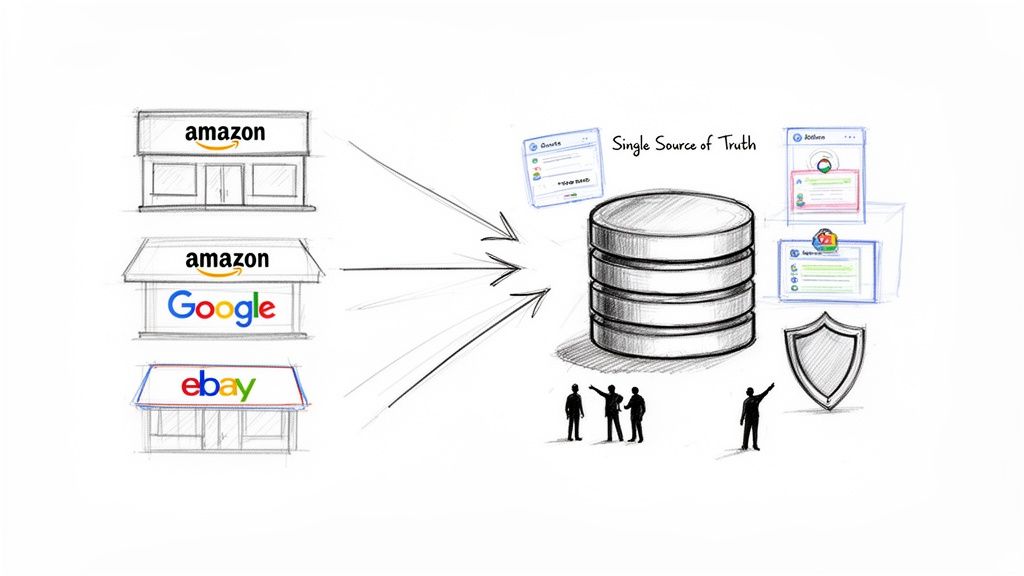
In a world powered by AI and omnichannel sales, your product data is either your greatest advantage or your biggest liability. A solid data governance plan is what tips the scales in your favor. It’s the process that wrangles scattered, inconsistent information into a single, reliable source of truth your whole team can trust.
This is especially critical for anyone trying to scale their business across platforms like Amazon, Google, and eBay. Without clear rules, you’re constantly dealing with inconsistent product descriptions, incorrect pricing, and a chaotic mess of digital assets.
The contrast between businesses that embrace data governance and those that don't is stark. It shows up everywhere from team morale to the bottom line. Here’s a look at the real-world outcomes we see every day.
| Business Area | With Strong Governance | With Weak Governance |
|---|---|---|
| Sales & Revenue | Increased sales from accurate, compelling product listings and fewer returns. | Lost sales due to cart abandonment, high return rates, and poor reviews. |
| Operational Efficiency | Teams work faster, launching products and campaigns with confidence. | Wasted hours hunting for correct info, fixing errors, and duplicating work. |
| Customer Experience | Consistent, trustworthy information builds brand loyalty and customer confidence. | Frustrated customers, brand damage, and a spike in support tickets. |
| Compliance & Risk | Reduced risk of fines (e.g., GDPR) and marketplace penalties. | High risk of costly legal penalties and account suspension from marketplaces. |
| AI & Innovation | AI initiatives succeed, delivering personalized experiences and optimized ads. | AI projects fail, producing unreliable outputs based on flawed data. |
Ultimately, a strong governance framework is the foundation for a scalable, profitable, and resilient business. It’s not just about clean data; it’s about creating an environment where your teams can do their best work.
When your data is a mess, the problems you face are real, and they directly hit your bottom line. We’ve seen it time and time again.
These aren't just minor inconveniences. These are the hidden costs of poor data governance, and they create friction that slows you down and erodes your brand's reputation.
The explosion of AI has made a clear data governance strategy more critical than ever. As teams lean on AI for everything from generating product copy to optimizing ad spend, the quality of the data feeding those models is everything.
The numbers don't lie. A staggering 73% of AI projects fail, and it’s not because the algorithms are bad. It's because they're being fed with subpar data managed by weak governance. For any eCommerce business using a PIM like NanoPIM to centralize product data for AI, this should be a wake-up call.
A data governance strategy is your framework for turning raw, messy data into a trustworthy asset that fuels growth, improves customer experience, and prepares your business for the future of AI-powered commerce.
Good governance is what truly unlocks the potential of your PIM and DAM systems. It’s the essential groundwork for building a more efficient, profitable, and scalable eCommerce operation. This guide will give you the practical playbook to make it happen.
Alright, you understand why you need governance. Now it's time to roll up our sleeves and actually build the thing. This is where the abstract ideas turn into a practical playbook for your team.
Don’t get intimidated. A governance framework isn't some dense legal document. At its heart, it’s just a clear set of rules for how your company will handle its product information. Think of it like a blueprint for a house. You wouldn’t just start nailing boards together; you’d have a plan that shows where every wall, window, and wire goes. Your framework does the same for your data.
Before you write a single rule, you have to know what you're fighting for. A simple mission statement for your data governance program keeps everyone, from marketing to the warehouse, aimed at the same target.
And that target isn't "perfect data." It's solving real-world business headaches.
For an omnichannel brand, a solid mission might sound like this: "To deliver a consistent, trustworthy, and compelling product experience on every channel, powered by accurate and complete data."
From there, you can break it down into tangible, measurable goals. These are the specific outcomes you’re trying to hit.
These kinds of goals give your team a finish line and make it much easier to prove the ROI of your work down the road. For more on how these goals fit into a bigger picture, check out our complete guide on building a data management strategy.
Your framework needs a solid foundation. These pillars are the core components that bring order to the chaos of product data. Nailing these is the difference between a framework that gets used and one that just collects dust.
Getting this structure right is quickly becoming non-negotiable. The data governance market is set to explode from $4.44 billion in 2025 to a staggering $18.07 billion by 2032. This isn't just hype; it's a reaction to the rise of AI and tightening data regulations. In fact, somewhere between 62-65% of data leaders now say governance is a higher priority than their shiny new AI and analytics projects, especially when single compliance fines can run into millions.
A great governance framework isn't about control; it's about clarity. It removes ambiguity, empowers your team to make confident decisions, and turns your data into a reliable asset instead of a constant source of friction.
This is exactly what modern PIM and DAM platforms are built to do. With a tool like NanoPIM, you’re not just writing rules in a document; you’re building them directly into your workflow.
The platform can automatically check product data for completeness, flag errors in real-time, and even block an incomplete record from being published. It turns your governance framework from a static document into an active, automated gatekeeper that helps your team, rather than hindering them.
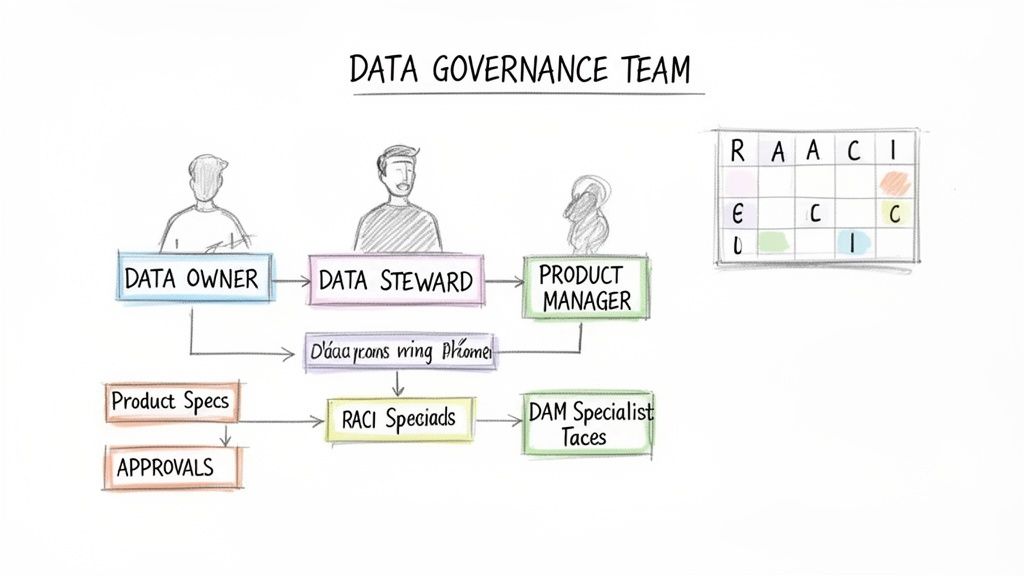
A great data governance strategy is just a document until you get the right people involved. This is where we stop talking about abstract rules and start figuring out who actually does what. It’s time to build your data governance dream team.
The goal here isn't to go on a hiring spree. It's about assigning clear data responsibilities to the experts you already have. When people know exactly what they’re responsible for, accountability just happens. This one move eliminates so much confusion and finger-pointing down the road.
Without clear roles, data governance becomes a game of hot potato. When something breaks, everyone assumes somebody else was supposed to catch it.
For a solid governance strategy in commerce, you really only need to nail down two key roles. The titles might sound corporate, but the jobs are incredibly practical.
I like to use a professional kitchen analogy. The Head Chef (Data Owner) is accountable for the entire menu and the quality of every dish leaving the kitchen. The Chef de Partie (Data Steward) is the station expert responsible for perfecting just the sauces or the pastries. Both are critical.
Assigning these roles is usually more intuitive than it seems. You just have to link them to the business functions your team already owns. The key is to make these responsibilities feel like a natural extension of their current job, not a whole new one.
For a typical retail business, it might look like this:
The Product Manager for the "footwear" category is the perfect Data Owner for all footwear data. They’re already accountable for that category's P&L, so owning its data is a no-brainer.
Then you have the Stewards:
By formally assigning ownership and stewardship, you're not just adding another task to someone's list. You're clarifying a responsibility that was probably already there, just undefined. This clarity is what makes your governance strategy real and actionable.
Okay, you've assigned roles. But how do you prevent people from stepping on each other's toes or letting tasks fall through the cracks? The answer is a RACI matrix.
RACI stands for Responsible, Accountable, Consulted, and Informed. It’s a simple chart that maps out who does what for any given data-related task.
Let’s use the task "Adding a new sunglasses product." Here’s how a simple RACI might break down:
| Task / Role | Product Manager (Owner) | Marketing Specialist (Steward) | DAM Specialist (Steward) | Legal Team |
|---|---|---|---|---|
| Define Core Product Attributes | A | R | I | I |
| Create Marketing Copy | A | R | I | C |
| Upload and Tag Product Images | A | I | R | I |
| Approve Final Product Record | A | C | C | I |
This simple grid makes it crystal clear who needs to do what, and when.
This is where a good PIM comes in. A platform like NanoPIM is built to support this structure right out of the box. You can configure review and approval workflows that perfectly mirror your RACI chart. Every single change, from a price update to a new image, is tracked in a clear audit trail. This makes accountability visible and constantly reinforces the roles you’ve defined. You can see how this works in practice by exploring how to set up effective data governance policies that the system can enforce for you.
Alright, we've covered the high-level frameworks and who does what. Now for the fun part: defining what 'good data' actually looks like in your organization. This is where your governance strategy moves from theory to the real world, turning messy, inconsistent information into your most reliable asset.
Think of it less like a stuffy library and more like the ultimate command center for your product catalog. Without a clear system, it’s chaos. With one, your entire team, and your customers, can find exactly what they need, every single time.
First up, let's cut through the jargon. Metadata and taxonomy are two terms that get thrown around a lot, but they're pretty straightforward.
Clothing > Men's > Shirts > T-Shirts. It’s how you classify and organize everything.A killer metadata model is the absolute backbone of good governance. It ensures every scrap of information has a home and follows a consistent format, which is non-negotiable for both your team and any AI you plan on using.
A well-designed taxonomy isn't just about being tidy. It's about creating a common language for your entire company. When marketing, sales, and logistics all use the same terms, you stamp out the confusion that costs you money.
Think about it: one team tags a product as "sneakers," while another uses "trainers." Seems minor, right? Wrong. That one tiny difference can completely break your website's filtering, frustrate customers, and throw your inventory reporting into disarray. A PIM like NanoPIM is built to enforce this common language from the get-go.
Once you have your structure, you need to decide what’s allowed in. These data quality rules are the specific, non-negotiable standards your information must meet to be considered "good." They’re the bouncers at the door of your data club.
And these rules can't be wishy-washy. They have to be concrete, measurable, and enforceable.
Here are a few real-world examples for any e-commerce business:
size, color, and upper_material. No exceptions.sale_price can never be higher than the msrp. The system should flag this as an error instantly.These aren't just polite suggestions; they are the guardrails that stop bad data from poisoning your entire ecosystem. For anyone managing a product catalog, a solid data quality framework is your first line of defense against utter chaos.
Defining rules is one thing, but enforcing them across thousands of SKUs is another. Manually checking every single record is a recipe for failure. This is where you let the machine do the heavy lifting.
Modern PIM and DAM platforms are designed to automate this enforcement. Instead of paying someone to eyeball a spreadsheet, you build the rules right into the system itself.
Here’s how you can put your governance on autopilot:
When you embed these rules and automations into your daily workflow, data governance stops being a chore and starts being a genuinely helpful partner for your team. This is how you build a clean, structured data model that not only makes you more efficient today but also fuels the AI-powered tools of tomorrow.
Let's be honest. A data governance strategy is just a fancy document until you actually put it to work. This is the exact moment where most initiatives die, crushed under the weight of trying to boil the ocean.
Instead, think of your rollout like a product launch. You start with a small, focused pilot. You get some quick wins on the board, show people what’s possible, and then you scale. A phased approach is the only way to keep governance from becoming a soul-crushing, year-long project with no finish line in sight.
This roadmap breaks the year down into three manageable chunks. It’s all about building momentum, proving value fast, and bringing your team along for the ride without burning them out.
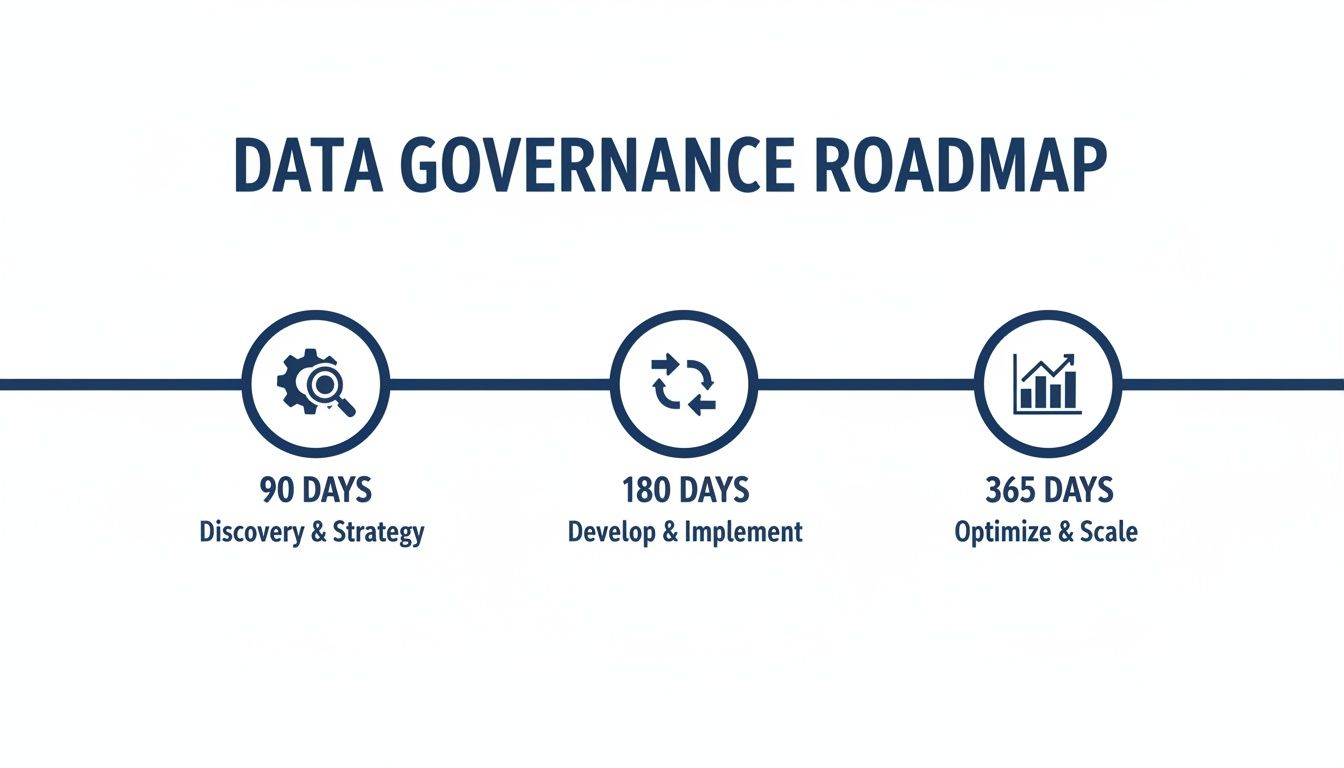
The journey below maps out how you'll move from initial planning and quick wins to a fully scaled, enterprise-wide governance program that’s baked into your company’s DNA.
To give you a clearer picture, here's a sample plan that outlines the key objectives and focus areas for each phase.
This phased roadmap is designed to guide the implementation of your data governance strategy, with key milestones and focus areas for each period.
| Phase | Key Objectives | Primary Focus Areas |
|---|---|---|
| Phase 1 (Days 1-90) | Establish Foundation & Secure Quick Wins | Assemble core team, select a high-impact pilot project, define initial metadata and quality rules for the pilot scope, and demonstrate tangible progress. |
| Phase 2 (Days 91-180) | Expand Scope & Prove Business Value | Onboard new departments, expand the governance framework, start tracking business impact KPIs, and begin using advanced PIM features for data validation. |
| Phase 3 (Days 181-365) | Scale Across the Enterprise & Embed in Culture | Finalize and publish all data policies, conduct organization-wide training, integrate governance into daily operations, and use clean data to power AI and analytics. |
This table provides a high-level blueprint. The real magic, of course, happens in the execution of each phase.
The first three months are all about building a solid foundation and, most importantly, scoring some quick, visible wins. Your goal here isn't to fix everything. It's to prove that this whole governance thing actually works and can solve real, painful problems.
First, assemble your core team. Formally assign the Data Owners and Data Stewards for your pilot. And I mean pilot. Keep it small. Don't even think about defining roles for the entire company yet.
Next, you have to choose that pilot project. This is probably the most critical decision you'll make. Pick a single, high-impact area that everyone knows is a mess. We’ve seen teams get huge traction by focusing on things like:
With your pilot chosen, define the metadata standards and quality rules for that area only. If you picked "footwear," your rule might be as simple as: "All footwear products must have a defined size, color, and upper_material."
The whole point of the first 90 days is to build momentum. A small, successful pilot is the single best weapon you have for winning over leadership and skeptical team members.
This is where a platform like NanoPIM becomes your mission control. You can set up a simple completeness score for your pilot category right on the dashboard. This makes your progress visible in real-time as the team cleans up the data, giving everyone a clear metric to rally behind.
You've got a successful pilot under your belt. Now it’s time to expand. In this phase, you take everything you learned from the first 90 days and start applying it to more of the business. The goal is to prove your initial success wasn't a fluke and that governance delivers real value at a larger scale.
Start by onboarding another department or two. If your pilot was with the product team, maybe now you bring in marketing or logistics. Define their Data Owners and Stewards and use your RACI matrix to make responsibilities crystal clear.
This is also when you have to start measuring the business impact. Track the right metrics to build a rock-solid business case.
Use these numbers to tell a story. Showing a drop in product returns or a faster time-to-market is infinitely more powerful than just talking about "data quality."
With more data coming in from different sources, you can start using more powerful PIM features. The Data Holding Bay in NanoPIM is perfect for this. It lets you import messy supplier data into a safe, sandboxed area where it can be cleaned and validated before it ever touches your live product catalog.
By the end of year one, data governance needs to stop feeling like a special project and start feeling like business as usual. Your focus shifts to scaling across the entire organization and weaving good data practices into the company culture.
This is when you finalize and publish all your data policies, standards, and procedures. Put them somewhere central and make sure everyone knows where to find them. Communication and training are non-negotiable. People can't follow rules they don't know exist.
Your governance work will also start to fuel bigger, more exciting projects. With a foundation of clean, structured, and trustworthy data, you can finally unlock the true promise of AI and advanced analytics.
By day 365, your governance framework shouldn't feel new anymore. It should just be how things are done. It should be the reliable system that supports your entire omnichannel operation, making your teams more efficient and your business more competitive.
Getting started with a data governance strategy can feel like a massive undertaking, and it's natural for a lot of questions to pop up. We’ve been in the trenches with countless teams and have heard them all.
Let's cut through the noise and tackle some of the most common hurdles we see managers and their teams face. Getting these right is half the battle.
Getting leadership to sign off on a data governance project comes down to one thing: speaking their language. Forget abstract concepts like “data purity.” You need to talk about money, risk, and speed.
Frame your pitch around outcomes that hit the bottom line. Talk about:
Don't just ask for a blank check. Present a phased plan with clear, achievable wins. When leaders see a direct path from good governance to better revenue and lower costs, getting the resources you need becomes a much easier conversation.
This is a classic point of confusion, but getting the roles straight is critical. It’s actually pretty simple when you think about it: the Data Owner is accountable, while the Data Steward is responsible.
A Data Owner is a senior-level manager who is ultimately accountable for a specific data domain, like "product data" or "customer data." They don't live in the spreadsheets every day, but they own the final decisions on rules, access, and quality. The buck stops with them.
A Data Steward, on the other hand, is the subject matter expert who is hands-on with the data. They are responsible for the day-to-day work of keeping that information clean, accurate, and compliant with the rules set by the Owner. They’re the guardians at the gate.
Think of it like this: The Owner designs the blueprint for the house. The Steward is the one on-site every day, making sure the foundation is solid and the walls are straight. You can't build a solid house without both.
Not only can you, you absolutely should. Trying to boil the ocean and launch a perfect, company-wide data governance strategy from the start is one of the fastest routes to failure. It’s a classic mistake that leads to burnout and abandoned projects.
The smarter move is to pick a pilot project. Find one specific, high-impact area that's causing real pain. Maybe it's a single product line with a sky-high error rate or a sales channel that's constantly plagued with listing problems.
Use that small-scale project to prove the concept. You’ll learn what actually works within your company’s culture, refine your process, and build momentum. A small, quick win is the most powerful tool you have for earning the trust and support needed for a bigger rollout.
Of course, a big part of any governance strategy is ensuring your policies are practical. This means digging into things like your data privacy policies to confirm they clearly spell out how customer information is managed and protected. Applying your rules in the real world like this is what builds trust, both inside your team and with your customers.
Ready to stop fighting with messy product data and start building a real asset? NanoPIM gives you the tools to automate your data governance strategy, enforce quality rules, and get your entire catalog ready for AI-powered commerce. See how we can help at https://nanopim.com.


