

A PIM, or Product Information Management system, is the single source of truth for all your product data. It’s a dedicated platform designed to pull all your scattered product information, from spreadsheets and documents to images and videos, into one clean, organized, and reliable hub.
Think about how most businesses manage product information without a PIM. It’s usually a mess. Technical specs are buried in a supplier’s spreadsheet, marketing descriptions are floating around in a dozen Google Docs, and the latest product photos are lost somewhere on a shared drive. Launching a new product or updating a listing feels like a chaotic scavenger hunt.
This is exactly the problem a PIM system is built to solve.
A PIM acts as the central command center for your entire product catalog. It's not just another database; it’s a smart system that gathers, enriches, and governs every piece of product-related content.

From SKUs and pricing to compelling marketing stories and high-resolution images, the PIM ensures every detail is accurate, complete, and consistent across your entire business.
Before a PIM, the difference between a smooth operation and a costly error is often just one outdated spreadsheet. It's a daily struggle that many e-commerce and marketing teams know all too well.
| Aspect | Before PIM (Manual Chaos) | After PIM (Centralized Control) |
|---|---|---|
| Data Storage | Scattered across spreadsheets, emails, and shared drives. | A single, unified platform for all product information. |
| Accuracy | Inconsistent and prone to human error. Different teams use different data. | A reliable "single source of truth." Everyone has access to the same data. |
| Updating Info | A manual, repetitive, and slow process. High risk of mistakes. | Updates are made once and automatically synced everywhere. |
| Teamwork | Teams work in silos, leading to miscommunication and confusion. | Collaboration is seamless. All teams work from the same playbook. |
| Customer Experience | Inconsistent product details across channels frustrate buyers. | A consistent, trustworthy, and professional brand experience. |
| Time to Market | Launching new products is slow and bottlenecked by data collection. | Drastically faster product launches and updates. |
The contrast is stark. A PIM doesn’t just organize data; it fundamentally changes how your teams work, removing the friction that slows down growth and creates bad customer experiences.
Without a centralized system, it’s easy for the marketing team to use an old product photo while the e-commerce team lists an incorrect price. These small mistakes erode customer trust and make your brand look unprofessional.
A PIM system solves this by creating a single, authoritative record for each product. When you update information in the PIM, it automatically pushes those changes to all your connected sales channels.
This guarantees your customers see the right information, whether they’re browsing your website, a marketplace like Amazon, or your mobile app.
This critical need for data consistency is why the global PIM market is exploding. It's projected to grow from $22.36 billion in 2026 to an incredible $47.54 billion by 2030. More and more businesses are realizing that organized data isn't a luxury, it's essential for survival. You can learn more about the key drivers behind these PIM market trends.
A PIM helps you manage four core types of product information:
By bringing everything together, a PIM finally gives you true control over your product information, making your entire operation more agile and scalable.
So, what’s actually inside a PIM? Let's pop the hood and look at the engine without getting lost in technical jargon. Think of a PIM platform as a specialized workshop where every tool has a precise job, all working together to build perfect product information.
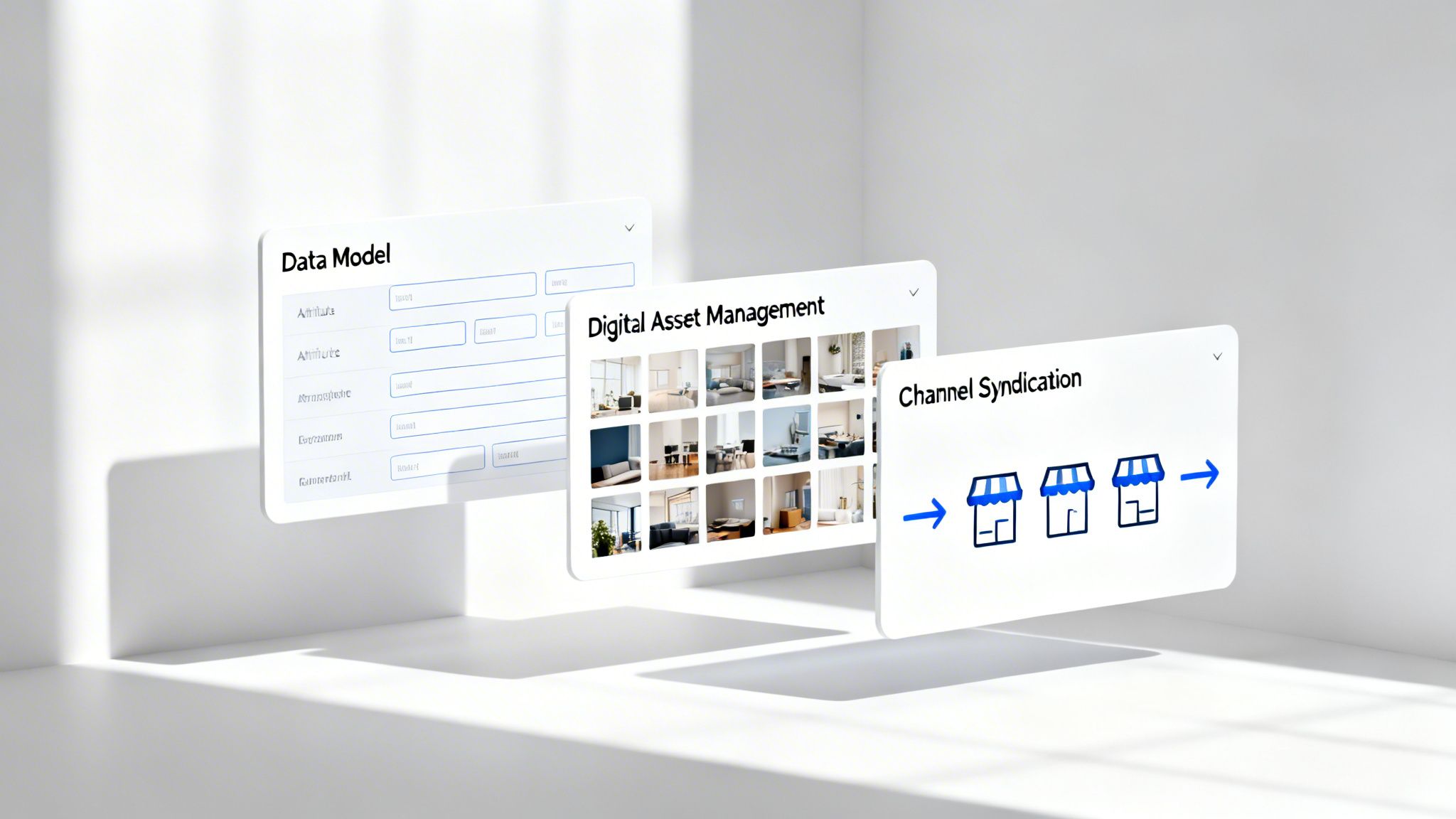
These are the core components that turn messy, scattered data into a serious business asset. Once you get how they work, you’ll see exactly how a PIM solves real-world ecommerce problems.
First up is data modeling. This might sound complex, but it’s really about creating a non-negotiable blueprint for your products. It’s how you define what information every single product must have, making sure nothing ever gets missed.
For example, you can set a rule that every shirt requires a size, color, and material. This simple rule means your team can't accidentally publish a new t-shirt listing without specifying whether it's cotton or polyester. Data modeling is what forces your product catalog to be logical and complete.
Next is Digital Asset Management, or DAM. This is the PIM’s secure, central library for all your media files. It’s home to everything from product photos and promo videos to instruction manuals and size charts.
A built-in DAM links these files directly to the right products. This connection is critical because it ensures that when you update a product’s main image, that change happens everywhere at once. No more outdated visuals slipping through the cracks and reaching your customers.
This feature is a godsend for marketing teams. It puts an end to the frantic searches for the latest high-res image or wondering which video is approved for the new campaign. You can learn more about how to streamline media organization with DAM in our dedicated guide.
A PIM isn't just a database; it’s a workspace. Workflow tools let you build an approval process directly into the system. You can create a clear, step-by-step assembly line where new product info moves from a copywriter to an editor and then to a manager for the final sign-off before going live.
This completely eliminates those endless email chains and gives everyone a transparent view of where each product is in the enrichment pipeline. Everyone knows what their task is, and managers can spot bottlenecks instantly.
Finally, we have channel syndication. This is, without a doubt, one of the most powerful features in any PIM. Once your product information is complete and perfect, syndication automatically pushes it out to all your sales channels.
This automation doesn't just save hundreds of hours; it guarantees absolute consistency across your entire brand. It’s the final step that takes your single source of truth and shares it, perfectly tailored, with the world.
It’s one thing to understand what a PIM is, but it’s another thing entirely to see what it can do for your bottom line. A Product Information Management system isn't just a fancy digital filing cabinet. Think of it as a growth engine that directly connects clean, organized information to real-world business results like faster launches and healthier sales figures.
By creating a single source of truth for all your product information, a PIM slashes your time-to-market. Instead of your team wasting weeks hunting down the right specs, approved images, or marketing copy, everything is ready to go in one place.
This means you can roll out a new product line across your website, Amazon store, and social channels in days, not months. That speed is a massive advantage. In fact, some businesses have cut their time-to-market by as much as 50% by automating their data validation and distribution. You can see more on the market dynamics behind this trend here.
Consistent, detailed, and accurate product information builds trust. It’s that simple. When a potential customer sees the same correct specs, rich descriptions, and high-quality images on every channel, their confidence to click "buy" skyrockets.
A PIM makes this possible by ensuring the product story you tell is the same everywhere. This consistency directly lifts conversion rates and, just as importantly, cuts down on returns from customers who received something different than what they expected.
Imagine a customer buying a new sofa. They need to know the exact dimensions to make sure it fits. With a PIM, you guarantee the measurements on your website, the spec sheet, and the printed catalog are all identical, preventing a costly and frustrating return.
Beyond the customer-facing benefits, a PIM delivers huge wins for your internal operations. It automates the soul-crushing, repetitive tasks that eat up your team's most valuable asset: their time. Instead of manually copying and pasting data across endless spreadsheets, your people can finally focus on what they do best.
This shift from manual data wrangling to high-impact, strategic work is where the real ROI comes from. It doesn’t just make your teams more productive; it boosts morale by letting talented people do meaningful work. To get a better handle on this, check out our guide on building a solid data management strategy.
Ultimately, a PIM stops your business from bleeding money through errors and inefficiency, freeing up those resources to actually grow.
When you start looking into how to manage product information, you'll quickly find yourself swimming in a sea of acronyms. PIM, ERP, DAM, they all sound related, but they each have very different and specific jobs. It can get confusing, fast.
Let's clear things up with a simple analogy: a restaurant kitchen.
Think of your Enterprise Resource Planning (ERP) platform as the kitchen’s operations manager. It’s all business. It handles the core financial and operational data like inventory levels, supplier invoices, costs, and order numbers. Common ERP systems know you have 500 tomatoes in stock and that they cost $0.20 each, but they have no idea how to make them sound delicious on the menu.
Next, you have the Digital Asset Management (DAM) system. This is your restaurant’s dedicated food photographer. The DAM is where you store, organize, and manage all the beautiful, high-quality digital files, like photos of your signature dishes, promo videos, and brand logos. It holds the stunning visuals but doesn’t know anything about the recipe itself.
So, where does a PIM fit in? The Product Information Management system is the master chef.
The PIM takes the raw ingredients (basic product data like cost and SKU from the ERP) and the stunning visuals (the photos and videos from the DAM). The chef then enriches this information, adds compelling descriptions, and crafts the perfect, complete "dish," your final, customer-ready product listing.
The PIM is the creative and organizational force that turns raw data and files into an appealing product story that actually makes customers want to buy. You can read more about the principles that make this work by exploring our guide to master data governance.
This table breaks down the unique roles of each system, showing how they serve different needs and different teams within your organization.
| System | Primary Function | Typical Data Managed | Main Beneficiary |
|---|---|---|---|
| PIM | Enriches and syndicates marketing and sales information for products. | Product descriptions, specs, digital assets, marketing copy, and channel-specific content. | Marketing & E-commerce |
| ERP | Manages core business operations and transactional data. | Financials, inventory counts, supply chain logistics, orders, and human resources. | Operations & Finance |
| DAM | Stores and organizes all creative media files. | High-resolution images, videos, audio files, design documents, and brand logos. | Creative & Marketing |
Each system is a specialist, and they work best when they work together. Trying to make an ERP manage your marketing copy is like asking your accountant to write a menu. It’s just not what they’re built for.
This visual shows how getting your product data right leads directly to tangible business growth.
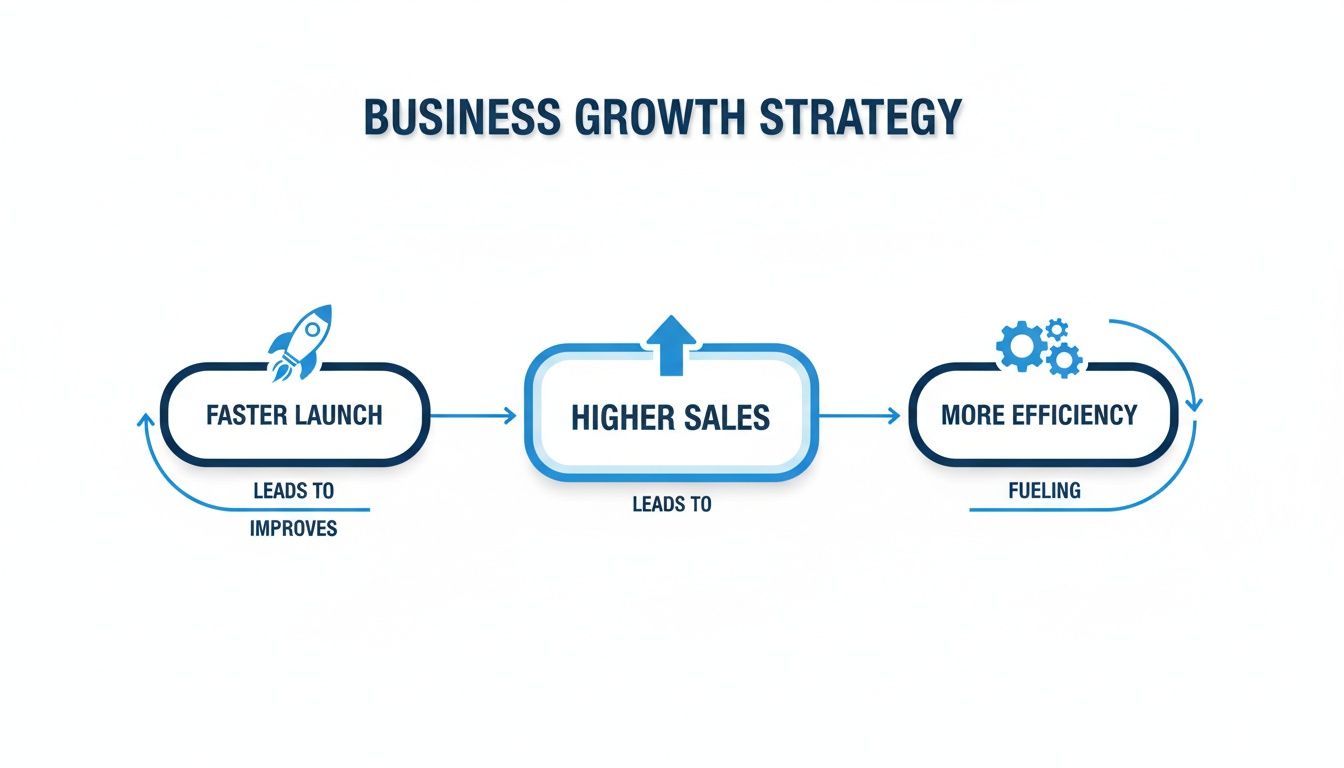
As you can see, launching products faster creates a powerful ripple effect, leading directly to higher sales and better operational efficiency.
Ultimately, a PIM doesn’t replace your ERP or DAM. It makes them better. It takes their raw inputs and transforms them into the rich, consistent, and compelling product experiences that actually drive growth.
So, you're ready to pick a PIM. This is a big decision, one that will define your e-commerce operations for years. Don't get distracted by flashy features. The goal is to find a system that truly fits your business size, technical reality, and where you're headed next.
Before you even book a single demo, you need a crystal-clear picture of your own needs. How many products are you managing now? What about in two years? Are you selling on two channels today but planning for ten tomorrow?
Answering these questions first will help you immediately cut through the noise and disqualify solutions that were never going to be the right fit anyway.
The single most important question you should ask is about scalability. The PIM you choose today has to be able to keep up with you tomorrow. Put simply: can this platform handle your catalog growing from 1,000 to 100,000 SKUs without grinding to a halt?
A truly scalable PIM grows with you. It gracefully handles massive spikes in data volume and user traffic without requiring a complete, and costly, overhaul. This is non-negotiable for any business with seasonal demand or an aggressive growth strategy.
When you're looking at different options, lean toward cloud-native solutions. They are built for scalability, automatically adjusting resources to meet demand. This means you only pay for what you actually use and avoid the nightmare of being stuck with a system you've already outgrown.
Your PIM won't be an island. It has to talk to all the other tools that run your business, and it needs to do so flawlessly. Strong integration capabilities are absolutely essential.
During your demos, drill down on this. Find out if the PIM has pre-built connectors for the platforms you already rely on.
A PIM with a powerful API and a healthy ecosystem of connectors will save you thousands in custom development fees and countless hours of frustration.
Finally, you have to think about usability. A PIM can have all the power in the world, but if your team hates using it, it's worthless. The interface needs to be intuitive enough for your non-technical folks, like marketers and content writers, to manage products without needing to file a support ticket.
Pay close attention to the user experience during those demos. How easy is it to find a product? To edit an attribute? To see who's working on what?
If the system feels clunky or confusing, your team won't adopt it. And if they don't adopt it, you'll never see the return on your investment. It's as simple as that.
Alright, let's get into the questions most people have once they start wrapping their head around what a PIM really is. This is where the rubber meets the road, moving from the "what" to the "how" and "why" for your specific business.
We’ll cut through the noise and give you straight answers on how a PIM works in the real world, who it's actually for, and why it’s become such a non-negotiable tool for modern commerce.
This is always the big question, and the only honest answer is: it depends. The timeline for getting a PIM up and running really hinges on your company's size, how complex your product catalog is, and, most importantly, how clean your data is right now.
As a general rule of thumb:
The single biggest factor is almost always the state of your existing data. If your product info is already well-organized, migration is a breeze. But if it’s a chaotic mess scattered across dozens of old spreadsheets, a good chunk of the project will be dedicated to data cleanup before you can even think about moving it into the PIM. Modern, cloud-based PIMs are also typically much faster to deploy than clunky, on-premise solutions of the past.
Yes, absolutely. PIM systems aren't just for massive corporations with bottomless budgets anymore. In fact, for a business that’s trying to grow, a PIM can be one of the best investments you make in scaling efficiently.
If you sell on more than one channel, even if it's just your own website and a single marketplace like Amazon or eBay, a PIM is a total lifesaver. It takes the soul-crushing, error-prone job of manually updating product details in multiple places completely off your plate. For a small team where everyone is already wearing ten different hats, that time savings is massive.
A PIM frees up your team to focus on what actually grows the business, like marketing, talking to customers, and developing new products, instead of getting lost in a swamp of repetitive data entry. It builds a solid foundation for growth, so you can add more products and sales channels without your operations imploding.
Artificial intelligence is what's making today's PIM systems so much smarter and more proactive. AI isn't some futuristic idea anymore; it's a practical feature that’s automating and elevating content creation in very tangible ways.
Here’s what AI is doing inside modern PIMs right now:
Basically, AI is transforming the PIM from a passive database into an active, intelligent partner that helps you create better content, faster.
A PIM is an absolute powerhouse for SEO, and it works its magic in a few different ways. Search engines like Google love businesses that provide consistent, structured, and deep information, and a PIM is engineered to deliver exactly that.
First, just by making sure your product data is uniform across every channel you sell on, you build authority and trust with search engines. Consistency is a huge signal of reliability.
Even more importantly, a PIM is what allows you to manage and optimize for the rich, specific details that help you rank for long-tail keywords. These are the longer, more descriptive search phrases that customers who are ready to buy actually use. For instance, instead of trying to compete for a generic term like "jacket," a PIM makes it easy to add and manage all the attributes you need to rank for something like "men's waterproof breathable shell jacket for hiking."
By centralizing this deep well of information, a PIM directly fuels a much more sophisticated and effective SEO strategy, helping the right customers find your products with ease.
Ready to stop juggling spreadsheets and start building a single source of truth for your products? NanoPIM uses the power of AI to not only centralize your product data but to enrich and optimize it for every channel. See how you can accelerate your e-commerce growth by visiting https://nanopim.com.


