

Imagine your business is trying to assemble a puzzle, but every piece comes from a different box with a slightly different picture on the cover. It’s a recipe for chaos. This is what happens when your critical business data is scattered across different systems, each telling a slightly different story. A master data management (MDM) solution is what brings all those pieces together to show you the one, true picture.
Think about your core business information. Customer details live in your CRM, product specs are in the ERP, and supplier information is tucked away in your procurement software. More often than not, this data is a mess.
A customer’s name might be misspelled in one system, their address is outdated in another, and a product’s dimensions don’t match between your warehouse records and your e-commerce site. These aren't minor typos. They lead to real-world problems like shipping errors, frustrated customers, and decisions based on faulty information.
An MDM solution doesn't try to replace all your existing systems. Instead, it sits on top of them, acting as the ultimate authority. Its job is to identify, clean, and consolidate all that conflicting data into a single, reliable version.
This definitive version is what we call the "golden record." It’s the one version of the truth that everyone in the company can trust.
Before we go deeper, let's quickly break down the core ideas behind MDM. These concepts are the building blocks for creating that single source of truth.
| Concept | Simple Explanation | Why It Matters |
|---|---|---|
| Master Data | The most critical, shared data in your business (e.g., customers, products, suppliers). | This is the high-value data that, if incorrect, causes the biggest problems. |
| Data Domain | A category of master data, like "Customer" or "Product." | Grouping data into domains helps organize the cleanup and governance process. |
| Golden Record | The single, authoritative version of a data entry created by the MDM. | This is the "one true record" that eliminates confusion and ensures consistency. |
| Data Stewardship | The people and processes responsible for maintaining data quality. | Technology alone isn't enough. You need human oversight to manage and protect data integrity. |
With these concepts in mind, the true purpose of MDM becomes much clearer. It’s not just a piece of software. It's a discipline for managing your most important information assets.
At its heart, an MDM solution is built to establish and defend this golden record across all your essential business data, including:
By getting this core information right, you build a solid data foundation that every department and application can rely on. This is especially vital for businesses juggling complex product catalogs, a topic we explore further in our guide on what a PIM system is.
An MDM solution turns data chaos into a powerful business asset. It’s not just about cleaning up data. It's about creating the reliable foundation needed for better decisions, operational efficiency, and scalable growth.
This need for data control is exploding. The global master data management market is projected to climb to USD 72.77 billion by 2034, growing at a compound annual rate of 16.30%. According to a market analysis from Fortune Business Insights, this surge is fueled by the immense pressure on businesses, especially in retail and e-commerce, to manage product information perfectly across demanding channels like Amazon and Google.
Think of a Master Data Management (MDM) solution as the ultimate organizer for your company's most important information. It steps into the chaos of raw, mismatched data from dozens of systems and turns it into a single, trusted asset everyone can rely on. This is how you get your marketing, sales, and supply chain teams all singing from the same hymn sheet.
The process kicks off with ingestion. The MDM platform connects to your various business applications, your CRM, ERP, and e-commerce platforms, and pulls in all their master data. From there, the real work begins: cleansing and standardizing that information to create one unified, reliable view.
The system methodically parses addresses into a consistent format, corrects misspelled customer names, and fills in missing product details. This cleanup is the foundational step toward building a trustworthy "golden record" for each entity.
This diagram perfectly captures the journey from data chaos to a single source of truth.
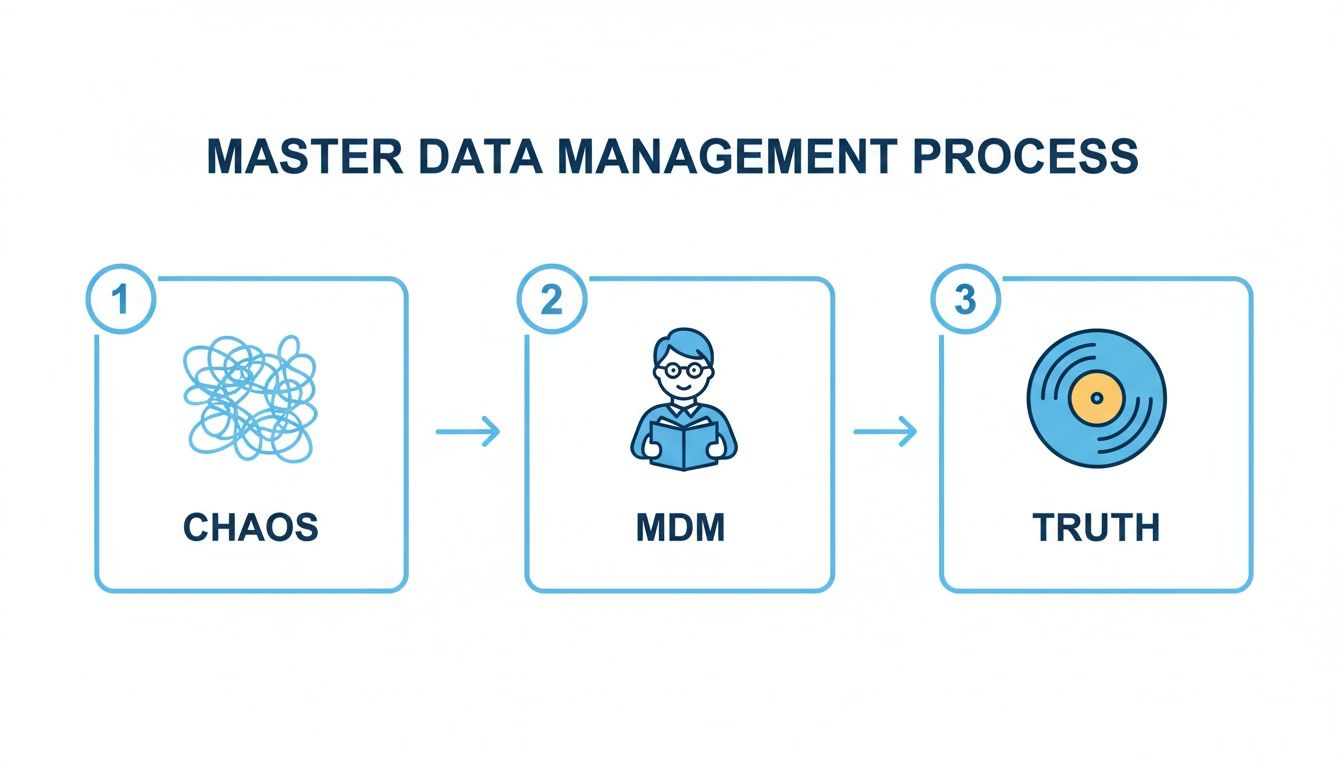
It shows how an MDM solution acts as that central, expert organizer, bringing order and dependability to your entire business's data landscape.
Once the data is clean, the next job is matching. Using smart algorithms, the MDM system identifies records across different systems that all point to the same person, product, or place. For example, it can figure out that "Jon Smith," "Jonathan P. Smith," and "J. Smith" are all the same customer.
After spotting these duplicates, the system merges them into a single golden record. It intelligently cherry-picks the best information from each source to build the most complete and accurate profile. Maybe one system has the right phone number, while another has the most recent shipping address. The MDM platform combines them into one master file.
Ultimately, a core function of modern MDM is to provide the strategies and tools for how to improve data quality across the board. This isn't a one-and-done cleanup. It’s a continuous cycle of improvement.
An MDM solution isn't just about matching records. It's about building a living, breathing asset that becomes more accurate and valuable over time through constant refinement and governance.
Great data doesn't happen by accident. It requires clear rules and ownership. A master data management solution gives you the framework to establish strong data governance. This means defining clear policies for how data is created, approved, and maintained.
For instance, you can build workflows that require new product data to be reviewed by both the product and marketing teams before it goes live. These guardrails are essential for preventing bad data from contaminating your systems in the first place. We dive deeper into this in our guide to master data governance.
This process typically includes:
Today, artificial intelligence is making these processes smarter and faster than ever. AI-powered MDM platforms can automate many of the tedious tasks involved in data cleansing and matching. Better yet, they learn from your data to improve their accuracy over time, spotting complex patterns that simple rule-based systems would miss.
This AI infusion is especially critical for managing customer and operational data. In fact, customer data is expected to capture 37.6% of the MDM market share in 2025, while operational MDM is projected to lead with a 48.6% share. These numbers show just how vital real-time data sync is for creating personalized experiences and running efficient operations.
Making any big tech investment is a major decision. When it comes to a master data management solution, you need to know it will deliver real, measurable value. So, let's move past the technical jargon and focus on what really matters to your bottom line: the tangible benefits and a strong return on investment.
At its heart, an MDM solution is about one thing: replacing chaos with clarity. That clarity then ripples through your entire organization, touching everything from how you operate day-to-day to how your customers feel about you. It's about building a healthier, more profitable business from the data up.
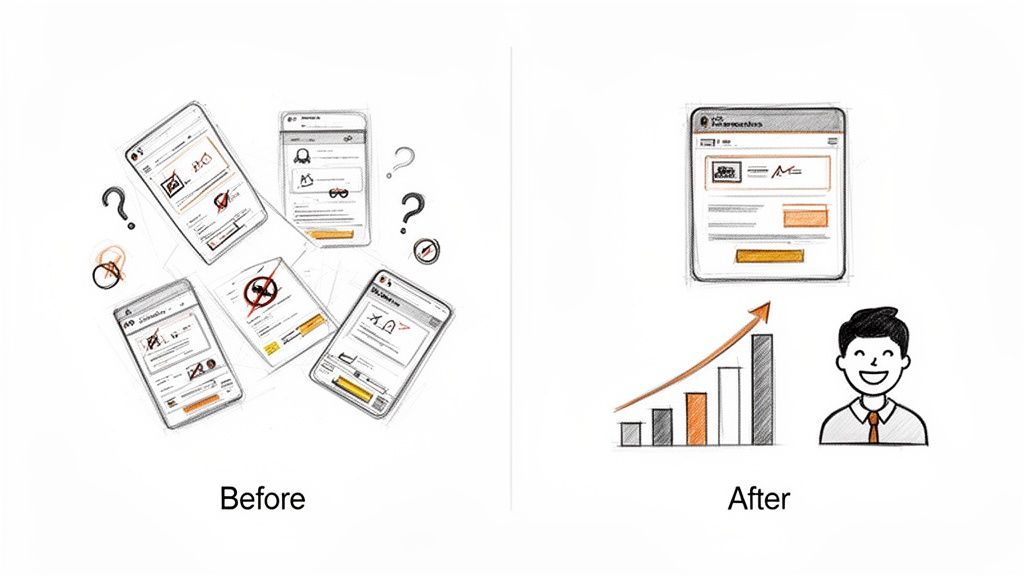
This simple visual nails the goal perfectly. It’s all about turning messy, confusing processes into streamlined growth and happy customers. An MDM solution is the engine that drives this change by ensuring everyone is working from the same reliable information.
Just think about all the time your teams waste hunting down the right information or fixing errors that stem from bad data. A sales rep using an old price list, a warehouse team shipping to the wrong address, or a marketing team targeting customers who’ve already opted out. These little mistakes add up to huge costs and wasted effort.
An MDM solution tackles this problem head-on by creating a single source of truth.
The less time your team spends fighting with data, the more time they can spend driving growth. An MDM solution directly translates into more productive hours every single day.
This efficiency boost isn’t just about people. It extends to your entire tech stack. A solid master data management solution provides the clean, reliable data needed for consistency across all your systems, even helping with understanding the core differences between ERP and CRM.
In today's market, customer experience is everything. Shoppers expect consistent, accurate information whether they're on your website, a mobile app, or a third-party marketplace. An MDM solution is the backbone that makes that consistent experience possible.
When your product data is unified, customers get the right information every single time. We're talking accurate product descriptions, correct pricing, and up-to-date availability across all your channels. The result?
For manufacturers, the benefits of a single source of truth are especially powerful. Trying to manage product specifications, supplier details, and parts information across complex supply chains is a monumental challenge. MDM is what brings order to that complexity.
For instance, in manufacturing, implementing an MDM can slash part redundancy by a massive 37% during ERP migrations. This not only accelerates technology adoption but also provides a substantial ROI through reduced risk and direct revenue gains. With analysts predicting 50% of purchases could be AI-initiated by 2028, having this clean data foundation becomes a critical competitive advantage.
By establishing a "golden record" for every component, material, and finished good, a master data management solution helps you:
With dozens of vendors all claiming their platform is the best, picking the right master data management solution can feel paralyzing. This isn't just about buying software. It's about choosing a partner that will underpin your company's data strategy for years to come.
Getting this choice right from the start saves you from a world of expensive headaches down the road. Let's walk through how to cut through the noise and find a platform that actually fits your business.
Before you look at a single demo or feature list, you have to get brutally honest about what you're trying to fix. It's easy to get mesmerized by impressive-looking dashboards, but features don't solve problems. Strategy does.
What's actually broken? Are you dealing with inconsistent product information between your Shopify store and your NetSuite ERP? Are customer support tickets piling up because of shipping errors caused by bad address data?
Pinpoint your most pressing pain points first. This gives you a lens to see every potential vendor through.
For most retail and e-commerce brands, "Product" and "Customer" data domains are the low-hanging fruit. For a manufacturer, "Supplier" and "Part" data might be just as critical. A solid MDM solution can handle many domains, but focusing on your most urgent need will help you get a quick win and prove the project's value early.
Once you know the why, you can dig into the how. Your MDM platform is going to be the central nervous system for your most important data. It absolutely has to play nice with your existing tech and be ready for what's next.
Here are the non-negotiables to look for:
Integration Horsepower: How easily can the solution talk to your other core systems like your ERP, PIM, CRM, and e-commerce platform? Look for a library of pre-built connectors and a well-documented API. A powerful API is your get-out-of-jail-free card for any custom connections you'll inevitably need.
Scalability: The platform needs to handle your data today and five years from now. Ask vendors directly about their architecture. Can it support more data domains, an influx of new users, and millions more records without grinding to a halt?
Deployment and Implementation Style: Do you want a cloud-native SaaS solution that gets you up and running faster, or does your business require a traditional on-premise installation? Also, think about the implementation model. Are you just looking for a consolidation hub for better reporting, or do you need a more advanced transactional model that can write corrected data back to your source systems?
A platform's technical fit is a hard-pass or a no-pass issue. If it can't integrate with your core systems or scale with your business, it will create more problems than it solves, no matter how slick the user interface is.
The most powerful technology is worthless if your team finds it impossible to use. User adoption can make or break an MDM project, so you have to evaluate the human side of the equation.
A clean, intuitive user interface is essential. Your product managers, data analysts, and marketers are the ones who will live in this system. They need to manage data, approve changes, and pull reports without needing a computer science degree.
Then there's the total cost of ownership (TCO). This is so much more than the sticker price. You need a transparent breakdown of all costs: implementation services, user training, ongoing support, and any hidden fees for adding more users or data records.
Finally, vet the vendor's customer support and partnership philosophy. Do they offer real training and a dedicated success team? A vendor who acts like a true partner is just as valuable as the software itself.
Choosing an MDM platform is a major decision. This checklist is designed to give you a structured way to compare vendors and ensure you're asking the right questions based on your specific business needs.
| Evaluation Criteria | What to Look For | Why It's Important |
|---|---|---|
| Data Domain Support | Flexibility to manage multiple domains (Product, Customer, Supplier, etc.). | Your needs will evolve. A multi-domain platform prevents you from being locked into a single-purpose tool. |
| Integration Capabilities | Pre-built connectors for your key systems (ERP, CRM, PIM) and a robust, well-documented API. | Seamless data flow is the entire point. Poor integration creates data silos and manual work, defeating the purpose of MDM. |
| Data Governance & Quality | Tools for defining business rules, data validation, deduplication, and enrichment. | An MDM isn't just a database. Its real value comes from actively cleaning, standardizing, and governing your data. |
| User Interface (UI/UX) | An intuitive, role-based dashboard that is easy for non-technical business users to navigate. | If your team can't use the tool efficiently, user adoption will fail, and the project won't deliver its promised ROI. |
| Scalability & Performance | Cloud-native architecture, ability to handle millions of records, and proven performance under load. | Your data volume will only grow. The platform must be able to scale without performance degradation. |
| Deployment Model | Options for cloud (SaaS), on-premise, or hybrid, depending on your security and IT requirements. | The right deployment model ensures the solution fits your existing infrastructure and compliance needs. |
| Total Cost of Ownership (TCO) | Transparent pricing covering licenses, implementation, support, training, and future scaling. | Avoid surprise costs. A clear TCO helps you build a realistic business case and budget accurately. |
| Vendor Support & Partnership | A dedicated customer success team, comprehensive training resources, and a clear product roadmap. | You're not just buying software, you're entering a long-term partnership. A supportive vendor is critical for success. |
Use this checklist as a starting point during your demos and discovery calls. It will help you move beyond the sales pitch and get to the core of whether a solution truly aligns with your long-term vision.
Picking the right MDM tool is one thing. Actually making it work is another challenge entirely. A successful MDM project lives or dies by its implementation plan. This is where your investment turns into a real, tangible asset.
Without a solid roadmap, an MDM project is like building a house without a blueprint. You might end up with something, but it won't be stable, and it certainly won't be what you envisioned. This is the blueprint you need.
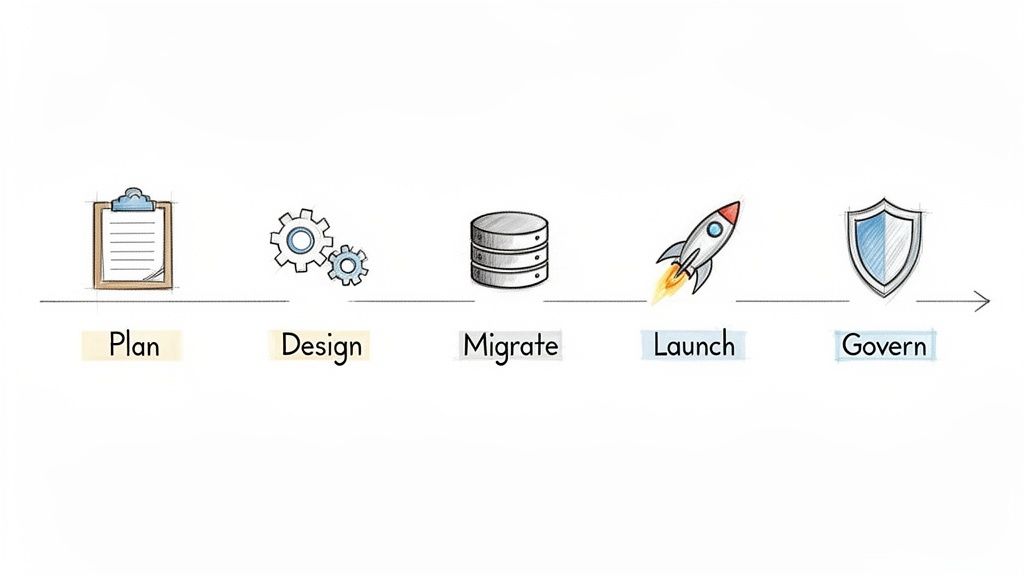
This isn’t a sprint. Each phase builds on the last, and trying to rush through one step will create massive headaches later. Trust the process.
The biggest mistake people make? Trying to boil the ocean. They want to fix all their data at once and end up with a project that stalls out from its own weight.
The smart move is to start with a single data domain. Pick the one that’s causing the most pain, for most ecommerce businesses, that’s almost always Product or Customer data, and get a quick win. This proves the value and builds momentum.
Here’s your checklist for this phase:
Now that you have a plan, it's time to architect the hub itself. You're translating business rules into technical specs inside your MDM platform. This is the framing, electrical, and plumbing of your data house.
The core of this phase is building the data model. This is the blueprint for your "golden record." For a product, that means defining every single attribute: SKU, name, description, dimensions, price, and so on.
You’ll also set up your workflows and governance rules. These are the automated checks and balances that keep your data clean. For instance, you could build a rule that says any new product requires sign-off from both product and marketing teams before it goes live.
The design phase is where you build the guardrails for your data quality. A strong data model and bulletproof governance rules are what will stop your clean data from getting messy all over again.
This is where the heavy lifting happens. You're pulling data out of all those old, messy systems, scrubbing it clean, and loading it into your shiny new MDM. This is a critical, and often grueling, process that creates your first set of master records.
The process has four main steps:
After all that work and some serious testing, it's time to flip the switch. Going live means pointing your other systems and training your users to treat the MDM hub as the one and only source of truth.
But you're not done. Far from it. The real value of an MDM comes from long-term maintenance and governance.
Your data governance team, a group of data stewards from across the business, takes over from here. Their job is to manage new records, fix quality issues as they arise, and evolve the system as the business grows. This constant oversight is what ensures your master data management solution continues to deliver value for years, not just months.
Whenever businesses start looking into master data management, the same handful of questions always pop up. It’s a big topic, so that’s completely normal. Let's tackle some of the most common ones head-on.
This is a great question, and the answer is all about scope. Think of a PIM as a specialist for product data and a CRM as a specialist for customer data. The master data management (MDM) platform is the general manager overseeing all the specialists.
While a PIM is busy enriching product descriptions for marketing, the MDM is working in the background to make sure the product's core identity, its unique ID, its cost, its supplier code, is the exact same in the PIM, the ERP, and everywhere else. MDM creates that one, definitive "golden record" that every other system can trust, stopping data conflicts before they even start.
Honestly, it varies. Anyone who gives you a single number is probably oversimplifying things. In our experience, a smaller, focused project, say, for just the "customer" data domain, can be up and running in 3 to 6 months.
For a full-blown, enterprise-wide implementation covering product, customer, supplier, and location data, you could be looking at a year or more. The smart approach is to start small. Pick one area, prove the value quickly, and then expand from there. Modern cloud solutions with pre-built templates can really speed things up, too.
Not anymore. That used to be the case when MDM was a massive, on-premise undertaking. But today's cloud-based platforms have made it accessible and affordable for small and medium-sized businesses.
For a growing ecommerce brand or a mid-sized manufacturer, getting an MDM in place early is one of the smartest strategic moves you can make. It builds a solid data foundation that prevents the data chaos that almost always comes with rapid growth. You're not just buying software. You're setting your business up for scalable, long-term success.
Ready to build a single source of truth for your product data? See how NanoPIM centralizes, enriches, and optimizes your product information with the power of AI. Learn more at NanoPIM.


