

It's easy to get lost in the jargon, but the core difference between omnichannel and multichannel is actually pretty simple. Multichannel means your brand is available in many different places, but those places do not talk to each other. Omnichannel means they all work together, creating one seamless experience for the customer.
The real question is not about how many channels you have, but how connected they feel to the person using them.
When we talk about omnichannel vs multichannel, we are really talking about two fundamentally different ways of looking at your business. At its core, the debate is about a single, critical question: how do you engage with your customers? The terms simply describe the philosophies behind managing every touchpoint where a customer meets your brand, whether that is on your website, in a brick-and-mortar store, or through a targeted social media ad.
A multichannel strategy is company-centric. It is all about casting a wide net and making your products available wherever customers might be. You might have a great website, a functional mobile app, and a beautiful retail store, but each one operates in its own silo. They do not share data, and the experience on one channel does not carry over to the next.
An omnichannel approach, on the other hand, is entirely customer-centric. It puts the customer at the absolute center of the strategy, ensuring that every single interaction, regardless of the channel, feels like part of one continuous conversation. This is the unified experience modern shoppers do not just want; they expect it.
To really get this, you have to look at the broader retail picture. Deep dives into online shopping vs in-store statistics show a clear and undeniable pattern. Customers no longer see a hard line between browsing on their phone and walking into a store. They see it all as just "shopping," and they expect it all to work together. This shift in expectation is precisely what is driving the move toward omnichannel thinking.
Before we dive into the deeper strategic implications, it helps to have a quick reference. The table below breaks down the fundamental differences between these two approaches across the most critical dimensions of your business.
Think of this table as your starting point. As we move forward, we will unpack what these differences mean for your operations, your technology stack, and your bottom line.
Once you get past the textbook definitions, you see how wildly different omnichannel and multichannel approaches really are in the wild. The split is not just about the tech you use; it is a fundamental difference in strategy and perspective. One is built around the company’s channels, and the other is built around the customer’s reality.
This single distinction creates two completely separate experiences for anyone who interacts with your brand. Nailing down this contrast is the first step in deciding which path makes sense for your business.
A multichannel strategy is really all about distribution. The primary objective is to make your products available across multiple platforms, your website, an Amazon store, physical retail, you name it. The problem is, each channel often operates like its own little kingdom with its own P&L and goals, which almost always leads to a disconnected customer experience.
Think about it: the e-commerce team is judged on website sales, while the retail team is laser-focused on in-store revenue. This setup inevitably creates conflicts. An online-only discount code will not work in the store, and that just leads to a frustrated customer at the checkout counter. The business is organized around its own internal structure, not the way a real person shops.
An omnichannel strategy flips this on its head.
The entire business realigns itself around a single, unified view of the customer. Success is not measured by how one channel performs, but by the customer's total journey and lifetime value. Every team and every channel works together to support one continuous conversation.
This means the experience is seamless. A customer might browse a product on your mobile app, add it to their cart later on a desktop, and then head to a physical store to see it in person. With an omnichannel setup, the in-store staff would already know what that customer was looking at online, allowing them to provide genuinely helpful, personalized service.
This infographic breaks down exactly how the two strategies structure their focus.
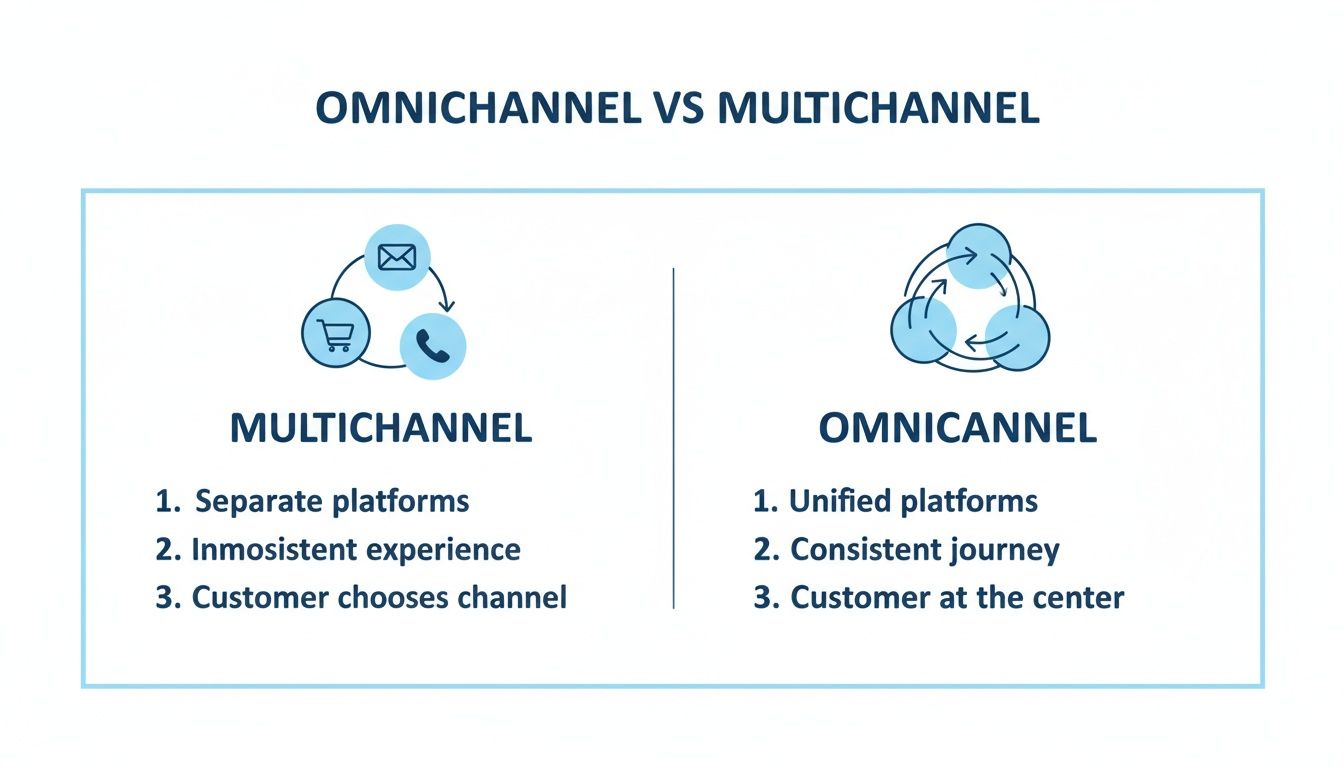
As you can see, multichannel just offers more disconnected roads. Omnichannel weaves them all into an interconnected web with the customer sitting right in the middle.
How a business handles its data is the biggest technical and operational hurdle in the omnichannel vs. multichannel debate. It is the engine that makes one strategy feel seamless and the other feel broken.
In a multichannel world, data is trapped in silos. Each channel collects and hoards its own customer information, completely isolated from the others.
This separation makes it impossible to get a 360-degree view of anyone. Your brand has no way of knowing that the loyal online shopper who buys every month is the same person who just walked into your store for the very first time. You end up wasting marketing spend and missing huge opportunities to build a real relationship.
An omnichannel strategy is entirely different. It is built on a foundation of unified data. All information from every touchpoint feeds into a central hub, creating a single source of truth for every customer.
This centralized data is what unlocks a deep understanding of customer behavior. For example, you can see a customer bought a jacket online last month and is now browsing for matching pants on the mobile app. With that insight, you can send a perfectly timed push notification with a special offer to complete the outfit. In fact, 89% of companies with strong omnichannel strategies use this kind of coordination to retain customers.
That level of a personalized, cohesive experience is simply out of reach when your data is scattered across a dozen different systems.

The choice between an omnichannel and multichannel strategy is not just a matter of preference. It is a decision with a direct, measurable impact on your company's bottom line and day-to-day operations. This is where the theory ends and the real-world results begin.
The financial argument for an omnichannel model is hard to ignore. When you break down the walls between channels to create a single, continuous customer journey, you open up huge opportunities for revenue and loyalty. This is not just about making customers happy; it is about building a more profitable, long-term relationship with them.
The move from multichannel to omnichannel is not just a trend; the numbers prove it is one of the most significant operational shifts in retail. 2025 data shows that omnichannel customers spend 16% more per order on average than single-channel shoppers. Even more telling, the purchase rate on omnichannel platforms is a staggering 250% higher than on single-channel setups. The long-term impact is even bigger: companies with strong omnichannel strategies retain 89% of their customers, a stark contrast to the 33% retention rate for those with weak ones.
That dramatic jump in retention and spending gets to the core of the omnichannel vs. multichannel debate. When the experience is seamless, customers do not just buy more, they stick around.
So, how does omnichannel actually generate more revenue and keep customers coming back? It all comes down to the data. By unifying customer information across every touchpoint, you can deliver the kind of personalized, context-aware experiences that siloed multichannel systems just cannot handle.
A well-executed omnichannel strategy optimizes the entire customer journey, which directly boosts operational efficiency and customer lifetime value. If you want to go deeper on this, there is a fantastic guide on Mastering Customer Journey Optimization for E-Commerce that offers some practical advice.
Think about it: an integrated system lets you see that the person who just abandoned their online cart is the same one who just walked into your physical store. This gives your team a chance to offer a helpful nudge, potentially saving a sale and creating a great interaction. That level of coordination is what drives customer lifetime value up.
The financial upside of omnichannel is not just about making more money; it is also about saving it. A multichannel approach, with its separate, channel-specific systems, is notoriously inefficient and creates data silos that lead to costly, frustrating problems.
For instance, when product information is managed separately for your website, mobile app, and Amazon store, your team is stuck doing the same work over and over. This duplicated effort does not just waste time; it invites errors. Inconsistent pricing or out-of-date product specs can destroy customer trust and lose you sales.
An omnichannel strategy, built on a central system, gets rid of that redundancy by creating a single source of truth for all product data. Using a tool like a Product Information Management (PIM) system, you can update a product's price or description in one place, and the change populates everywhere instantly. To learn more about building this kind of efficiency, check out our guide on product information management.
This unified approach delivers a few key operational wins:
Ultimately, the efficiency you gain from an omnichannel model leads directly to lower costs and a more agile business, making the financial case for this connected strategy crystal clear.
Choosing between omnichannel and multichannel is not about a "winner" and a "loser." It is about being honest about where your business is right now, your stage, your resources, your immediate goals.
For many businesses, a multichannel approach is not just a smart starting point; it is a necessary one.
Think of it as testing the waters. A startup launching its first product needs to get in front of customers, period. That might mean a simple e-commerce site and an Instagram shop. The focus is on making those channels work individually, not creating a perfectly synchronized customer journey from day one. This approach keeps you nimble, letting you experiment without the heavy upfront investment of full integration.
A multichannel strategy is the right call in a few key situations. It lets you focus your efforts where they will have the biggest impact, without getting bogged down by the complexity of integration before you are truly ready.
It makes perfect sense if:
For many growing companies, multichannel is not the final destination. It is a critical leg of the journey. It is the practical way you build a presence and learn about your customers before you have the infrastructure to connect every single dot.
But eventually, the cracks in this approach will start to show.
As you grow, the limitations of a multichannel world become impossible to ignore. These are not just small hiccups; they are major operational bottlenecks and customer frustrations that hit your bottom line.
When these triggers pop up, it is a clear sign you need to evolve.
Recognizing these signs early is the key. The most common indicators are:
When you start hearing these complaints and seeing these problems, it is no longer a question of if you should move to omnichannel, but when. Your multichannel strategy has taken you as far as it can. It is time to start planning for a more connected, customer-centric future.
Let us be blunt: shifting from a multichannel setup to a real omnichannel strategy is not just about good intentions. It is a technology problem. Without the right systems connecting everything, your grand vision for a seamless customer journey will crumble, leaving you with the same disconnected channels you started with.
The root of this challenge is almost always data. Multichannel operations are notorious for creating information silos. Your website, your Amazon store, your brick-and-mortar locations, and your mobile app all end up with their own private pools of product and customer information. This fragmentation is precisely what makes a unified experience impossible.
A genuine omnichannel experience depends on having a single source of truth for all your information. This is where specialized tech, specifically a Product Information Management (PIM) system, becomes the engine for your entire strategy.
Think of a PIM as the central command center for your entire product catalog. It is a platform built specifically to demolish the data silos that define a multichannel approach. Instead of juggling product info across a dozen spreadsheets and back-end systems, you consolidate everything into one organized, reliable hub.
This hub does not just store SKUs and prices. It holds everything: detailed descriptions, technical specs, and all your rich media like high-res images and how-to videos. When you need to update a product, you do it once in the PIM, and that change automatically propagates to every single channel.
A PIM does not just store data; it structures, enriches, and validates it. It is the foundational layer ensuring the information a customer sees on their laptop is identical to what they find on the mobile app and what an in-store associate can pull up on their tablet.
This level of consistency is non-negotiable for omnichannel. It is how you build trust and prove that your brand is reliable, no matter how a customer chooses to interact with you. A well-designed PIM is usually the first and most important step in building a modern data management strategy.
A PIM does more than just prevent embarrassing typos and outdated prices. It actively empowers you to deliver the consistent, context-aware experiences that are the hallmark of great omnichannel execution. Specific PIM features directly solve the most common multichannel headaches.
Key capabilities that make this happen include:
This degree of automation and control simply is not achievable when you are managing channels by hand. It is what shifts your operations from being reactive and chaotic to proactive and organized.
Ultimately, this all comes back to creating a better, smarter customer journey. With a PIM serving as the backbone of your operations, you can finally deliver experiences that feel intelligent and truly helpful.
For example, when all your product data is unified, you can confidently roll out complex but customer-centric initiatives like "buy online, pick up in-store" (BOPIS). The PIM ensures that online and physical store inventory levels are perfectly synced, preventing the disastrous experience of a customer arriving to pick up an item that was never actually in stock.
This technological foundation connects all the dots behind the scenes. It is what creates the seamless, intuitive front-end experience that customers do not just appreciate, they now expect. It transforms your collection of separate channels into a single, interconnected ecosystem, all powered by one reliable source of product truth.
Theory is great, but seeing a strategy in action makes all the difference. When you look at how leading retailers actually pull off an omnichannel approach, fuzzy concepts like “seamless” and “integrated” suddenly become concrete. It is not just about showing up on multiple channels; it is about making those channels work together in perfect harmony.
The difference between a true omnichannel setup and a simple multichannel presence is never clearer than when physical and digital retail work in concert. A perfect example is the powerful effect a brick-and-mortar storefront has on online sales. One study found that after opening a new physical store, department stores see their online revenue jump by a staggering 50.6%. Apparel retailers also enjoy a healthy 11.6% lift.
This proves that an integrated infrastructure creates growth that isolated channels simply cannot match. You can dive deeper into these channel synergies and what they mean for modern retail at Martal.ca. It is a core omnichannel truth: channels do not compete, they complement each other.
Some of the most effective omnichannel tactics have become so common we barely even notice them anymore, which is usually the sign of a brilliant user experience. These strategies put the customer’s convenience at the absolute center of the business.
A classic example is Buy Online, Pick Up In-Store (BOPIS). This simple feature lets a customer browse and buy from their couch, then swing by a local store to grab their items, often within the same day. It is a win-win, but it only works if a company’s e-commerce platform and its physical store inventory systems are perfectly in sync. That sync is the hallmark of a true omnichannel setup.
Seamless returns are another non-negotiable. In an omnichannel world, a customer can buy a shirt online and return it to any physical store for a refund or exchange, no questions asked.
This removes a major point of friction for anyone shopping online who dreads the hassle of repackaging items and mailing them back. It seems simple, but it requires a unified backend that can process a transaction from one channel through another without a single hiccup.
These experiences are not magic. They are built on a foundation of connected data.
Ultimately, the goal of omnichannel is to know your customer so well that you can anticipate their needs before they even voice them. By creating a single profile that tracks every interaction, from website clicks and abandoned carts to in-store purchases and customer service calls, brands can finally deliver truly personal marketing.
Think about it. A customer might browse for a specific pair of running shoes on a retailer’s mobile app. A smart omnichannel system logs this interest and can then follow up with:
This is not just random advertising; it is a continuous, relevant conversation that respects the customer's journey. It is what transforms a series of disconnected interactions into one cohesive brand experience. This level of coordination is only possible with a central data hub, like a PIM system, which ensures every channel has access to the exact same, up-to-the-minute customer and product information.
Still sorting through the omnichannel vs. multichannel debate? Let us tackle some of the most common questions we hear from teams making the switch.
Yes. And you do not need a massive budget or a team of 50 to do it.
For a smaller business, omnichannel is not about being on every single platform. It is about making sure the few channels you do use talk to each other perfectly.
Start with your core. Connect your online store to your physical one. Make sure a conversation started in a social media DM can be seamlessly picked up by your customer service team without the customer having to repeat themselves. Modern tools have made this far more achievable than it was even a few years back.
Before you do anything else, you need to conduct a data audit. You have to get brutally honest about where your customer and product information is living right now. Is it a chaotic mess of spreadsheets, disconnected e-commerce backends, and siloed marketing apps?
The goal is to tear down those data silos. You need to establish a single source of truth, a central hub for all your data. This is where a Product Information Management (PIM) system becomes the non-negotiable foundation for any real omnichannel experience.
You have to change how you look at your metrics. Stop obsessing over channel-specific performance and start measuring the entire customer journey as one cohesive experience.
Your new North Star KPIs should include:
Ready to build that foundational single source of truth? NanoPIM centralizes your product data, using AI to keep your content consistent and perfectly optimized for every channel. It’s time to ditch the data chaos and deliver the seamless experience your customers have come to expect.


