

Think of an order management system (OMS) as the control center for your entire retail business. It’s the software that sees, tracks, and manages every single customer order. It handles everything from the moment someone clicks "buy" until the package lands on their doorstep.
This system is what turns a bunch of separate tasks into a smooth, connected journey.
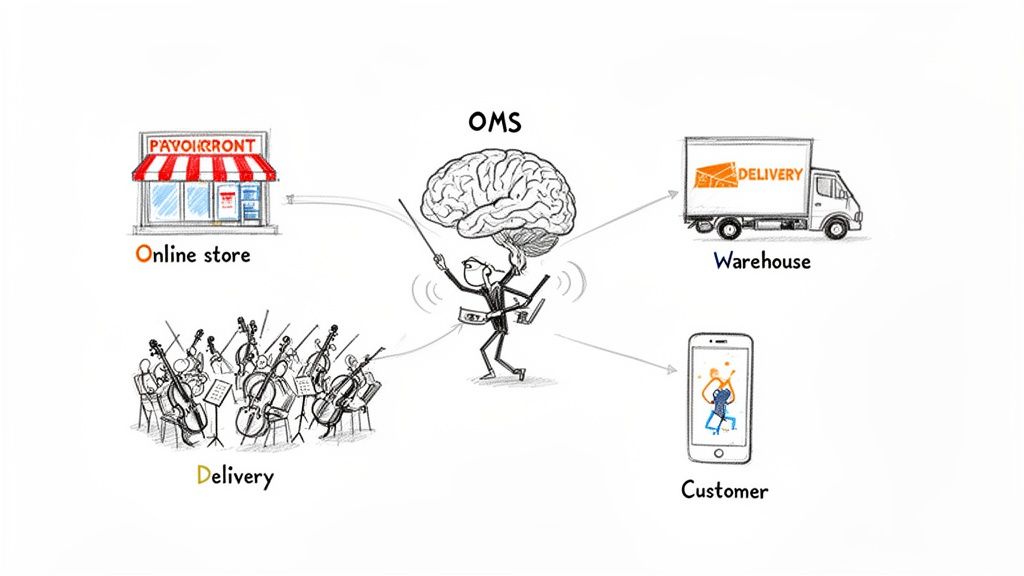
Imagine your business is an orchestra. You have your website, physical stores, warehouses, and shipping partners all playing their own instruments. An order management system is the conductor, making sure every section works in perfect harmony to give your customer a flawless experience.
Without that conductor, you get chaos. The same thing happens in retail without an OMS. You might sell an item online that just sold out in-store, forcing you to cancel an order and say sorry to a frustrated customer. Worse, an order placed in New York might ship from a California warehouse. This wastes days and racks up shipping costs, even though your New Jersey stockroom was full.
An OMS connects these dots. To give you a clearer picture, here’s a quick breakdown of the core jobs an OMS handles.
This table sums up the essential tasks an OMS performs. It gives you a snapshot of its critical role in unifying your sales and fulfillment operations.
| Core Function | What It Does |
|---|---|
| Order Capture & Validation | Gathers all orders from every channel (web, mobile, store) into one place. |
| Inventory Synchronization | Provides a single, real-time view of all stock across all locations. |
| Order Routing & Logic | Intelligently decides the best place to fulfill an order from (e.g., closest warehouse). |
| Fulfillment Orchestration | Sends picking, packing, and shipping instructions to the right warehouse or store. |
| Returns & Exchanges | Manages the entire reverse logistics process, from initiation to restocking. |
As you can see, each function is designed to create a more efficient and customer-friendly process from start to finish.
A unified system prevents these disconnected, frustrating moments that break customer trust. It's the only way to handle today's retail world, where customers expect to buy anywhere, return anywhere, and get their orders fast.
An OMS moves a business from reacting to orders to intelligently managing them. It’s about keeping promises to your customers consistently, no matter how or where they choose to shop.
The industry's rapid adoption tells the story. The global market for these platforms is surging, projected to grow from $2.4 billion in 2026 to a staggering $7.1 billion by 2034. This isn't just a trend. It's a fundamental shift, showing just how essential integrated order management has become.
Ultimately, an OMS solves painful, everyday operational headaches and clears the path for you to scale. It provides the backbone needed to:
By creating one source of truth for all order and inventory data, an OMS turns operational complexity into a real competitive advantage. And when your operations run this smoothly, it directly helps increase ecommerce sales, making it one of the most critical investments a modern retailer can make.
So what does an OMS actually do? Let's break it down. Think of these as the five core functions that hold up your entire post-purchase operation. They’re what turn a chaotic mess of manual tasks into a smooth, automated process that keeps your customers coming back.
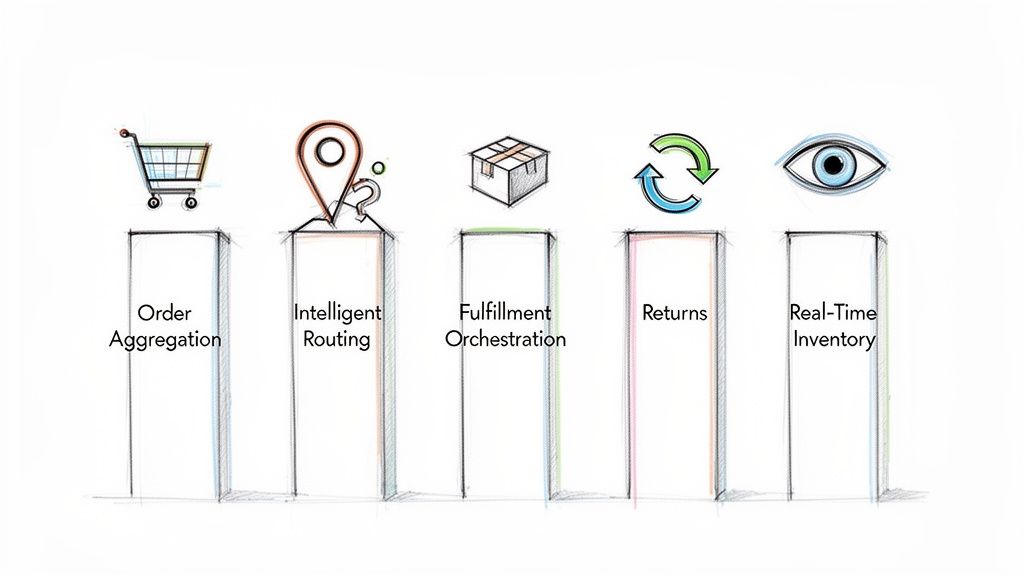
First and foremost, an OMS acts as a single inbox for every order, no matter where it came from. A sale on your Shopify site, a purchase from your Amazon store, and an order placed in-person at a retail store all land in one unified dashboard.
This immediately kills the need to constantly switch between platforms just to see what you’ve sold. It’s the first step toward creating a single source of truth for your entire business.
Once an order is captured, the OMS has to figure out the best place to fulfill it from. This is where "intelligent routing" comes in, and it’s one of the most powerful features of any modern order management system. The system uses a set of rules you define to find the smartest and most cost-effective fulfillment path.
Instead of just defaulting to your main warehouse for every order, the OMS can weigh factors like:
For example, a customer in Chicago places an order. Instead of shipping it from your main warehouse in Los Angeles (a 4-day trip), the OMS sees you have the item in stock at your Chicago retail store. It instantly routes the order there for same-day local delivery or in-store pickup. This saves you significantly on shipping costs and blows the customer away with speed.
With the best fulfillment location chosen, the OMS then organizes the actual "get it out the door" process. It pushes all the necessary order data to the assigned warehouse or store team’s system. This includes customer details, product SKUs, and the requested shipping method.
This is the pillar that connects the digital decision with the physical action of picking, packing, and shipping. It ensures the team on the floor has exactly what they need to get the right product to the right person without any guesswork.
An OMS doesn’t just decide what to do; it ensures it gets done. It's the coordinator that manages the handoff from your digital brain to your physical operations, making sure every single order is fulfilled accurately and on time.
The customer journey doesn't end at the doorstep. A truly great experience includes a painless returns process, and an OMS is built to manage this "reverse logistics" flow from start to finish. It handles everything from generating a return label for the customer to instructing your warehouse team on how to inspect and process the returned item.
This unified approach means you can confidently offer flexible options like "buy online, return in-store" without creating an operational nightmare. The system tracks the return, updates inventory levels once the item is back on the shelf, and triggers the customer's refund automatically.
This final pillar is the glue that holds everything else together. An OMS provides a single, constantly updated view of your inventory across every single place you hold stock. This includes warehouses, retail stores, third-party logistics (3PL) partners, and even in-transit goods.
When an item is sold on your website, picked from a warehouse shelf, or returned to a store, the system updates the global inventory count instantly.
This real-time visibility is what prevents overselling and frustrating stockouts. It makes sure your website isn't promising products you don’t actually have. This gives both your team and your customers confidence that the data they're seeing is always accurate.
We've talked about the technical guts of an OMS order management system, but let's get to the real story: how this tech translates into genuinely happy customers. An OMS is the control center powering the experiences people now demand. Things like buying online and picking up in-store (BOPIS), curbside service, or getting an online order shipped from a local shop. It dissolves the barrier between your website and your physical stores, merging them into one cohesive, powerful retail network.
To see what a difference this makes, let's play out two scenarios.
First, the clunky, disconnected version. A customer spots a pair of shoes online. The site vaguely says "In Stock" but gives no clue where. They click buy, only to get a dreaded email a day later: "Sorry, this item is on backorder and will ship in three weeks." The customer is frustrated, they cancel, and your brand's reputation takes a hit. Sale lost.
Now, let's rewind and run it through an OMS. The same customer finds the same shoes. This time, the product page shows live, local availability: "In stock at your downtown store." They buy it online, and in under 30 minutes, a notification pops up: "Your order is ready for pickup." That’s the magic. You've turned a potential point of failure into a genuinely great experience.
Without an OMS, every sales channel is its own little island. Your website has no idea what's on the shelves in your brick-and-mortar store, and the store has no simple way to help out with online orders. This siloed approach is a recipe for customer frustration, where what they're told online doesn't match reality in person.
An OMS smashes those walls. It acts as the central brain, making sure every channel is working from the same playbook of inventory and order data. This includes your website, your app, your physical stores, and your marketplace listings. This single source of truth is what makes modern retail strategies not just possible, but profitable.
Buy Online, Pick Up In-Store (BOPIS): The OMS verifies stock at the customer's preferred store, takes the payment, and pings the store's staff to go pick the item. This gets people in the door and delivers that instant-gratification buzz.
Ship-from-Store: An online order comes in. Instead of it automatically going to a massive, distant warehouse, the OMS intelligently routes it to the closest retail store that has the item. Suddenly, your stores are mini-distribution centers, cutting down shipping times and costs.
Curbside Pickup: Much like BOPIS, the OMS handles the entire workflow. It manages everything from the moment the order is placed to alerting the team that the customer has just pulled up out front.
These aren't just trendy bells and whistles; they’re how you build loyalty. When you consider that a recent study found 73% of shoppers jump between different channels on their way to making a purchase, you realize how crucial it is to make that journey seamless.
The upside of this unified world goes way beyond one happy customer. For the people running the business, a good OMS delivers hard, measurable results that show up on the bottom line. It’s not just an operational tool. It’s a strategic asset that fuels growth.
The core promise of an OMS is simple: Fulfill every order in the fastest, most cost-effective way possible, no matter where it comes from or where it needs to go. This operational excellence is the foundation of a modern, customer-centric retail business.
By getting operations right, you're directly solving the big problems that eat into profits. Giving customers flexible ways to get their order, all powered by data they can trust, creates a ripple effect of positive outcomes. If you're exploring more ways to connect your channels, our guide on omnichannel e-commerce strategies has some great starting points.
At the end of the day, an OMS helps you keep the promises you make to your customers. It ensures that when your site says "in stock," it really is. It makes fast, affordable shipping the standard, not an expensive exception.
This kind of reliability builds an incredible amount of trust and keeps people coming back. And for a business to truly nail omnichannel, its OMS has to be able to juggle the complexities of global logistics and fulfillment. It must make sure products move smoothly from the warehouse shelf all the way to the customer's hands. This leads to real, tangible benefits:
An OMS isn't just a piece of software. It’s a strategy. It's the decision to put the customer experience right at the heart of your operations, turning logistical efficiency into your most powerful engine for growth.
An Order Management System doesn't work in isolation. You have to think of it as the central nervous system of your entire commerce operation. It’s constantly talking to all the other critical systems that keep your business running, making sure everyone is on the same page.
Without that tight integration, you get data silos. Your finance team sees one version of reality, your warehouse sees another, and your marketing department is working with completely different numbers. A great OMS implementation hinges on how well it connects everything, creating that single source of truth you need to run a modern retail business.
This is what it looks like when it all comes together.
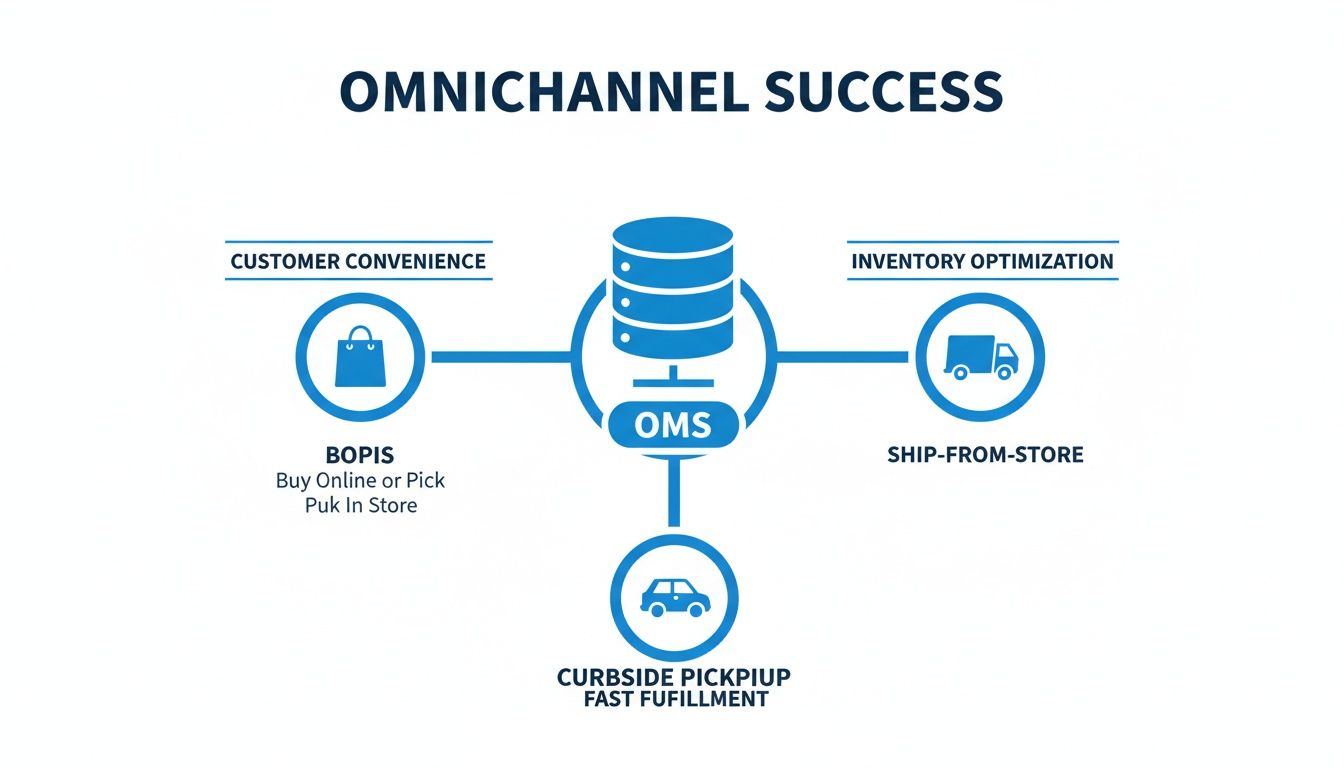
As you can see, the OMS is the engine that actually makes all those customer-pleasing fulfillment options a reality. Things like BOPIS, ship-from-store, and curbside pickup. It’s the behind-the-scenes coordinator for every order.
While an OMS can connect to dozens of different apps, its relationships with three specific systems are absolutely essential for any retailer today. Let's break down how it works with your PIM, ERP, and your sales channels.
Your PIM system is the master record for every single thing you sell. It holds all the rich product data. This includes SKUs, marketing descriptions, high-res images, and crucial logistical details like weight and dimensions.
The OMS needs this data to do its job correctly. If the PIM doesn’t provide precise weight and dimension data, the OMS can’t calculate an accurate shipping cost. That’s how you end up with surprise shipping fees that completely wreck your profit margins on an order.
A simple way to think about it is this: The PIM tells the OMS what is being sold, providing a detailed blueprint for every item. The OMS then figures out how to get that item into the customer's hands.
Your ERP is the financial heart of your business. It handles the big-picture stuff: accounting, invoicing, company-wide financial reports, and procurement. Every time an order is placed, shipped, or returned, the OMS has to immediately communicate that event to the ERP.
This connection keeps your books accurate in real-time. The ERP gets the data it needs to recognize revenue correctly, manage accounts receivable, and keep the general ledger updated. Automating this flow cuts out the tedious and error-prone process of manual data entry.
Your OMS absolutely must have a bulletproof connection to every single place you sell your products. This includes your own website, whether it’s on Shopify or BigCommerce. It also includes any third-party marketplaces like Amazon or eBay.
This is a two-way street. The OMS pulls new orders from these channels and simultaneously pushes real-time inventory updates back to them. This constant communication is what stops you from accidentally selling an item that just went out of stock. It ensures customers always see accurate availability no matter where they shop.
For brands looking to simplify this web of connections, learning how an integration platform as a service works can be a game-changer.
It’s easy to get confused about where one system’s job ends and another’s begins. Each of these platforms plays a very specific role, and understanding the division of labor is key to building a tech stack that doesn’t trip over itself.
| System | Primary Role | Key Data Handled |
|---|---|---|
| PIM | Manages product information for marketing and sales. | Descriptions, images, specs, attributes, and marketing content. |
| OMS | Manages the customer order lifecycle from purchase to delivery. | Order details, customer info, inventory levels, and fulfillment status. |
| ERP | Manages core business and financial operations. | Financial records, invoices, purchase orders, and company-wide accounting. |
At the end of the day, each system has a specialized purpose. They are designed to be the best at one particular thing, and they become truly powerful when they are integrated to work in harmony.
This shift toward specialized tools is exactly why the Order Management Software Market, valued at USD 3.4 billion in 2023, is expected to grow to USD 5.7 billion by 2032. As commerce gets more complex, businesses are realizing they need the right tool for the right job. You can read more about these order management market trends to see where the industry is headed.
So, you're ready to find an OMS order management system. Moving on from your current setup can feel like a massive task, but choosing the right platform doesn't have to be a nightmare. The secret is to look past the slick sales pitches and focus on what will actually drive your business forward.
This isn't just another generic vendor questionnaire. This is a battle-tested checklist to help you ask the right questions. It will help you see which platforms are built for the long haul and which ones you’ll outgrow before the year is out.
Scalability isn’t just a tech buzzword. It’s the difference between a record-breaking Black Friday and a weekend spent rebooting servers while your customer service inbox explodes. Your business is growing, and your OMS needs to handle not just today's order flow, but your most aggressive sales goals.
Get specific when you talk to vendors. Don't settle for a simple "yes, we're scalable." Push them on the details:
A truly scalable OMS order management system gives you the freedom to run any promotion you dream up, any time you want, without a single worry about your tech crashing down.
An OMS that can't talk to your other systems isn't an asset; it's a very expensive data silo. You need a central hub that connects seamlessly with your entire tech stack. This especially includes your eCommerce platform, ERP, and any 3PL partners you rely on.
Your magic words here are pre-built connectors. A vendor with off-the-shelf integrations for platforms like Shopify, NetSuite, or common WMS providers will save you a fortune in custom development and months of integration headaches.
Think of integrations like pre-built bridges. The more bridges a vendor has already built to the tools you use, the faster you can connect your operational world. A lack of bridges means you're stuck funding a slow, expensive, and risky construction project from scratch.
No two businesses fulfill orders the same way. Maybe you need to ship from stores in a certain region to clear out old stock. Or perhaps you need to route orders with hazardous materials to a specially certified warehouse. A one-size-fits-all routing logic just won't cut it.
This is where customizable fulfillment logic becomes a game-changer. You need the power to build your own "if-this-then-that" rules that tell the system exactly how to route orders to meet your business goals. A solid OMS will let you create rules based on criteria like:
This level of control is what turns an OMS from a simple order tracker into a machine that saves you money and delights your customers. And as you grow, you'll find that managing all this requires clean, centralized product data. To see how this works, check out our guide on what is a PIM system and how it partners with an OMS.
Finally, you have to look beyond the sticker price. The initial quote is almost never the full story. The Total Cost of Ownership (TCO) includes every single dollar it takes to get the system running and keep it that way.
Demand a full breakdown of all potential costs from every vendor. Make sure it includes:
Choosing the right OMS order management system is a huge strategic decision. By using this checklist to dig deep, you can cut through the marketing noise and find a partner that’s truly invested in your long-term success.
As you start exploring the world of order management, a lot of practical questions are bound to come up. It's one thing to get the high-level concepts, but it’s another thing entirely to picture what an OMS would actually mean for your business day-to-day.
This is where we get into the nuts and bolts. Let's tackle the most common questions we hear from brands trying to figure out their next move.
This is the big one, and the only honest answer is: it depends. I’ve seen projects go live in a few weeks, and I’ve seen others take the better part of a year. The timeline really hinges on how complex your operations are and how many other systems you need to connect to.
A straightforward setup might look like this:
A more complex, enterprise-level project could be much different:
The single biggest key to a fast, smooth process is preparation. The more time you spend mapping your current workflows and cleaning up your data before you start, the quicker any implementation will go.
In the past, the answer was almost always no. An OMS used to be a clunky, on-premise beast that cost a fortune and needed a dedicated IT team to keep it fed. Thankfully, that world is long gone.
Today, cloud-based, software-as-a-service (SaaS) platforms have put powerful order management within reach for ambitious, growing brands. You're not looking at a massive upfront cost anymore, but a manageable monthly subscription that grows with you.
Here’s why it’s worth considering even when you're still small:
The question isn't really if you're big enough for an OMS. The real question is: Do you plan on growing? If the answer is yes, an OMS is one of the best investments you can make to ensure your operations don't break on the way up.
This is a fantastic question because, at first glance, it looks like there's a lot of overlap. And to be fair, the built-in dashboard on platforms like Shopify, BigCommerce, or Wix does a decent job of handling orders. That is, as long as you have one website and one place you ship from.
The difference snaps into focus the second you add a layer of complexity. Think of your eComm platform's tools as a great starter kit. An OMS is the professional-grade upgrade you bring in when you get serious about scaling.
Here’s a quick breakdown of where they diverge:
| Feature | Basic eCommerce Platform (e.g., Shopify) | Dedicated OMS Order Management System |
|---|---|---|
| Inventory View | Shows stock just for its own online store. | Gives you a single, real-time view of inventory across all your warehouses, retail stores, and 3PLs. |
| Order Routing | Sends all orders to one default location. Simple and direct. | Uses smart, custom rules to send each order to the best fulfillment point based on cost, speed, and stock levels. |
| Multi-Channel | Manages orders from its own website. Adding marketplaces like Amazon usually means bolting on separate apps. | Natively pulls orders from all your sales channels (multiple websites, Amazon, physical stores) into one central dashboard. |
| Fulfillment | Handles a basic "pick, pack, ship" workflow from one location. | Orchestrates sophisticated strategies like ship-from-store, BOPIS, and routing orders to different 3PL partners automatically. |
While your eCommerce platform is designed to be brilliant at creating a beautiful storefront and capturing the sale, a dedicated OMS is purpose-built to master everything that happens after a customer clicks "buy."
Getting ready for an OMS has less to do with technical skills and more to do with getting your operational house in order. A little bit of prep work up front will make the entire journey dramatically smoother, from choosing a vendor to going live.
Here are the most important things you can do to get ready:
Ultimately, preparing for an OMS is about deeply understanding your own business. The clearer you are on where you are today and where you want to go, the better you'll be at choosing the right partner to help you get there.
Ready to build a rock-solid foundation for your product data? NanoPIM gives you the tools to centralize, enrich, and optimize your product information, creating the single source of truth your OMS and other systems need to thrive. Learn how NanoPIM can streamline your operations.


