
Let's get one thing straight. Omnichannel e-commerce isn't just another industry buzzword. It's a huge shift in how you see your customers and, more importantly, how they see you. It’s about creating one single, smooth experience that follows your customer wherever they go, from your website to your mobile app and right into your physical store.
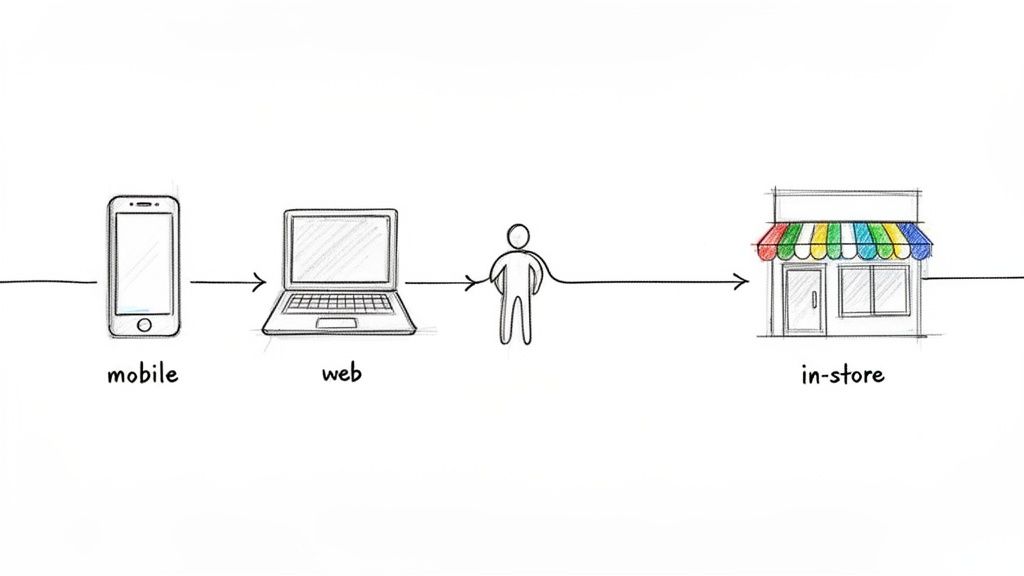
Picture this: a customer is browsing for a new jacket on their laptop during a lunch break. Later, on the train home, they open your app and that same jacket is sitting right there in their cart. With a few taps, they check if a nearby store has it in stock, reserve it, and swing by to pick it up on their way home.
That perfectly connected journey? That's omnichannel in a nutshell. It’s not just about being on multiple channels. It’s about making those channels talk to each other to build a unified system that revolves entirely around the customer.
Plenty of businesses are "multichannel." They have a website, a physical store, maybe a shop on Amazon or Instagram. The problem is, each of these channels often works alone. They’re like separate storefronts that just happen to share the same owner, but they don't share information.
An omnichannel strategy is what connects those storefronts. It pools data, syncs inventory, and shares customer history between them to create an experience that feels consistent and incredibly convenient. A great place to start is by defining what is omnichannel commerce and how it delivers that seamless experience.
Let's look at the numbers, because they tell a powerful story. Back in 2023, e-commerce sales across multiple channels hit a massive $575.6 billion, making up a huge 47% of all online sales. And it's not slowing down. Projections show that figure climbing to $775.7 billion by 2025. A key piece of this puzzle, click-and-collect, is on track to become a $154.3 billion market in its own right by 2025.
An omnichannel approach accepts a simple truth: your customer doesn’t see channels. They only see your brand. A disjointed experience at any point reflects poorly on the entire business.
Not long ago, having a website and a physical store was enough. But today's customers expect to interact with your brand on their terms, moving between their phone, laptop, and your store without hitting a single snag.
A true omnichannel approach delivers on that expectation. Here's what that looks like in practice:
Without this level of integration, you’re creating frustrating dead ends for your customers. They might find a product online only to see it priced differently in the store. Or worse, they try to return an online order at a physical shop and get turned away.
These small frictions add up quickly, costing you sales and, over time, hurting the trust you've built with your customers. If you want to dive deeper into how these strategies differ, we've put together a guide on the distinctions between omnichannel vs multichannel.
This unified strategy isn't a luxury anymore. It's essential for survival in modern retail.
Let's move past the theory. An omnichannel strategy is where your business starts seeing real, tangible growth. This isn't just about making customers feel good. It's about building a system that directly fattens your bottom line through fierce loyalty and higher spending.
When you create a truly seamless experience, customers don't just buy more once. They come back. Again and again. A great omnichannel setup removes the friction that sends shoppers scrambling to your competitors, making your brand the easiest, most reliable choice.
Today’s shoppers have incredibly high expectations. They expect to jump between your website, mobile app, and physical store without ever hitting a snag. An omnichannel approach makes this fluid movement a reality, and the impact on customer loyalty is massive.
By connecting every single touchpoint, you create a brand experience that is consistent and, above all, dependable. That consistency builds trust, which is the foundation of any long-term customer relationship.
Think of it like a good friendship. When a friend remembers your last conversation no matter where or when you had it, you feel valued and understood. An omnichannel strategy does the same thing for your customers. It makes them feel seen.
The numbers back this up in a big way. Companies with strong omnichannel strategies see an impressive 89% customer retention rate, completely dwarfing the 33% rate for businesses with weak or siloed channels. These shoppers also have a 30% higher lifetime value (LTV).
A loyal customer is a profitable one, and an omnichannel strategy is your best tool for maximizing that value. When you make the shopping journey easier and more personal, customers don't just stick around. They spend more.
Here’s how that translates directly into revenue:
This powerful mix of convenience and personalization is the key to improving the overall customer experience in ecommerce and turning one-time buyers into your most valuable brand advocates.
If you're an operations manager, you know that any tech investment needs to prove its worth. An omnichannel system isn't just another IT project. It's a core business strategy with a crystal-clear financial upside.
Making the case is surprisingly straightforward when you lead with the data. Showing that omnichannel shoppers spend 4% more in-store and a whopping 10% more online for each additional channel they use builds a compelling argument that’s hard to ignore.
This isn’t just about tweaking customer service. It’s about building a more resilient and profitable retail machine. By knitting your sales channels together, you create a powerful engine for growth that locks in loyalty, skyrockets customer lifetime value, and drives significant revenue.
To really get what omnichannel e-commerce is, let's ditch the theory and follow a real person on a real shopping trip. Meet Alex. Alex needs a new pair of running shoes. The path from "I need shoes" to "I bought shoes" is never a straight line anymore. It's a winding road that crisscrosses a dozen different touchpoints.
This whole process is what we call customer journey mapping. It’s how smart brands stop guessing and start understanding what it’s like to be their customer. Let’s follow Alex from the first moment of discovery all the way to the final purchase.
The journey doesn't kick off on a website. It starts on social media. Alex is scrolling through Instagram and a sharp-looking ad from a sportswear brand catches their eye. It’s for their latest running shoes, showing off new cushioning and a lightweight design.
Intrigued, Alex taps the ad. This is the first, crucial handover. The link doesn’t just dump Alex on a generic homepage. It opens the specific product page inside the brand's mobile app, which Alex already has installed. The switch is instant and completely seamless.
Now inside the app, the real research begins. Alex is met with a product page loaded with high-res photos, a 360-degree view of the shoe, and all the nitty-gritty specs. They dig into customer reviews, filtering for feedback on long-distance comfort, and then watch a quick video of the shoes in action.
This is where consistency is king. Every single piece of information, from the available colors to the price, has to be perfectly identical to what’s on the desktop site or anywhere else.
Next, Alex decides they want to see the shoes in person. This is where a true omnichannel e-commerce system shines. Alex uses the app’s store locator, which shows real-time inventory, to see if a nearby physical store has the right size and color.
A recent study found that 73% of shoppers use multiple channels during their buying journey. A disconnect at any point, like showing an item in stock when it isn't, is the fastest way to lose a customer.
The app confirms the local shop has three pairs left in a size 10. With a tap, Alex uses the "click-and-collect" feature to reserve a pair for pickup later that day. That single action just bridged the digital world (the app) and the physical one (the store).
Later that day, Alex walks into the store. A sales associate has already received a notification about the reservation. When Alex arrives, the shoes are ready and waiting. The associate, armed with a tablet, can see Alex’s browsing history and might even suggest a pair of performance running socks to go with the shoes.
After trying them on, Alex decides to buy. The purchase is made right there in the store, but the transaction data instantly updates Alex's unified customer profile. The brand now knows that Alex, who first saw an Instagram ad, bought a specific pair of size 10 running shoes at a specific store.
This entire journey was only possible because a single, unified system was humming away behind the scenes. Here’s what made it all click:
Without that central hub of information, the journey would have been a mess of dead ends. The app might have shown the wrong stock. The store might have had no clue about the reservation. By mapping and supporting this journey, the brand didn't just sell a pair of shoes. It delivered a smooth, trustworthy experience that builds loyalty for the long run.
Alright, you've seen what a modern customer journey looks like. Now, let's get into the nuts and bolts of the technology that makes it all happen. A true omnichannel e commerce strategy isn't about one magic piece of software. It’s about building a connected ecosystem of tools that talk to each other.
Trying to manage this with a dozen spreadsheets or by manually updating product listings is a fast track to failure. Customers expect consistency, and that's what we're going to build. It's a foundation that can actually scale with your business.
Before a single system gets connected, you need a central command center for all your product information. This is non-negotiable. Without it, everything you build will be on shaky ground.
This hub is your Product Information Management (PIM) and Digital Asset Management (DAM) system. Think of it as the master library for every single detail about your products.
Every product description, price, technical spec, image, and video is stored in one place. When you update it here, the change automatically cascades out to every single channel.
This is the only way to guarantee a customer sees the exact same price on your website, your mobile app, and a marketplace like Amazon.
With a central hub locked in, you need to set the rules of the road. Data governance sounds overly corporate, but it’s really just about deciding who can do what with your product data.
You need a clear, documented process for how new product information gets created, who needs to approve it, and who has the final say. This is your quality control. It stops sloppy, inconsistent, or incomplete data from ever making it in front of a customer. A solid data management strategy is what keeps your data clean and reliable as you grow.
For example, your rules might look like this:
These rules create a predictable workflow that keeps every piece of information accurate and on-brand.
Below is a great illustration of how customers move between channels. They might see an ad on social media, read reviews on your site, and then buy in-store.
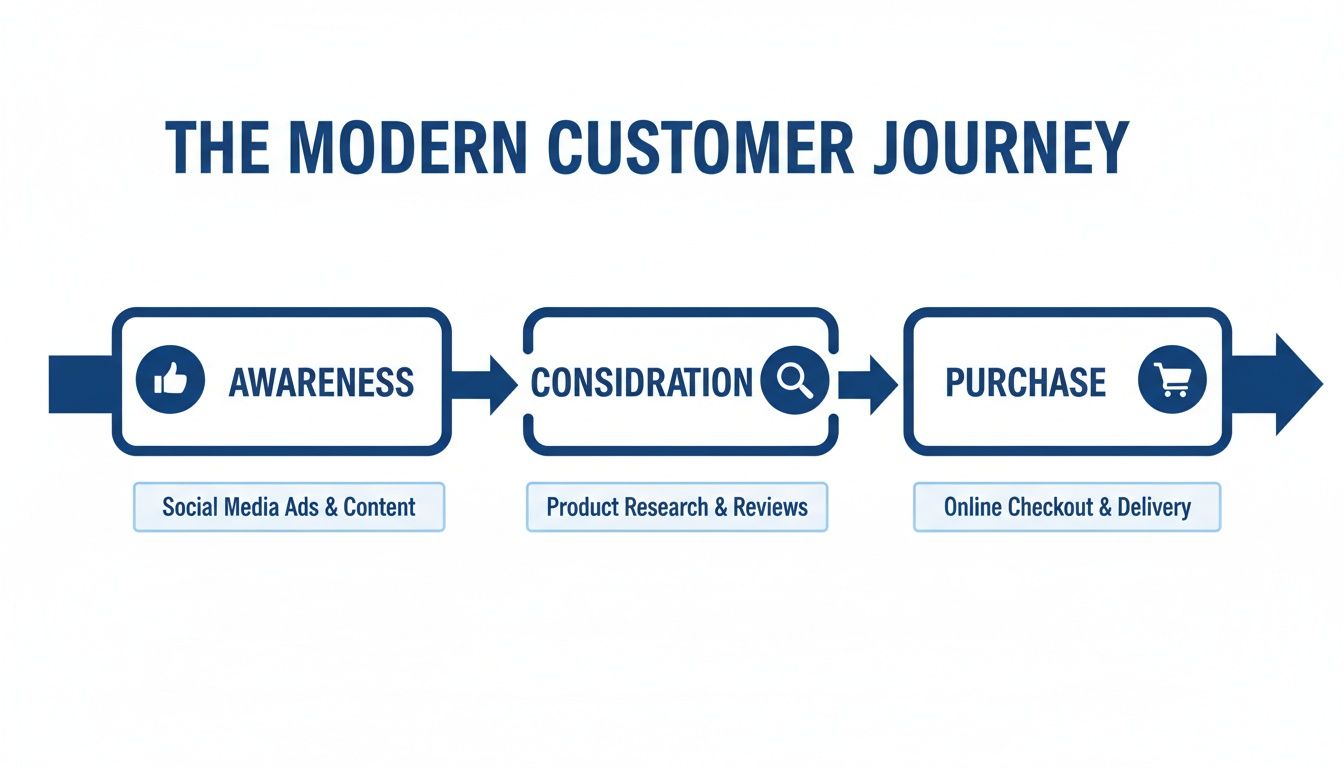
This journey is anything but linear. That’s why your tech stack has to support these fluid transitions without missing a beat.
This is where you start connecting the dots. Your PIM/DAM is the core, and from there you'll integrate your other mission-critical business platforms. The goal is a seamless, two-way flow of information across your entire operation.
To power this ecosystem, you need a specific set of tools that work in concert. Here’s a breakdown of the essential components.
| Technology Component | Primary Function | Why It's Critical |
|---|---|---|
| PIM / DAM | Centralizes all product information and digital assets. | Creates a "single source of truth," ensuring data consistency across all channels. |
| ERP System | Manages core business data like inventory, pricing, and financials. | Syncs operational data (like stock levels) with product content in real-time. |
| Commerce Platform | Powers the front-end shopping experience (e.g., Shopify, BigCommerce). | Pushes accurate product data to your website, mobile app, and other direct sales channels. |
| Marketing Automation | Manages email, social media, and advertising campaigns. | Feeds rich product data into campaigns for highly personalized marketing. |
| AI Content Tools | Optimizes text and media for specific channel requirements. | Tailors content automatically for different platforms (e.g., Google vs. Amazon) to maximize performance. |
Each of these components plays a distinct role, but it's their integration that unlocks true omnichannel capability. Let's look at the key connections you'll need to make.
A crucial concept to understand for building flexible, integrated experiences is what is headless ecommerce, which separates your front-end presentation from your back-end functions.
Here are the key integrations you can't skip:
With your foundation built and your systems communicating, you can add the real game-changer: Artificial Intelligence. AI can take your raw product data and automatically transform it into high-performing content that's perfectly tailored for each channel.
For example, the product title that performs best on your website is probably not the same one you’d use for an Amazon listing or a Google Shopping feed. AI can analyze performance data and generate optimized versions of your content, saving your team hundreds of hours.
It can create:
This level of automated optimization ensures your products aren't just on every channel. They're positioned to win. This is how you go from just managing an omnichannel e commerce presence to truly mastering it.
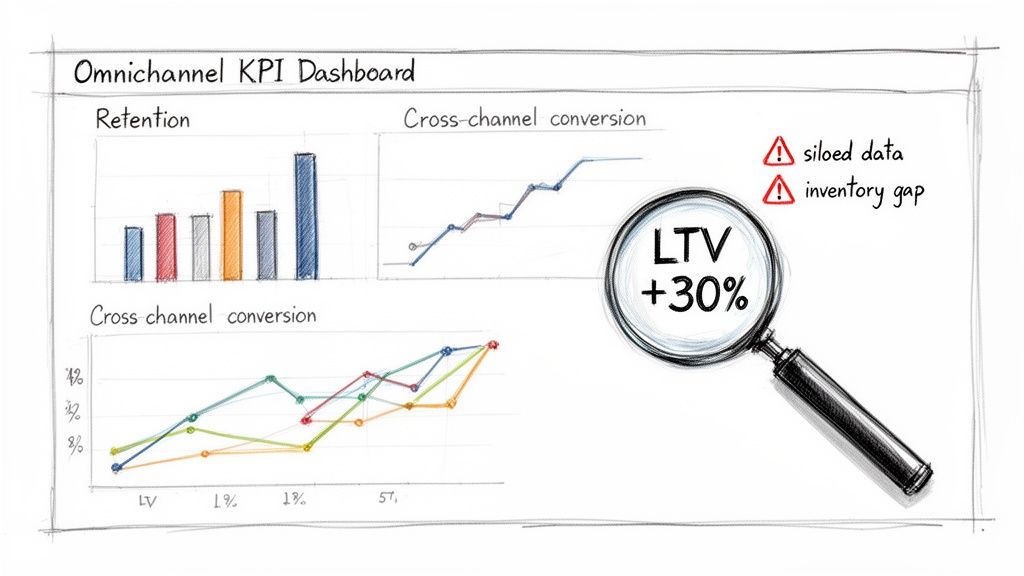
You’ve built out a connected omnichannel e commerce strategy. That’s a massive step. But how do you actually know if it’s working? An omnichannel project is only as good as the results it drives, so you need to be tracking what truly matters.
This means looking past surface-level stats like website traffic or total sales. Real success is found in the Key Performance Indicators (KPIs) that prove your channels are working together to create happier, more valuable customers.
To get a true picture of your performance, you have to track metrics that span your entire ecosystem. These are the KPIs that connect the dots between your digital storefront and your physical world, proving the real value of a unified approach.
Focus on these core metrics to see the impact:
These numbers tell a story. When you see a rising LTV paired with a strong cross-channel conversion rate, you know your omnichannel e commerce strategy is firing on all cylinders.
Even with the best intentions, plenty of omnichannel projects hit a wall. Certain common mistakes can completely sabotage your efforts, leaving you with a disconnected mess that frustrates customers and your internal teams.
The good news? These pitfalls are entirely avoidable. By knowing what they are, you can build a strategy that sidesteps them from day one.
A Salesforce report found that 80% of customers believe the experience a company provides is just as important as its products. A single misstep in your omnichannel execution can shatter that experience and send them running to a competitor.
Here are the most common tripwires to watch out for.
For every mistake, there’s a practical, actionable solution. The theme connecting them all is simple. Break down internal barriers and use technology to create a single source of truth.
Here’s how to solve these common challenges:
By focusing on these core solutions, you can build a resilient omnichannel e commerce strategy that not only avoids common pitfalls but also delivers a truly exceptional customer experience.
Jumping into an omnichannel e-commerce strategy brings up a lot of questions. We’ve covered the big picture, the what, why, and how, but sometimes you just need a straight answer.
This section is your go-to for clearing up those common points of confusion. Think of it as the quick reference for the questions that pop up right when you’re ready to get started.
This is, by far, the most common question. The difference is everything. A lot of businesses believe they’re omnichannel when they’re really just multichannel.
Here's a simple way to think about it. Multichannel means you have multiple, separate roads leading to the same town. You might have a highway (your website), a scenic route (your Instagram shop), and a local street (your physical store). They all get customers to your brand, but the roads don’t connect. The journey on one has zero impact on the others.
Omnichannel connects all those roads into a single, intelligent grid. The channels are all aware of each other and work together to create one seamless experience for the customer. It's a fundamental shift away from a brand-centric view and toward a customer-centric one.
The core difference is integration. Multichannel is about being present on multiple platforms. Omnichannel is about uniting those platforms around the customer to create one fluid conversation.
Let's make it real:
Multichannel forces the customer to adapt to each channel's silo. Omnichannel makes the brand adapt to the customer's journey, wherever it takes them.
You don't need a massive budget or a dedicated IT department to get started. The secret is to start small and focus on connecting your most critical channels first. For most small businesses, that means linking their e-commerce store and their physical location.
The single most powerful and accessible starting point is "buy online, pick up in-store" (BOPIS). This feature immediately bridges your digital and physical worlds, offering a huge convenience boost that customers genuinely appreciate. It tells them you value their time.
But before you do even that, you have to take one critical first step: centralize your product data.
This is the absolute bedrock of any omnichannel effort, big or small. Trying to manage product information in spreadsheets is a recipe for disaster. It guarantees inconsistencies, errors, and countless wasted hours.
A Product Information Management (PIM) system is the answer. Even with a small catalog, a PIM serves as your single source of truth.
Starting with a solid data foundation makes your omnichannel e-commerce strategy scalable from day one.
A PIM system is the heart of any modern omnichannel strategy. It's the central nervous system that connects your product data to every single customer touchpoint, ensuring everything stays perfectly in sync.
Imagine trying to direct an orchestra where every musician has a different version of the sheet music. The result would be chaos. That's exactly what's happening when your product data is scattered across spreadsheets, your ERP, and your e-commerce platform.
A PIM acts as the conductor's master score. It is the single source of truth for all your product information, including:
Instead of manually updating this information in a dozen different places, you update it once in the PIM. The PIM then automatically formats and distributes the correct, up-to-date information to every channel. This includes your website, mobile app, in-store kiosk, or marketplaces like Amazon and Google Shopping. This guarantees absolute consistency and saves an incredible amount of time.
Artificial Intelligence takes a solid omnichannel foundation and completely supercharges it. AI acts as a massive accelerator, automating tasks that were once painfully manual while uncovering insights that were previously impossible to see.
If your PIM is a perfectly organized library of product facts, think of AI as the brilliant librarian who can instantly weave those facts into compelling stories, perfectly tailored for any audience.
AI improves your omnichannel e-commerce strategy in three key ways:
In the end, integrating AI isn’t just about being more efficient. It’s about making your omnichannel experience smarter, more relevant, and more effective at every single touchpoint.
Ready to build a powerful foundation for your omnichannel strategy? NanoPIM is an AI-powered PIM and DAM platform designed to centralize your product data and optimize it for every channel. Turn raw specs into high-performing content and ensure absolute consistency across your entire e-commerce ecosystem. Learn more and get started at https://nanopim.com.