

Let's be honest, the phrase information management life cycle sounds like something you would hear in a stuffy corporate boardroom. But it is not as complicated as it seems. In fact, it is one of the most practical concepts in eCommerce.
Think of it as the journey every piece of your product data takes, from the moment you receive it to the day it is no longer needed.
Imagine trying to run a professional kitchen without a system. Ingredients arrive from dozens of suppliers, chefs grab whatever they can find, and nobody knows if the fish is fresh or a week old. It would be chaos. That is exactly what happens to product data without a clear process.
This "life cycle" is your kitchen system. It is the set of rules that turns messy data into a reliable, valuable asset.
This system stops the madness of inconsistent listings, frustratingly slow updates, and expensive errors before they ever start.
Without a structured life cycle, your product information gets scattered. Data lives in a dozen different spreadsheets, old images get mixed with new ones, and no one is quite sure which description is the "final" version.
Consider this: the average company works with 3,000 suppliers for every $1 billion in revenue, each sending data in their own unique format. That is a flood of information.
An effective information management life cycle transforms your data from "stuff we just collect" into a core business asset that your team can actually find, trust, and use to drive more sales. It's the engine for quality and consistency.
This is not just about being organized; it is about solving real problems that hit your bottom line. It helps you:
Ultimately, mastering this process gives you control. It turns your biggest data headache into a competitive advantage.
To put it all together, here is a quick breakdown of the six stages we'll be exploring.
This table gives a high-level look at each stage and what it aims to accomplish in a retail or eCommerce setting.
Each of these stages presents its own challenges and opportunities, but when managed together, they create a powerful, streamlined workflow for your entire operation.
Alright, now that we have the 30,000-foot view, let's get our hands dirty. The information management lifecycle is not some dusty academic theory; it is a series of concrete actions your team takes every single day.
We'll walk through each of the six stages with real-world e-commerce scenarios that will probably feel all too familiar. Think of this as the playbook that turns abstract concepts into a practical, repeatable process.
This is ground zero. The creation stage is the moment any new piece of information enters your world. For an e-commerce team, this is a constant, messy flood.
A new supplier emails you a spreadsheet with 500 new SKUs. A photographer drops a folder with 2,000 raw product shots. Your marketing team churns out a first draft of product descriptions. This is where it all begins.
This raw data is both an opportunity and a massive headache. The only goal here is to capture it all without losing anything. You're not aiming for perfection yet. The focus is purely on ingestion, getting all this varied information into a starting point, like a "holding bay" in a PIM, where it won't clutter up your live site while you sort it out.
This first step is exactly why the Product Information Management (PIM) market is exploding. The sheer volume of data at this creation stage has created a huge need for tools that can tame the chaos. The global PIM market was valued at USD 5.48 billion in 2025 and is on track to hit USD 20.66 billion by 2034. That growth is a direct answer to the daily reality for e-commerce managers, where up to 70% of initial product information lands on their desk in a messy, inconsistent state. You can dig into the numbers in the full market analysis from Fortune Business Insights.
This diagram breaks down that high-level flow from raw data to a published product.
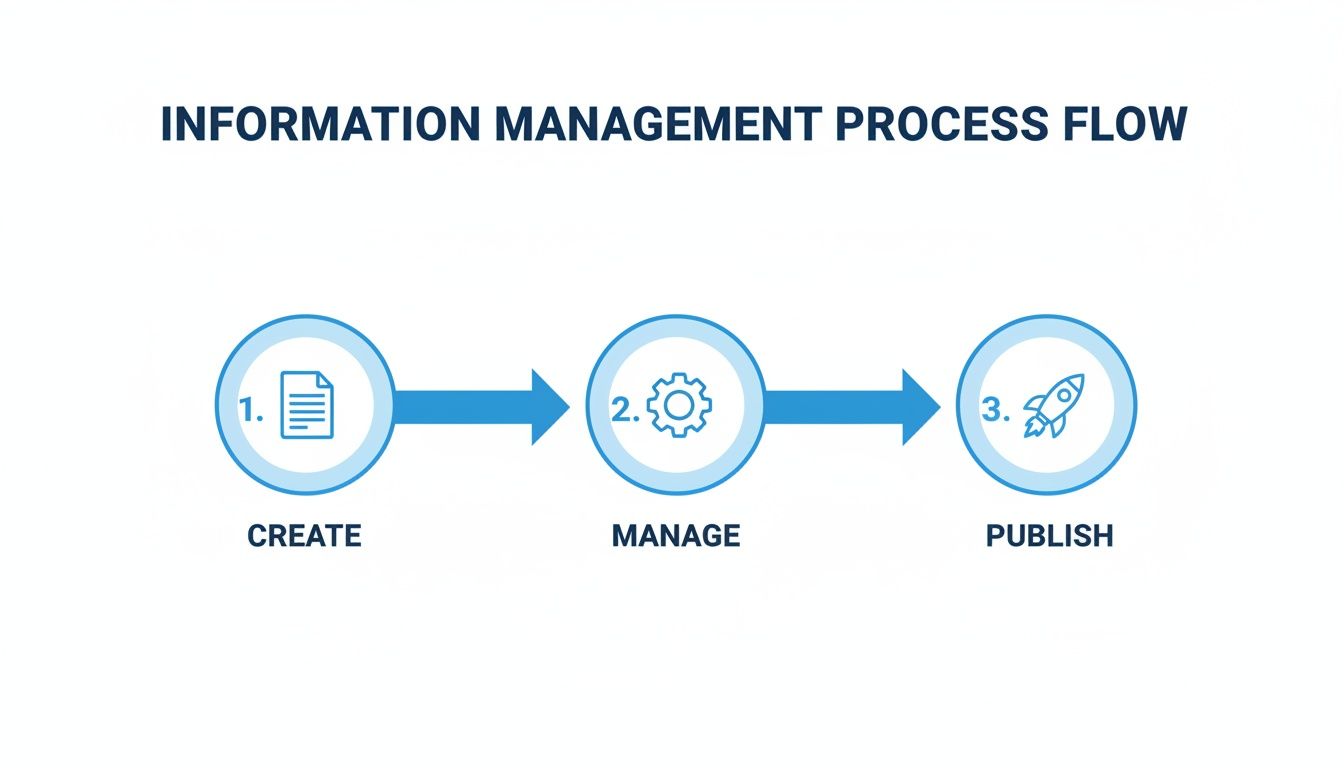
It's a simple journey: create the raw info, manage and refine it, then publish it for the world to see.
Raw data is basically useless. A spreadsheet with a product name like "BLU_TSHIRT_V2" and a folder of images named "IMG_8821.jpg" mean nothing to a customer trying to make a purchase. This is where classification and enrichment turn noise into signal.
color: blue, material: cotton, and sleeve_length: short. This structured data is what makes your products findable and comparable.Without this stage, your website is just a digital junk drawer. Proper classification is what lets customers filter and search effectively, preventing them from getting frustrated and leaving. We go much deeper on this in our guide on managing data quality in eCommerce.
Once your data is clean and organized, it needs a safe, reliable home. This is the storage stage, and the ultimate goal is to create a single source of truth, one central hub where every piece of product information lives.
Honestly, this is the biggest hurdle for most businesses. Data gets scattered across dozens of spreadsheets, shared drives, and, worst of all, the desktops of individual employees. The result? Total chaos. Nobody knows which information is the most current or correct.
A centralized system, like a PIM, is the fix. It becomes the definitive library for all your product content. When someone on the marketing team needs the latest approved product photo, they know exactly where to find it. No questions asked.
This is not just about storage; it is about building trust and efficiency. When everyone is working from the same playbook, consistency across all your sales channels stops being a daily battle and starts becoming automatic.
Your data is now clean, enriched, and stored in one place. It is time to put it to work. The usage stage is all about publishing your product information out to the world.
This could mean:
The key here is channel-specific optimization. The product description that shines on your website is probably too long for an Instagram post. The image requirements for a Google Shopping ad are different from what your mobile app needs. A solid information management process lets you tailor and distribute content for each channel without having to manually recreate it every single time.
The product is live, but the job is not done. The retention stage is about keeping your information accurate and relevant over time. Prices change, inventory levels go up and down, and marketing messages get refreshed.
This stage also involves keeping historical data for strategic purposes. For example, last season's sales data and product information are gold for forecasting trends and planning future inventory. You might not need last year's holiday collection on your main website, but you definitely want to hang onto that data for business analysis.
Eventually, products reach the end of the road. They are discontinued, replaced, or just not relevant anymore. The final stage, archival and disposal, is about retiring this old information cleanly and deliberately.
This is a critical cleanup step. It stops your active product database from getting bloated with irrelevant junk, which makes it faster and easier for your team to manage the products you actually sell today. A good archival process also ensures that old, discontinued product pages don't hang around to break links or confuse customers.
It is one thing to map out a perfect, six-stage information management lifecycle on a whiteboard. It is another thing entirely to make it work in the real world. Without clear rules and designated owners, it is like handing over the keys to a high-performance race car with no driver, no pit crew, and no rules of the road. It is a recipe for a spectacular crash.
This is where governance comes in, and it is not about adding bureaucracy or scheduling more meetings. It is about creating simple, effective 'rules of the road' for your product information. These guidelines prevent data pile-ups, expensive mistakes, and those frustrating slowdowns that kill productivity.
Ultimately, these policies are your secret weapon for turning theory into reality. Simple rules about how to name a product, who can approve a new description, or what "ready to publish" actually means are what stop chaos before it even starts.
You cannot run a professional kitchen without a head chef and a kitchen manager, and you cannot run a data lifecycle without clear roles. In information management, a couple of key players are essential to keep everything flowing smoothly and prevent a mess.
Data Stewards: These are your subject matter experts. Your Data Steward for the "footwear" category lives and breathes that product line. They know every material spec, every seasonal trend, and every last detail. They are the go-to person for approving content in their domain, guaranteeing its accuracy and quality.
Data Custodians: These are your tech pros. They might not know the difference between suede and nubuck, but they are masters of the systems that hold all that information. Data Custodians manage the technical infrastructure, like your PIM platform, ensuring it is secure, backed up, and running like a well-oiled machine.
Assigning these roles creates accountability. When a product description is wrong, you know the Data Steward for that category is the person to see. If the system goes down, the Data Custodian is already on it. No more finger-pointing.
Good governance does not have to be a 100-page binder of rules. It often boils down to a handful of practical policies that solve the most common headaches in ecommerce. You can learn more about how to create your own by reading up on data governance policies and frameworks.
The real power of governance is turning abstract goals like "data quality" into concrete actions. It’s the framework that makes sure your information management lifecycle delivers consistent results day in and day out.
This structured approach has a massive financial upside. Strong data quality governance is proven to slash retail losses. It is no surprise the PIM market is projected to explode from USD 15.66 billion in 2024 to USD 62.87 billion by 2033. On the flip side, weak governance is costly; internal audits often find that 63% of product content fails initial completeness checks, directly leading to preventable and expensive returns.
Here are a few examples of simple policies that make a world of difference:
1. Naming Conventions
This is a straightforward rule for how to name product files, images, and SKUs. It is a simple fix that prevents duplicate assets and makes everything instantly searchable.
2. Access Controls
This policy defines who gets to do what. For instance, maybe only a Data Steward can approve a final product description for their category. This prevents a well-meaning intern from accidentally publishing draft copy to your live site.
3. Completeness Checklists
This is a clear, non-negotiable checklist of all the information required before a product can go live. It ensures your marketing team always has the latest approved images and every customer sees the details they need to make a purchase. For modern systems, ensuring this data is pristine for AI is critical, which makes Trusted LLM Optimization a key part of the governance puzzle.

Trying to manage your information lifecycle manually is like running a modern warehouse with a paper ledger and a clipboard. It is slow, riddled with errors, and simply can't keep up.
The good news is, you do not have to. The right tools can put your entire data workflow on autopilot, transforming a chain of tedious chores into a smart, automated process.
At the center of this tech stack is the Product Information Management (PIM) system. Think of a PIM as the command center for all your product data. It is built from the ground up to handle every stage of the lifecycle, from that first messy spreadsheet to the polished listing on a sales channel.
A PIM is not here to replace your existing systems. Quite the opposite. It creates a seamless ecosystem by integrating with the tools you already rely on, finally breaking down the data silos that cause so much friction.
This integration is non-negotiable. In the high-pressure world of omnichannel retail, things fall apart fast without a central hub. In fact, a staggering 80% of manufacturers report struggling with data silos between departments, a problem that can inflate lifecycle costs by 30%.
This challenge is fueling explosive growth in the PIM market, which is projected to jump from USD 22.36 billion in 2026 to USD 47.54 billion by 2030. You can find more details in the complete product information management market report.
This is where it gets really interesting. Artificial intelligence, Machine Learning (ML), and Large Language Models (LLMs) are completely reshaping each stage of the information lifecycle, making it smarter and more efficient.
Imagine AI automatically sorting incoming supplier data during the ‘Classification’ stage. Or generating five different product descriptions for the ‘Usage’ stage. This is not science fiction; it is happening right now inside modern PIMs.
AI and automation don’t just make the process faster; they make it better. They can analyze data, spot inconsistencies, and enrich content at a scale that's impossible for any human team to match.
Let's look at how this plays out in a tool like NanoPIM, which is built with these capabilities at its core:
1. Simplifying Creation and Ingestion
Instead of manually copying and pasting from supplier spreadsheets, a feature like a Data Holding Bay gives you a safe sandbox. It lets you import, compare, and merge new data without any risk to your live products. This automates the most error-prone part of the entire ‘Creation’ stage.
2. Intelligent Classification and Enrichment
During the ‘Classification’ stage, AI can analyze raw text and images to automatically suggest categories and tags, saving hundreds of hours of manual labor. For the ‘Usage’ stage, multi-LLM enrichment can write compelling, channel-specific content. You can ask it to draft a technical description for your B2B portal and a punchy, benefit-driven one for your Instagram shop, all from the same core data.
By putting these modern tools to work, you turn the theoretical framework of the information management lifecycle into a practical, automated, and powerful engine for your eCommerce business.
Okay, theory is great, but how do you actually put this into practice? Getting started can feel like staring up at a mountain of messy spreadsheets and thousands of SKUs. It is easy to get paralyzed.
Don't worry. This is not about boiling the ocean. It is about making a few smart, focused moves that deliver quick wins and build real momentum. We've put together a simple roadmap for busy operations managers to get a real information management life cycle strategy off the ground, without the overwhelm. Progress over perfection is the name of the game.

Before you fix anything, you have to know what is most broken. Audit your current data landscape and pinpoint the one area causing the most friction for your team. Don't try to document everything under the sun. Just look for the most obvious, painful problems.
Is your team constantly patching errors on your most profitable sales channel? Are product launches getting held up, waiting for images or specs from one particular supplier? Find the bottleneck that everyone on your team complains about. That is your ground zero.
The goal of this first audit isn't to create a perfect inventory of all your data. It's to find the one problem that, if you solved it, would make the biggest immediate impact on your team's sanity and the business's bottom line.
Once you've zeroed in on the pain point, attach a number to it. Vague goals like "improve data quality" are impossible to measure and easy to abandon. You have to get specific. A clear, measurable goal gives your project focus and makes it ridiculously easy to prove its value down the road.
Here are a few examples of what a strong goal looks like:
Remember those Data Stewards we mentioned earlier? It is time to make them official. You need to assign clear ownership for your most critical data domains. This is not about creating a new full-time role; it is about making someone the official go-to person.
For instance, Sarah is now the owner of all "apparel" data, and David owns "accessories." When a question comes up, everyone knows exactly who to turn to. This simple move creates accountability and puts a stop to the endless finger-pointing.
To truly tame the chaos, your data needs one home. This is where a Product Information Management (PIM) platform becomes your anchor. It is built to be this "single source of truth," centralizing your information and becoming the definitive hub for everything from SKUs and descriptions to images and compliance docs.
Choosing a PIM is probably the most important technical decision in this whole process. It acts as the foundation for your entire information management life cycle, connecting all the stages into one cohesive flow. When done right, a robust information strategy can dramatically improve outcomes, such as optimizing ecommerce and customer service through AI-powered support to accelerate growth.
Now it is time to put it all together. But please, don't try to migrate your entire catalog at once. That is a classic recipe for disaster. Pick just one product line or a single category, ideally, the one tied to your measurable goal, and treat it as your pilot project.
Your mission is to get this one small slice of your business running perfectly through the lifecycle in your new PIM. This approach lets you work out all the kinks on a small scale, learn valuable lessons, and, most importantly, score a quick, tangible win.
Finally, create a dead-simple dashboard to track your progress against the goal you set back in step two. This could be a chart showing your time-to-market shrinking or a graph showing data completeness scores climbing.
Share these results with your team and, crucially, with leadership. Proving the value of this new process with hard numbers is the single best way to get buy-in to expand the strategy across the rest of the company. It turns your small pilot project into a powerful, undeniable case study for change.
Even with a solid plan, taking that first real step toward a formal information management life cycle can feel like a huge leap. It is easy to get bogged down in the “what ifs” and “how-tos.” Let's cut through the noise and tackle the most common questions we hear, so you can move forward with confidence.
First, don't try to boil the ocean. Seriously. Aiming to clean up everything at once is a surefire way to burn out your team before you even get started. The secret is to start small and build momentum.
Pick one single, high-impact product category. Maybe it is your top seller or the one that is generating the most customer service tickets. Do a quick data audit on just that category to pinpoint the absolute must-have information for your most important sales channel, whether that is Amazon or your own website.
This small, focused project becomes your testing ground. It is where you define your process, try out a PIM platform, and score a quick, tangible win. That success is the best argument you'll have for getting buy-in from leadership. Once you have a working model for one category, you can use that blueprint to expand across your entire catalog. The goal here is progress, not perfection.
By a long shot, the most common and damaging mistake is not having a “single source of truth.” When your product information is scattered across a tangled web of spreadsheets, shared drives, and disconnected apps, chaos is not just possible, it is guaranteed.
This mess creates data silos, and that is where the inconsistencies creep in. You end up with different product specs on your website than on your eBay store. A marketing campaign might launch with an old, unapproved product shot. Every tiny update turns into a soul-crushing manual chore that just devours your team's time.
The single most effective fix is implementing a centralized Product Information Management (PIM) system. It forces everyone, from marketing to sales and customer service, to work from the exact same correct, up-to-the-minute information.
It is a simple concept, but this one change drastically boosts your operational efficiency. More importantly, it gives customers the consistent, trustworthy experience they expect.
A modern PIM is so much more than a digital filing cabinet. It is a full-on command center built to actively manage the entire information management life cycle from creation to disposal. It takes those theoretical stages and turns them into a practical, automated workflow your team can actually use.
Think about how a platform can map to each stage:
In short, a PIM connects all the dots, transforming a long list of manual headaches into one cohesive, intelligent system.
Not anymore. While it is true that enterprise giants have been doing this for years, modern cloud-based tools have made sophisticated information management both accessible and affordable for businesses of every size.
The real game-changer has been the rise of scalable platforms with flexible pricing. For instance, a system with a token-based AI model lets growing teams tap into enterprise-grade tools without a massive upfront investment. You only pay for what you actually use, whether that is for generating descriptions, enriching data, or syncing to a new marketplace.
In today's market, customers are everywhere, and they expect perfect information on every channel. A smart information strategy is not a luxury; it is a fundamental part of the toolkit for any eCommerce business serious about scaling efficiently and building a brand people trust.
Ready to turn your product information from a chaotic liability into your greatest asset? With NanoPIM, you can centralize, enrich, and distribute your product data with AI-powered simplicity. See how our platform maps directly to the information management life cycle to help you launch products faster and sell more. Get your free demo of NanoPIM today!


