

So, what exactly is Generative Engine Optimization (GEO)? Put simply, it’s the art and science of making your content the go-to source for AI tools like ChatGPT and Google's AI Overviews. It's about structuring your brand’s information so that when an AI answers a question, it uses your data to do it.
Think of your traditional SEO work like being a meticulous librarian. You've spent years tagging every webpage (book) with the right keywords and organizing your site (the library) so people can easily find what they’re looking for on the right shelf. It’s a solid system.
Generative Engine Optimization is a whole different ballgame. It’s less like a librarian and more like training an expert personal shopper. This AI-powered shopper doesn't just point a customer to an aisle; it listens to their needs, selects the perfect products, explains why they're the best fit, and makes a direct, confident recommendation.

This is the new search reality. With generative AI baked directly into search engines, users are getting direct answers, not just a list of blue links. That means your old SEO playbook is no longer enough. If your product data isn't primed for these AI engines, you’ll become invisible to a huge, and growing, number of shoppers who depend on them.
At its core, GEO represents a massive shift away from just chasing keywords. The real focus now is on providing clear, fact-dense, and highly structured information that an AI can use to confidently answer a nuanced question.
For instance, a shopper might ask, "What's the best waterproof running jacket under $200 with reflective details for night running?"
An AI model scans its trusted sources for content that hits every single one of those points. It’s not looking for a page that just repeats "best waterproof running jacket" over and over. It's hunting for product details and articles that explicitly state things like:
This is exactly why GEO is so crucial for eCommerce brands. You can get the full rundown on how GEO and SEO should work together for eCommerce success in our detailed guide.
To really get a handle on this change, it helps to see the two strategies side-by-side. Traditional SEO has always been about getting a human to click a link. GEO is all about getting an AI to trust and cite your information.
Of course, the terminology in this new space is still taking shape. You might see a lot of different acronyms floating around, which is why it helps to understand the relationships between terms like AI SEO, AEO, GEO, GAIO, or LLMO.
GEO doesn't replace SEO. Think of it as an essential new layer on top of your existing strategy, one that ensures your brand’s voice is part of the AI-driven conversation.
Here’s a quick table to break down the key differences.
This table highlights the key differences between the established practices of Search Engine Optimization and the emerging field of Generative Engine Optimization.
| Aspect | Traditional SEO | Generative Engine Optimization (GEO) |
|---|---|---|
| Primary Goal | Drive clicks to a webpage from a search engine results page (SERP). | Influence and appear within AI-generated answers and summaries. |
| Main Audience | Human users searching for information. | AI models (LLMs) that retrieve and synthesize information. |
| Optimization Focus | Keywords, backlinks, site speed, and technical signals for ranking. | Factual accuracy, structured data, semantic clarity, and authority. |
| Success Metric | Organic traffic, click-through rate (CTR), and keyword rankings. | Brand mentions in AI responses, share of voice, and referral quality. |
As you can see, the focus, audience, and even the definition of success are fundamentally different. While SEO gets people to your door, GEO makes sure you're the one being recommended in the first place.
The ground is shifting underneath the entire world of search. For years, the game was simple: get your website to the top of Google. But with AI tools like Google’s AI Overviews and ChatGPT now giving people direct answers, that top spot just isn’t what it used to be.
This isn't a small tweak; it's a fundamental change creating a "traffic collapse" for businesses still clinging to old-school SEO. When a user gets a complete answer without ever needing to click a link, even a #1 ranking can feel like shouting into an empty room.

For any eCommerce brand, the new reality is pretty stark. If your product information isn't built to be understood by these generative engines, a huge and growing slice of your potential customers will simply never see you. It's like having the best products in the world tucked away in a stockroom while an AI concierge is out front, guiding every shopper.
The numbers here don't just whisper; they scream. The data paints a clear picture of this new world, and it’s not something to brush aside. Recent analysis shows a jaw-dropping trend: organic click-through rates (CTR) on informational searches have plummeted by a staggering 61% since AI Overviews went mainstream.
This isn't a minor dip. It's a seismic shift in how people behave. The most shocking stat comes from the 2026 Fuel AI Index™, which discovered that an astonishing 92% of top brands are effectively invisible to the leading AI engines. The report, which audited 1,000 enterprise websites, also found that the organic CTR for the coveted Position 1 spot cratered from 1.76% to just 0.61%. That’s a devastating 65.3% collapse in clicks. You can dig into more of the eye-opening findings in the full State of Generative Search report here.
What this data is telling us is that being "discoverable" by old standards no longer means you'll actually be seen. If you don't have a strategy for what generative engine optimization is, you're basically handing the microphone to competitors who are learning to speak the AI's language.
Ignoring this evolution isn't just a missed opportunity, it's an active threat to your brand's future. As more and more users turn to AI for product recommendations and complex buying advice, brands without a GEO strategy will slowly but surely fade from the conversation.
The greatest risk in this new era isn't failing to rank number one. It's failing to be part of the AI's answer at all. When you're not mentioned, you don't exist.
This isn’t some far-off, futuristic scenario. It's happening right now. Every single day, customers who would have clicked through to your site are instead getting a perfectly good answer directly from an AI, an answer that might not feature your brand at all. Your beautifully crafted landing pages and expert blog posts are losing their audience.
But here’s the flip side: where there's disruption, there's always a huge opportunity. While most brands will be slow to react, those who get on board with Generative Engine Optimization now are going to lock in a massive competitive advantage.
By structuring your product data and content specifically for AI consumption, you position your brand as a trusted, primary source for these new engines. This is how you win.
It allows you to:
In the end, GEO isn't just another marketing trend you can afford to "keep an eye on." It's a critical business priority. The brands that act now will be the ones defining their categories in the new AI-driven marketplace. Those who wait will be left scrambling to regain a voice they didn't even realize they were losing. The choice is simple: adapt and thrive, or ignore the shift and become invisible.
So you get why Generative Engine Optimization is a must-have. Now for the important part: how do you actually get an AI engine to notice, trust, and, most importantly, recommend your products?
This isn't about dusting off your old SEO playbook. Keyword stuffing and link-building schemes are dead ends here. Instead, it’s all about feeding the AI a steady diet of high-quality, verifiable facts.
Think of it like you're prepping an expert witness for a high-stakes trial. You wouldn't just give them a few talking points to repeat. You’d arm them with hard evidence, specific details, and a clear timeline so their testimony is rock-solid. The same logic applies to your content. It needs to be so packed with facts that AI models see it as an undeniable source of truth.
Forget vague marketing fluff. Instead of just calling a backpack "durable," tell the AI it's made from 1000D Cordura fabric and uses YKK zippers. That kind of specific, quantifiable data is exactly what AI engines are designed to find and prioritize.
The heart of any good GEO strategy is creating content an AI can easily verify. Generative models are built to synthesize information, and they're biased toward sources they can cross-reference for accuracy. Your job is to make your product pages the most factual, detail-rich resource on the web.
This directly fuels a process called Retrieval-Augmented Generation (RAG). Put simply, RAG is how an AI fact-checks itself in real time. When it gets a query, it first "retrieves" information from a trusted knowledge base (like your website) to "augment" its answer, making it far more accurate and reliable.
By giving these AI engines clear, structured information, you’re essentially building a private knowledge base just for them. This builds their confidence in your data and makes it much more likely they’ll cite your brand by name. For a deeper look at this, our guide to managing data quality for better AI outcomes is a great next step.
If fact-dense content is the "what," then structured data is the "how." You have to present your information in a way that’s not just human-readable but also crystal clear to a machine. This is where semantic clarity comes in, making sure the meaning behind your content is completely unambiguous.
Organizing your data logically is the key to helping AI models parse it correctly. A few simple tactics go a long way:
The goal is to make every piece of information self-contained. An AI should be able to grab a single bullet point from your product page, and it should make perfect sense on its own, even out of context.
Of course, a core part of any good GEO strategy is mastering the art of the prompt. Following these 10 prompt best practices will dramatically improve how you can use AI to generate content based on the structured data you've created.
Finally, there’s a small but critical technical step: make sure your site is open for business to the bots that power these AI engines. Just like you want Googlebot crawling your site for traditional SEO, you need to roll out the welcome mat for AI crawlers.
The main one to know right now is GPTBot, the web crawler from OpenAI. It’s worth taking a quick look at your site’s robots.txt file to make sure you aren't accidentally blocking it. Allowing these bots to access your content is a non-negotiable step to get your information included in AI-generated answers.
Ultimately, these three principles all feed into each other. When you create fact-dense content, organize it with structured data, and give AI crawlers access, you build a powerful foundation for your GEO efforts. You're no longer just running a website; you're building an authoritative knowledge source for the future of search.
Thinking about Generative Engine Optimization might feel a bit abstract, but putting it into practice is surprisingly concrete. For any brand managing more than a handful of products, a Product Information Management (PIM) system is the secret weapon for making GEO a scalable reality. It’s the central engine for your entire strategy.
So, what is a PIM? Think of it as a single source of truth for all your product data. It’s one centralized hub where you can gather, manage, and enrich every piece of information about your products, from technical specs and dimensions to marketing copy and high-resolution images. You can dig deeper into how a PIM creates a rock-solid data foundation in our guide to product information management.
Without one, your data is probably scattered across spreadsheets, department folders, and forgotten databases. That chaos makes it nearly impossible to create the consistent, fact-dense content that AI engines crave. A PIM brings order to that chaos and builds the foundation needed to "feed the AI" effectively.
Implementing GEO with a PIM system like NanoPIM boils down to a clear, repeatable process. It’s all about taking your raw product data and systematically transforming it into optimized content that's ready for AI discovery. It’s a structured approach that ensures consistency and quality at scale.
This simple diagram shows the core three-step workflow that powers a successful GEO strategy inside a PIM.
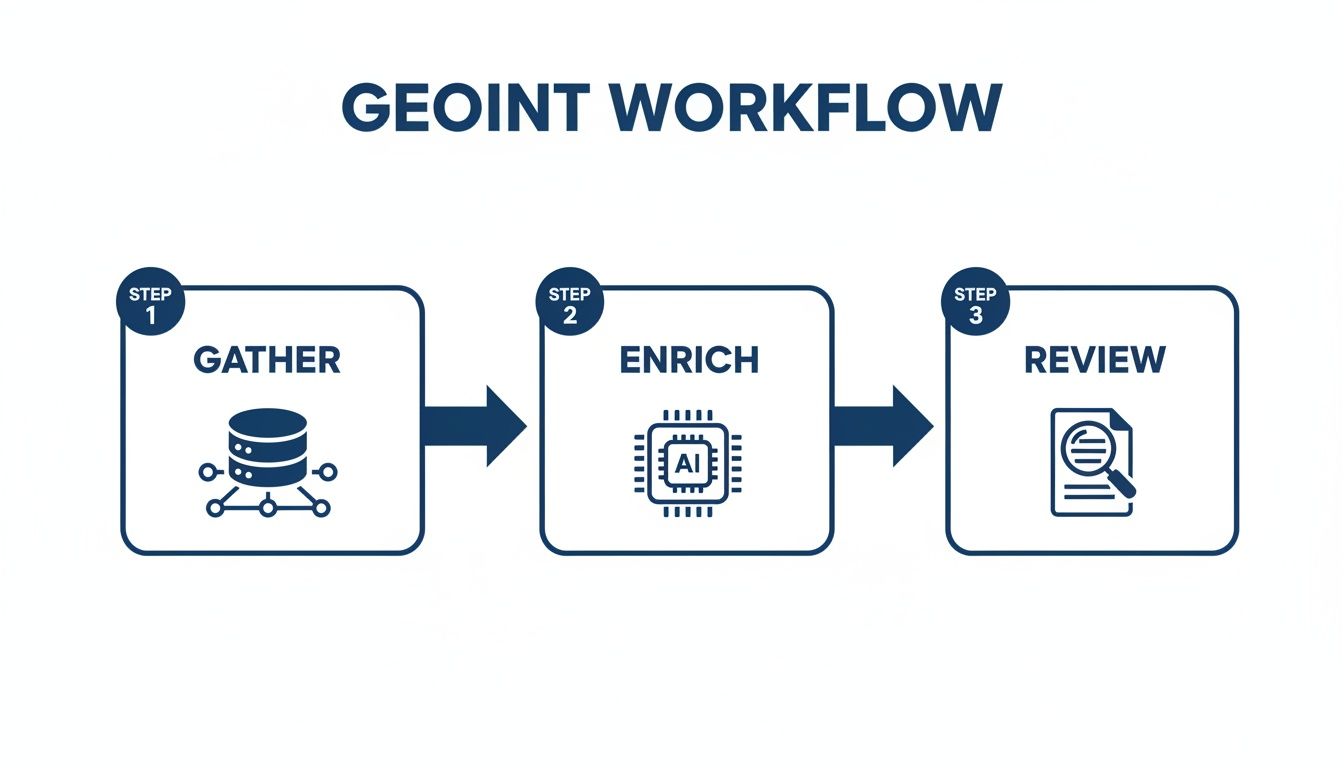
The key insight here is that GEO isn't a one-and-done task. It's a continuous cycle of gathering data, enriching it with AI, and then validating the output.
This workflow turns a complex concept into a set of achievable actions. Here’s the breakdown:
The real magic happens during the enrichment phase. A modern PIM system doesn't just store your data; it actively helps you improve it. This is where you connect GEO theory to a powerful, automated tool.
For omnichannel retailers and product managers, this means centralizing all product data, attributes, variants, specs, and media, and then using multiple LLMs with prompt templates to enrich and optimize content automatically. Imagine turning raw manufacturer specs into GEO-optimized copy tailored for Amazon, Google Shopping, or eBay, all while ensuring consistency. The stakes are high: without GEO, brands risk becoming invisible. You can find more details on this market trend in Intel Market Research's latest report.
A PIM system with built-in AI doesn't just automate content creation; it automates optimization. It transforms your messy, inconsistent data into a structured, fact-dense knowledge base that AI engines will see as a trusted source.
For example, a PIM can take a dry, technical spec like "Material: 6061-T6 Aluminum" and, using a predefined prompt, generate a compelling, GEO-friendly bullet point:
This small but significant change makes your content far more valuable, both to human shoppers and to the AI models trying to understand your products.
One of the biggest challenges with GEO is maintaining quality when you're dealing with thousands of products. This is another area where a PIM system shines, especially one built for this new world.
Features like completeness scoring are vital. The PIM can automatically score each product based on how complete its data is, flagging items that are missing critical information needed for optimization. For instance, it can alert you that 75% of your products are missing "material composition" data, which is crucial for answering specific user queries.
Furthermore, built-in review and approval workflows ensure a human touch is always part of the process. Content can be automatically routed to the right team members for approval before it's published. This combination of AI-powered generation and human-led oversight makes enterprise-level GEO not just possible, but manageable.
The old SEO playbook is getting tossed out the window. For years, we obsessed over climbing the rankings and boosting click-through rates (CTR). But with Generative Engine Optimization, those numbers are starting to feel like vanity metrics. They just don't tell the whole story.
Think about it. When an AI gives a user a direct, perfect answer, there’s no click. Your information might have been the star of the show, but your website analytics won't even register a blip. We need a new way of looking at success, one that moves beyond the click and focuses on influence.
The new game is all about measuring your brand’s presence inside the AI-generated answer. It's less about driving traffic and more about becoming the trusted source that AI models turn to. This means we need a new breed of key performance indicators (KPIs) that track your influence, not just your pageviews.
These new KPIs are how you’ll prove the value of your GEO work. They demonstrate how you're shaping the conversation in your industry, even when it doesn't lead to a direct visit to your site.
Here are the metrics that matter now:
While the total volume of traffic from AI-powered search might be lower, don't let that fool you. That traffic is often far more valuable. When a user lands on your site because an AI has already vouched for your product, they are incredibly qualified and much, much closer to making a purchase.
This is high-intent traffic. These users have already had their basic questions answered and are now in decision-making mode. The AI has essentially pre-sold them on your solution.
This shift means we're trading high-volume, low-intent traffic for lower-volume, high-intent traffic. The result is often a significant boost in conversion rates, making every click from an AI source incredibly valuable.
Recent data shows this trend in action. One analysis revealed that AI search traffic has skyrocketed an unbelievable 527% year-over-year. While it's still early days, some sites are already seeing over 1% of their total traffic come directly from platforms like ChatGPT and Perplexity. And the best part? This traffic converts at a higher rate because users arrive with a solid recommendation already in mind. You can dig into more stats on the growth of AI-driven search on Fuel Online.
So, how do you actually measure all this? You'll need to roll up your sleeves, because standard analytics tools are still playing catch-up. Tracking GEO success involves a mix of manual spot-checks and diving deep into your referral data.
For starters, you can begin by regularly asking AI engines questions that matter to your business. See what they say. Document when and how your brand gets mentioned.
You can also set up specific filters in your analytics platform to isolate referral traffic from domains tied to these AI tools. Keep an eye out for referrers like chat.openai.com. By combining these hands-on methods, you can start building a new framework for proving the ROI of your content in the age of AI.
Getting started with Generative Engine Optimization might feel like a huge project, but it doesn't have to be. The trick is to start small, find what works, and then build on that momentum. This simple plan will get you moving from theory to real-world results, positioning your brand for the new reality of AI search.
Make no mistake, this shift is happening fast. By 2026, AI search became a dominant force. Google's AI Overviews were already serving over 2 billion users a month, ChatGPT hit 800 million weekly users, and Perplexity was handling hundreds of millions of questions. With some studies showing roughly 60% of searches now result in no clicks, having a plan isn't just a good idea, it's essential for survival. You can dive deeper into mastering GEO in 2026 over at Search Engine Land.
First things first: don't try to boil the ocean. Pick one single, important product category to focus on. This makes the whole process manageable and gives you a repeatable blueprint you can use for everything else later.
Ready to jump in? This checklist breaks it all down into five clear, concrete steps. Follow this, and you’ll build a solid foundation for your entire GEO strategy.
A solid, centralized data foundation isn't just nice to have; it's the engine that powers everything else. Your AI-optimized content is only as good as the accurate, reliable information it's built on.
Got a few questions about Generative Engine Optimization? You're in good company. Let's tackle some of the most common ones to help clear things up.
While just about any business can get something out of it, eCommerce brands and companies with complex products stand to gain the most from a solid GEO strategy. It all comes down to the kind of information your customers need before they buy.
If your customers are asking specific, fact-based questions about technical specs, materials, or how one model compares to another, then GEO is critical for you. It’s the only way to make sure AI engines can find and use those details to confidently recommend your products.
This isn't like traditional SEO, where you might be waiting months for your rankings to budge. The impact of GEO can show up much faster. Once you’ve updated your product data with structured, fact-dense information, AI crawlers can pick up on those changes pretty quickly.
That said, building real authority takes time. You might see some initial wins in a few weeks, but consistently appearing in AI-generated answers as a trusted, go-to source is a long-term goal. It requires ongoing effort.
Nope. Think of them as partners, not competitors. Traditional SEO is still absolutely vital for getting discovered on standard search result pages, driving direct traffic, and building your website's overall authority.
Generative Engine Optimization is an essential new layer on top of your existing SEO work. SEO gets people to your website; GEO ensures you're part of the conversation even when they don't click. Together, they create a complete strategy for visibility.
Ready to build a GEO strategy that puts your products front and center in the AI era? NanoPIM is the AI-powered PIM and DAM system designed to centralize, enrich, and optimize your product information for generative search. See how it works at https://nanopim.com.


