

A generative engine optimization tool is your secret weapon for getting products seen and recommended by AI assistants like ChatGPT. It's the software that ensures your brand gets found in a world where shoppers get answers directly, not just a list of blue links.
The way customers find products is changing, and it's happening fast. For years, Search Engine Optimization (SEO) was the only game in town. You chased keywords and built backlinks to climb Google's rankings. But today, AI chatbots and answer engines are the new starting point for millions of shoppers.
Think of it like asking a super knowledgeable store assistant for a recommendation instead of wandering the aisles yourself. This is a complete game changer for e-commerce. As we step into this new frontier, it's vital to grasp the deep implications of generative AI, especially in how SGE will change small business marketing forever.
The rise of AI isn't just a trend; it's a huge event rewriting the rules of online visibility. Just look at the explosive growth hitting e-commerce right now. AI-generated traffic to U.S. retail sites skyrocketed by a staggering 4,700% year-over-year as of July 2025.
This surge, led by tools like ChatGPT which holds 59.70% of the generative AI market, is a clear signal: brands that ignore this shift are already being left behind. You can dig deeper into these trends and what they mean for retailers by checking out the latest GEO statistics.
This new reality demands a new strategy. Generative Engine Optimization (GEO) is the art and science of preparing your product information so AI models can understand, trust, and ultimately recommend it. Your old SEO playbook is losing its punch because it was built for search engine crawlers, not for conversational AI.
To put it simply, optimizing for a list of links is fundamentally different from optimizing for a direct, conversational answer.
Here’s a quick comparison to show you what I mean:
| Aspect | Traditional SEO | Generative Engine Optimization (GEO) |
|---|---|---|
| Primary Goal | Rank high in a list of search results (SERPs). | Be the source for a direct AI-generated answer. |
| Target Audience | Search engine crawlers (bots) and then humans. | AI models (LLMs) and then humans. |
| Key Signals | Backlinks, keywords, domain authority. | Structured data, factual accuracy, clarity, context. |
| Content Focus | Keyword density, on-page optimization. | Comprehensive, well-structured, factual information. |
| Outcome | User clicks a link to visit your page. | Your product/brand is cited directly in the answer. |
As you can see, the focus moves away from simply trying to rank and toward providing the most accurate, useful, and trustworthy information possible. It’s a shift from gaming an algorithm to genuinely informing an intelligence.
A generative engine optimization tool is the bridge between your product catalog and the AI that customers now use to make buying decisions. Its main job is to translate your data into the language that answer engines prefer.
Without a specific strategy for AI, your products are at risk of becoming invisible. A generative engine optimization tool is built to stop that from happening. It takes your raw product information and structures it perfectly for AI models to consume.
Here’s what that really means for your business:
Throughout this guide, we’ll use a solution like NanoPIM as a practical example. It's a platform built from the ground up to help brands master this new challenge and win in the age of AI search.
A Generative Engine Optimization (GEO) tool might sound intimidating, but its process is surprisingly straightforward when you peek under the hood. It’s not magic. It’s a smart, repeatable workflow that turns your raw product data into high-performing content that AI answer engines love.
Think of it like an automated gourmet kitchen. It takes your raw ingredients (product data) and follows a precise recipe (your brand rules) to cook up perfect product descriptions, titles, and summaries every single time. It’s the engine connecting what you sell to how people now discover it.
This flow shows just how much the customer journey has changed, shifting from old-school SEO to the new world of GEO.
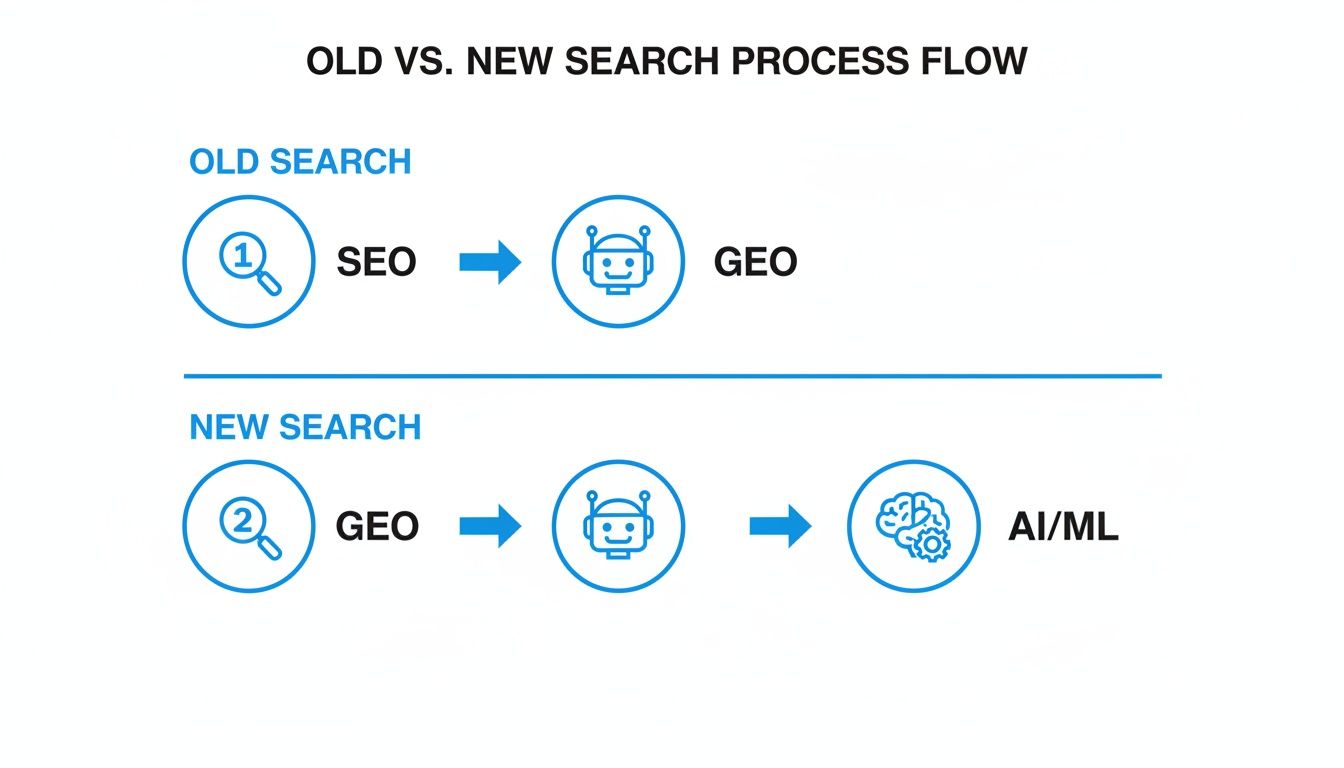
The big takeaway here? The search no longer just ends with a list of blue links. Today, AI-powered tools are the critical bridge between a person’s question and the direct answer they get.
At its heart, a GEO tool is an orchestrator, bringing several key pieces together in perfect sync. Once you understand the parts, the whole system makes a lot more sense. Your data is the fuel, AI is the engine, and your brand guidelines provide the steering.
The main players are:
The tool acts as the head chef, pulling ingredients from your PIM, handing the right recipe to the LLM, and ensuring the final dish is ready to serve.
Everything starts by connecting to your single source of truth, your PIM system. Your PIM is like a digital pantry, holding all the raw ingredients for your content. A good GEO tool plugs directly into it, ensuring it's always pulling the most accurate, up-to-date information.
This direct connection is absolutely vital. It means the AI is always working with the latest specs, pricing, and availability. Without that live link, you’re just asking for trouble, generating content based on old data that erodes customer trust and tanks your AI visibility.
A generative engine optimization tool transforms your PIM from a simple database into a dynamic content-generation hub, ready to feed AI answer engines exactly what they need.
The tool grabs the necessary product attributes, like dimensions, materials, or key features. This raw data is the foundation for everything else. The cleaner and more organized your data is, the better the final output will be. You can learn more about this by reading our guide to effective generative engine optimization strategies.
Once an LLM generates the first draft, the work isn't over. Now it's time for the "taste test." This is where an advanced GEO tool really shines by using an automated scoring system.
This feature instantly analyzes the new content against a checklist of rules. For instance, it checks if:
The content gets a score based on this analysis. If it doesn't pass, the tool can automatically send it back to the LLM with instructions for revision. This loop continues until the output is not only creative but also accurate, compliant, and perfectly optimized for its destination.
For years, the rules of the game were simple. You invested in Search Engine Optimization, learned what Google wanted, and fought your way to the top of the results page.
But let’s be honest: that playbook is getting old. The way people find products and answers has completely changed, and your old SEO strategy just wasn't built for this new reality.
The customer journey doesn’t always start with a search bar anymore. More and more, especially with younger shoppers, it begins with a conversation. People are turning to AI assistants for fast, direct answers, and that’s a huge problem if you aren't ready. Your products risk becoming invisible to a massive, growing audience.
You might think that ranking number one on Google automatically makes you the top recommendation in an AI response. Shockingly, that’s almost never the case. The rules for getting an AI's attention are completely different from what traditional search engines reward.
The data makes this painfully clear. One analysis of responses from ChatGPT, Gemini, and Copilot was particularly revealing. Fewer than 10% of the sources they cited even appeared in the top 10 Google results for the same questions. This just goes to show how flat the old SEO tactics are falling in the age of generative AI. You can see how some are trying to bridge this gap by looking into top GEO agencies.
This means all the time and money you spent climbing the search rankings might do next to nothing to get your products mentioned in an AI summary. These models are looking for something else entirely, a difference that can make or break your visibility online.
AI answer engines don't just index your content; they interpret it, summarize it, and form opinions. They are shaping how customers perceive your brand long before anyone ever visits your website.
So, what do these AI models want? They crave structured, factual, and unambiguous information. While old-school SEO obsessed over keywords and backlinks, Generative Engine Optimization (GEO) is all about clarity and context. An AI needs to understand your product's features, materials, and benefits with absolute certainty.
This is where a generative engine optimization tool becomes critical. It's not just another SEO plugin; it's a solution purpose-built to solve this exact problem. It takes your messy, scattered product data and refines it into a perfectly structured format that AI models can easily digest and trust.
Think of it this way:
We’re already seeing this shift in other areas. The move from tedious manual work to automated workflows, like using advanced tools for Automatic 3D Modeling, proves that structure and automation are what's required to keep up.
A dedicated GEO tool like NanoPIM is designed to turn your product information into that "perfect index card." It prepares your data so that AI models don't just find it, they are far more likely to cite and recommend it. It's about making the shift now, before you get left behind in this new era of discovery.
Picking the right generative engine optimization tool can feel like a huge decision, especially with new options popping up all the time. How can you tell which features actually matter for a retail or manufacturing business? The secret is to look past the flashy dashboards and zero in on the core capabilities that drive real results.
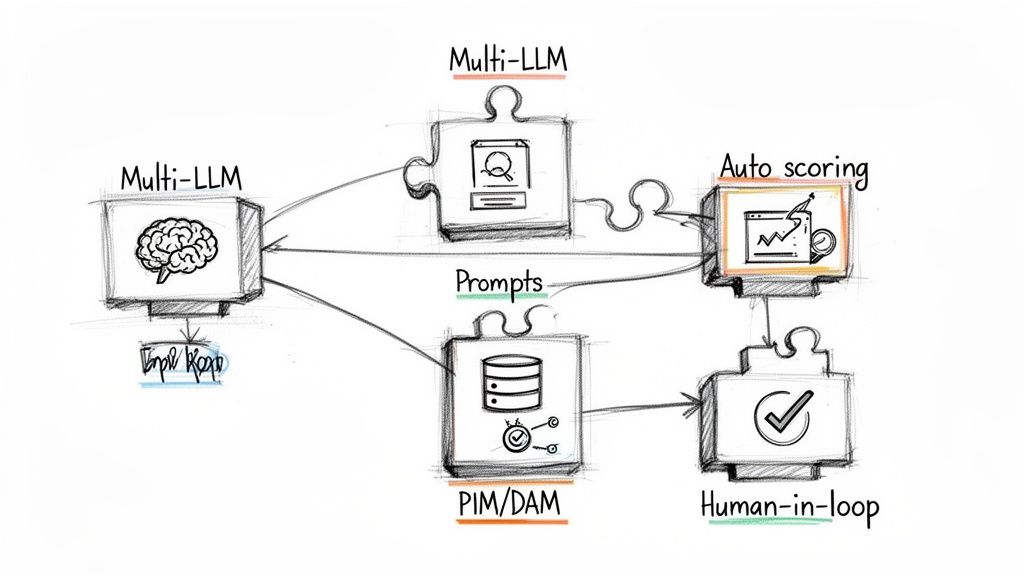
When you're evaluating a solution, think of it like hiring a key team member. You need someone smart, flexible, detail-oriented, and who plays well with your existing tech stack. These features are your job description, making sure you find a tool that will actually help you win.
Let's break down the must-haves that separate a good generative engine optimization tool from a great one.
Not all Large Language Models (LLMs) are created equal. Some are brilliant creative writers, while others are masters of sticking to the hard, technical facts. A top-tier GEO tool won’t lock you into a single AI model.
Instead, it offers multi-LLM support, letting you pick the best "brain" for the job.
For instance, you might use one LLM to write a killer marketing description for a new sneaker and a different one to generate a precise, fact-based summary of its material specs. This flexibility is what guarantees you get the highest quality output, no matter the type of content you're creating. It also future-proofs your entire strategy, allowing you to plug in new and better LLMs as they hit the market.
If LLMs are the engines, then prompt templates are the steering wheels. These are your pre-built "recipes" that tell the AI exactly how to create content that’s on-brand, accurate, and perfectly tuned for a specific channel.
A great GEO tool gives you total control to build and save templates for all your different needs:
Customization is everything. It’s the difference between generic, robotic text and content that feels like it was written by someone who truly gets your brand and your customers.
The most powerful feature of a generative engine optimization tool isn't just generating content; it's generating the right content, every single time. Customizable templates make this possible.
A GEO tool is only as good as the data it’s fed. That’s why seamless integration with your Product Information Management (PIM) and Digital Asset Management (DAM) systems is completely non-negotiable.
This connection creates a direct pipeline from your single source of truth to the AI content engine. You can dive deeper into how a central data hub works in our guide on what a PIM system is and why you need one.
Without this, you're stuck with manual data exports and imports, a process that’s slow, tedious, and a breeding ground for errors. A solid connection ensures the AI is always working with the latest product specs, pricing, and images.
It prevents the tool from hallucinating or writing content based on old information, protecting your brand's reputation and ensuring both AI answer engines and customers can trust what they read. This turns your PIM from a simple database into a dynamic hub for all your content creation.
So you’ve implemented a new tool. It’s only a matter of time before management asks the big question: “How do we know it’s working?” When it comes to a generative engine optimization tool, answering that question is everything, but it calls for a new way of thinking. You can't just slap your old SEO dashboard on this and expect it to make sense.
Measuring the success of Generative Engine Optimization (GEO) isn’t just possible; it’s essential. It’s about moving past vague ideas and getting laser-focused on tangible metrics that prove the tool is delivering real value. The goal is to connect your brand's presence in AI-generated answers to actual business outcomes.
Let’s break down the specific numbers you need to be watching to prove the value and calculate the return on investment (ROI) for your GEO efforts.
Your GEO dashboard won't look like your Google Analytics dashboard, and that’s a good thing. It’s focused on a completely different part of the customer journey, one that’s all about influence and citations, not just clicks from a search results page.
Here are the primary KPIs you should be monitoring:
These metrics give you a crystal-clear view of your visibility inside AI assistants. If these numbers are climbing, it's the first sign your generative engine optimization tool is doing its job. It means your structured data is successfully influencing the AI models.
Visibility is great, but ROI is what keeps the lights on. The next step is to draw a straight line from your GEO performance to core business metrics like traffic, conversions, and revenue. You need to show how getting cited by an AI directly impacts your bottom line.
This connection is becoming more critical by the day. As AI summaries become more common, clicks to traditional organic links are taking a serious hit. We're already seeing that when AI summaries appear, clicks to traditional links drop by a staggering 54%, from 15% to just 8% of visits.
But here’s the flip side: brands that get cited in those summaries see huge benefits, enjoying 38-39% lifts in clicks and ad performance. The future is generative, and getting optimized is no longer optional. You can discover more about how to master GEO in the coming years.
A successful GEO strategy doesn't just get you mentioned; it drives qualified traffic that converts. The ultimate goal is to prove that AI-referred visitors are more engaged and more likely to buy.
To build this case, you need to track the behavior of users who arrive from AI referrals. Dig into these secondary metrics:
By tracking these numbers, you build a powerful, undeniable story. You can walk into any meeting and say, "Our investment in a generative engine optimization tool increased our citations by 40%. This drove 1,000 new high-intent visitors last month and resulted in a 15% lift in conversions from that cohort."
That's an ROI calculation any leader will understand and appreciate.
Theory is great, but turning that knowledge into real-world results is what matters. Bringing a generative engine optimization tool into your workflow might feel like a massive undertaking, but it doesn't have to be. The key is breaking it down into a manageable plan.
Think of this as your practical guide to getting started.
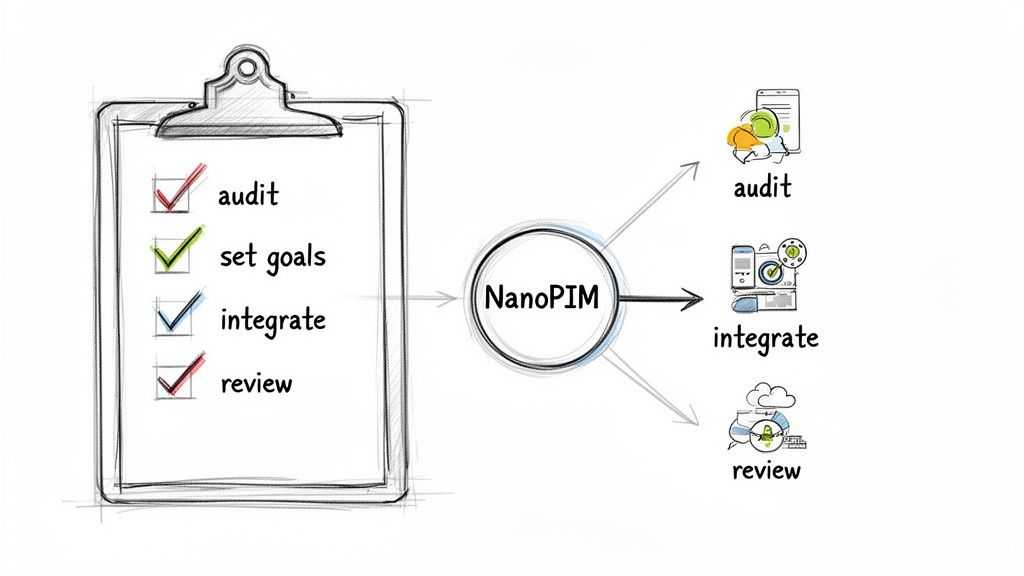
Follow these phases to get GEO running smoothly within your e-commerce operations.
Before you can ask an AI to create anything, you need to get your house in order. Any generative tool is only as good as the data you feed it. This first phase is all about building that solid data foundation.
Here’s where you start:
Audit Your Product Data: Be brutally honest. Take a hard look at your current product information. Is it accurate? Is it complete? You need to hunt down and fix the gaps, inconsistencies, and outdated details that will trip up an AI.
Centralize Everything in a PIM: This is non-negotiable. If you do nothing else, do this. Get all your product data into a single hub like NanoPIM. A Product Information Management system becomes your single source of truth and makes every other step infinitely easier.
Define What Success Looks Like: You can't hit a target you can't see. Decide on your goals and KPIs before you start. Is it increasing your "Share of Voice" on Amazon? Getting more citations for a key product line? Set clear, measurable goals from day one.
With your data organized, it's time to wire everything together. This is where you teach the GEO tool to work for your brand and follow your rules.
The goal of integration isn't just connecting software. It's about creating a seamless, automated flow of information from your data source straight to your customer-facing channels.
Focus on these three connections:
Automation gets you 90% of the way there, but that final 10% of human oversight is what protects your brand and ensures quality. This last phase is about building a governance process to keep your content engine running perfectly.
Put a simple review loop in place:
Even after diving deep into a new concept, a few questions are bound to pop up. It’s completely normal. Let’s clear the air and tackle some of the most common things people ask about generative engine optimization tools and what they really mean for your business.
I love this question because it gets right to the heart of the matter. Here’s a simple way to think about it:
SEO is about getting your product on the right shelf in the store so people can find it. GEO is about convincing the expert store clerk to pick up your product and personally recommend it to the customer.
Simply put, SEO gets you found on a page of results. GEO makes you part of the answer itself.
If you take away only one thing, let it be this: you absolutely need clean, organized product data. A generative engine optimization tool is powerful, but it’s not a mind reader. It can’t invent facts or specs out of thin air.
Your product data is the fuel for your GEO engine. The higher the quality of the fuel, the better the performance. Without a clean and centralized source of information, any content generation efforts will fall flat.
Honestly, before you even look at a demo, your first step should be getting your house in order. That means gathering all your product specs, attributes, and marketing copy into a single source of truth, like a PIM system. It’s the foundation that everything else is built on.
Absolutely. In fact, for businesses with smaller catalogs, a generative engine optimization tool can be your secret weapon. When you aren't managing tens of thousands of SKUs, you have the luxury of focusing on quality over quantity.
Think about it. With a smaller product lineup, you can:
This is how smaller teams can punch way above their weight. You can create world-class product content that outshines much larger brands in AI-generated answers.
Ready to transform your product data into your most powerful sales tool? With NanoPIM, you can centralize your information and start optimizing for the new era of AI-powered search. Learn more and get started today.


