

Ever walked into a store and just felt like you were in the right place? The way things are arranged, the displays that catch your eye, the clear path that guides you to exactly what you need. That's great merchandising.
Now, translate that feeling to a screen. That’s e-commerce merchandising. It's the craft of organizing your digital store to turn a simple visit into a great shopping experience.

Think about your favorite retail shop. You probably remember the inviting window displays, the neatly organized aisles, and the little signs that point you toward a great deal. E-commerce merchandising does the exact same thing, just in a digital space.
It’s the art and science of presenting your products in a way that just makes sense to the shopper, naturally encouraging them to explore and buy. This goes way beyond just having a list of items for sale. It’s about every visual and organizational decision you make.
And today, getting this right is non-negotiable. With global e-commerce sales expected to reach an incredible $6.88 trillion by 2026, the online world is more crowded than ever. That growth is driven by more than 2.77 billion digital buyers, meaning just having a website isn't enough to capture their attention. You can dive deeper into these global e-commerce trends to see just how fast the market is expanding.
When a customer has endless choices just a click away, your store has to do more than just exist. It has to connect. This is where smart merchandising separates a confusing, frustrating website from a store that feels genuinely helpful.
The goal is to build a shopping journey that helps people discover things they’ll actually love, turning casual browsers into repeat customers.
This means every piece of your site needs to work together. From the banners on your homepage to the order of products on a category page, every single detail plays a part in guiding your customer.
So, what does this actually involve? A few key activities form the bedrock of any solid online merchandising strategy. Think of them as the building blocks for a store that not only looks fantastic but also drives sales.
Ultimately, great e-commerce merchandising builds a shopping experience that feels effortless and enjoyable. This is where tools like a Product Information Management (PIM) system become so important. A PIM works behind the scenes, making sure every product has accurate, consistent, and compelling information no matter where your customer discovers it.
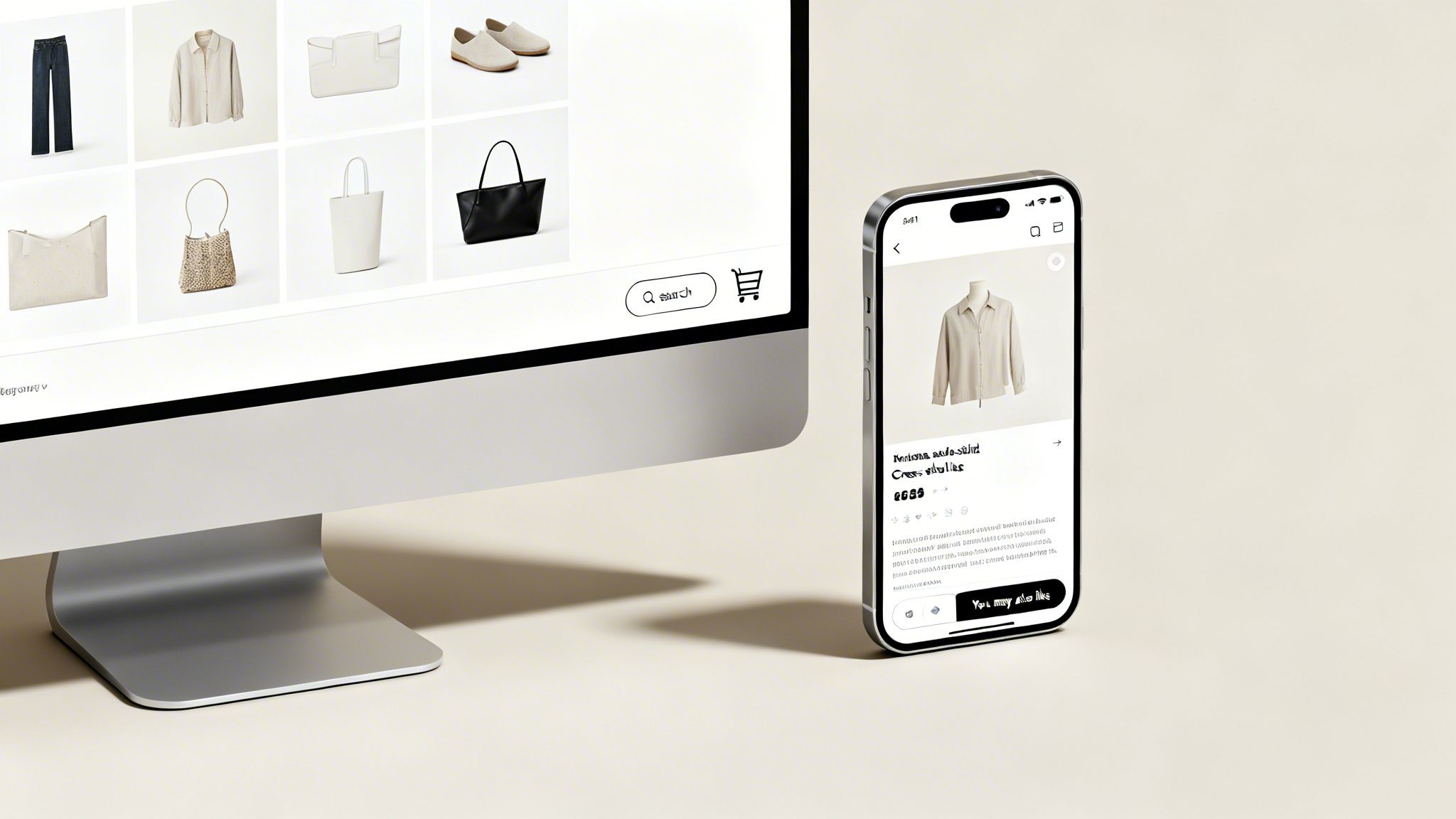
So, you’ve got products to sell. That’s the easy part. The real work is in creating a digital experience that guides customers from "just browsing" to "just bought." This isn't about luck or random promotions; it's about a handful of core strategies that build a high-performing online store.
Think of your website like a physical retail space. The homepage is your main window display, category pages are the well-organized aisles, and the product pages? That's where you make your final sales pitch.
Let's break down how to nail each part.
Your homepage is your welcome mat and your primary window display, all rolled into one. You have seconds to grab a shopper's attention and pull them deeper into your site. A cluttered or confusing homepage is a guaranteed way to send visitors bouncing before they see a single product.
A great homepage immediately spotlights your most compelling stuff, like bestsellers, new arrivals, and any promotions you're running. Use sharp, high-quality banners to make a strong first impression. Don't forget, around 94% of first impressions are tied directly to your site's design. Make it count.
The product detail page (PDP) is where the sale is truly won or lost. This is your one shot to tell a product’s story and convince a shopper that it’s the perfect fit for them. A great PDP does more than just list features; it answers questions, builds trust, and creates real desire.
Here are the non-negotiables for a product page that actually converts:
Once a shopper shows interest in a product, you have a golden opportunity to increase their order value. This is where cross-selling and up-selling come into play. They're simple tactics, but they are incredibly effective for any merchandising strategy.
Cross-selling is the art of suggesting complementary products. It’s the digital version of "Do you want fries with that?" On a product page for a pair of jeans, you might show a matching belt. Selling a new toy? Suggest the batteries it needs.
Up-selling, on the other hand, is about nudging the customer toward a better, more premium version of the item they're looking at. This could be a larger size, a newer model, or a package with more features.
When done right, a cross-sell or up-sell feels genuinely helpful, not pushy. The key is to offer relevant suggestions that actually improve the customer’s purchase.
Of course, none of these strategies work if your product data is a mess. A central source of truth for all your product information, like a Product Information Management (PIM) system, is what holds it all together. It ensures every description, image, and price is accurate everywhere, making your merchandising efforts consistent, scalable, and ultimately, successful.
You’ve poured hours into perfecting your product pages, refining your site navigation, and creating beautiful collections. But in e-commerce, looks aren't everything. How do you know if any of it is actually working?
You can’t rely on gut feelings. You need data. Tracking the right numbers is like having a real-time dashboard for your merchandising strategy. It tells you the unvarnished truth about what’s resonating with customers, what’s falling flat, and where your biggest opportunities are hiding.
Let's break down the essential numbers that truly matter.
If you only track one metric, make it this one. Your conversion rate is the bottom line. It’s the percentage of visitors who do what you want them to do, which is almost always making a purchase.
Think about a brick-and-mortar shop. If 100 people walk in but only two buy something, the store’s conversion rate is a dismal 2%. The same principle applies to your online store. A healthy conversion rate is the clearest sign that your merchandising is successfully turning browsers into buyers.
Great merchandising has a direct impact on this number. Are your product pages convincing? Is the path to checkout effortless? A rising conversion rate tells you the answer is yes.
Next on the list is Average Order Value (AOV). This metric reveals the average amount of money a customer spends in a single transaction. You can figure it out easily: just divide your total revenue by your total number of orders.
AOV is where smart merchandising tactics like cross-selling and upselling really shine. When you successfully suggest a complementary battery for that new gadget (a cross-sell) or nudge a customer toward a more premium version of a product (an upsell), you're actively pushing your AOV higher.
A rising AOV means your merchandising isn't just selling products. It's creating bigger, more valuable baskets. It shows you’re moving beyond simple transactions to effectively showcase the full breadth and value of your catalog.
If you’re testing out product bundles or "shop the look" features, keep a close watch on this metric. An increase is the proof you need that those strategies are hitting the mark.
Beyond the two headliners, several other KPIs provide the critical context you need to build a complete picture of your performance. They help you diagnose specific issues and understand the "why" behind your main numbers.
The table below breaks down the most important metrics you should be tracking.
| Metric (KPI) | What It Measures | Why It's Important for Merchandising |
|---|---|---|
| Add-to-Cart Rate | The percentage of visitors who add at least one item to their cart. | A high rate means your product pages are compelling, with strong visuals, persuasive copy, and a clear call-to-action. |
| Cart Abandonment Rate | The percentage of shoppers who add items to a cart but leave without paying. | A high rate often points to friction in the checkout process, like surprise shipping costs or a complicated form. |
| Bounce Rate | The percentage of visitors who land on a page and leave without any interaction. | On a product page, this signals a mismatch. The product wasn't what they expected, or the page was confusing or unappealing. |
| Product Views per Session | The average number of product detail pages a visitor sees before leaving. | This shows how well your site encourages discovery through related items, categories, and internal search. |
| Sales per Category | The revenue generated by each of your product categories. | Helps you identify which parts of your catalog are strongest and where to focus your merchandising efforts. |
By keeping an eye on this full suite of indicators, you get a much sharper, more nuanced view of your store’s health. These numbers give you the actionable insights needed to stop guessing, make smarter decisions, and build a merchandising strategy that consistently drives growth.
Jumping onto marketplaces like Amazon and Google is a whole different ballgame. It's like moving from a cozy neighborhood shop to a sprawling, chaotic global bazaar. The rules are different, the competition is everywhere, and shoppers show up with a unique mindset. What got you this far on your own website won't just magically work here. Your merchandising e commerce strategy needs a serious rethink to stand a chance.
Each platform is its own world. Think of Amazon as a product-finding machine; people land there ready to buy. Google Shopping, on the other hand, is often where the journey begins, a discovery engine for comparing options. Nailing this fundamental difference is the first step to crafting a winning approach for each.
On Amazon, your product detail page is your entire storefront. You’re literally surrounded by your competition, so your listing has to do some heavy lifting to grab attention and earn trust. This is where smart merchandising becomes your secret weapon.
One of the best tools in your arsenal is A+ Content. It’s an Amazon feature letting brands swap out plain text descriptions for rich visuals, comparison charts, and brand stories. This is your shot to take control of the conversation and build a premium experience that makes generic listings look amateur. To really pull ahead, you have to dig into the details of effective Amazon Listing Optimization.
Great A+ Content transforms a basic product listing into something that feels more like a dedicated landing page. It visually answers questions, shows the product in action, and builds the confidence needed to turn a "maybe" into a definite "add to cart."
Put it this way: a standard listing is a black-and-white instruction manual. A+ Content is the full-color, glossy brochure that tells a story. Our in-depth guide on Amazon product listing optimization has even more tactics to make your products impossible to ignore.
While Amazon is a destination, Google Shopping is usually the starting line. Shoppers use it to compare products from dozens of retailers at a single glance. Your success here comes down to one thing: the quality of the product data you feed into Google's system.
Your product feed is everything. It's the blueprint Google uses to show your products to the world, and a messy, incomplete feed will render you invisible. To get noticed, you need to obsess over two things:
A great Google Shopping listing gives the shopper all the essential info upfront, so they click through to your site already knowing they're in the right place.
Trying to manually manage unique content for your own site, Amazon, and Google is a recipe for burnout. This is where modern tools give you a massive leg up. An AI-powered Product Information Management (PIM) system can automate a huge chunk of this work.
Imagine having a single source of truth for all your product information. From that central hub, you can use AI to automatically spin up optimized titles and descriptions that are perfectly tailored to each marketplace's rules and character limits. It keeps your merchandising e commerce efforts consistent but customized, saving you hundreds of hours of mind-numbing work.
This kind of automation is a game-changer in crowded markets. The top categories, like consumer electronics and fashion, pulled in over $1.89 trillion in global sales. With U.S. marketplace sales alone projected to hit $477.7 billion in 2025, you need serious tools to compete at that scale. You can explore more about these e-commerce statistics to grasp just how big the opportunity is. A PIM acts as your command center, helping you show up and sell better, everywhere.
Ever look at a top e-commerce brand and wonder how they manage thousands of products so seamlessly? It’s not a massive team working around the clock. The secret is a smart tech stack doing the heavy lifting.
If you’re still wrestling with a jungle of spreadsheets to manage your product catalog, you know the pain. It’s a guaranteed path to chaos that is slow, full of errors, and impossible to scale. The most successful stores have moved on. They’re running on specialized tools built for the realities of merchandising e commerce, and it's this engine that powers a killer customer experience.
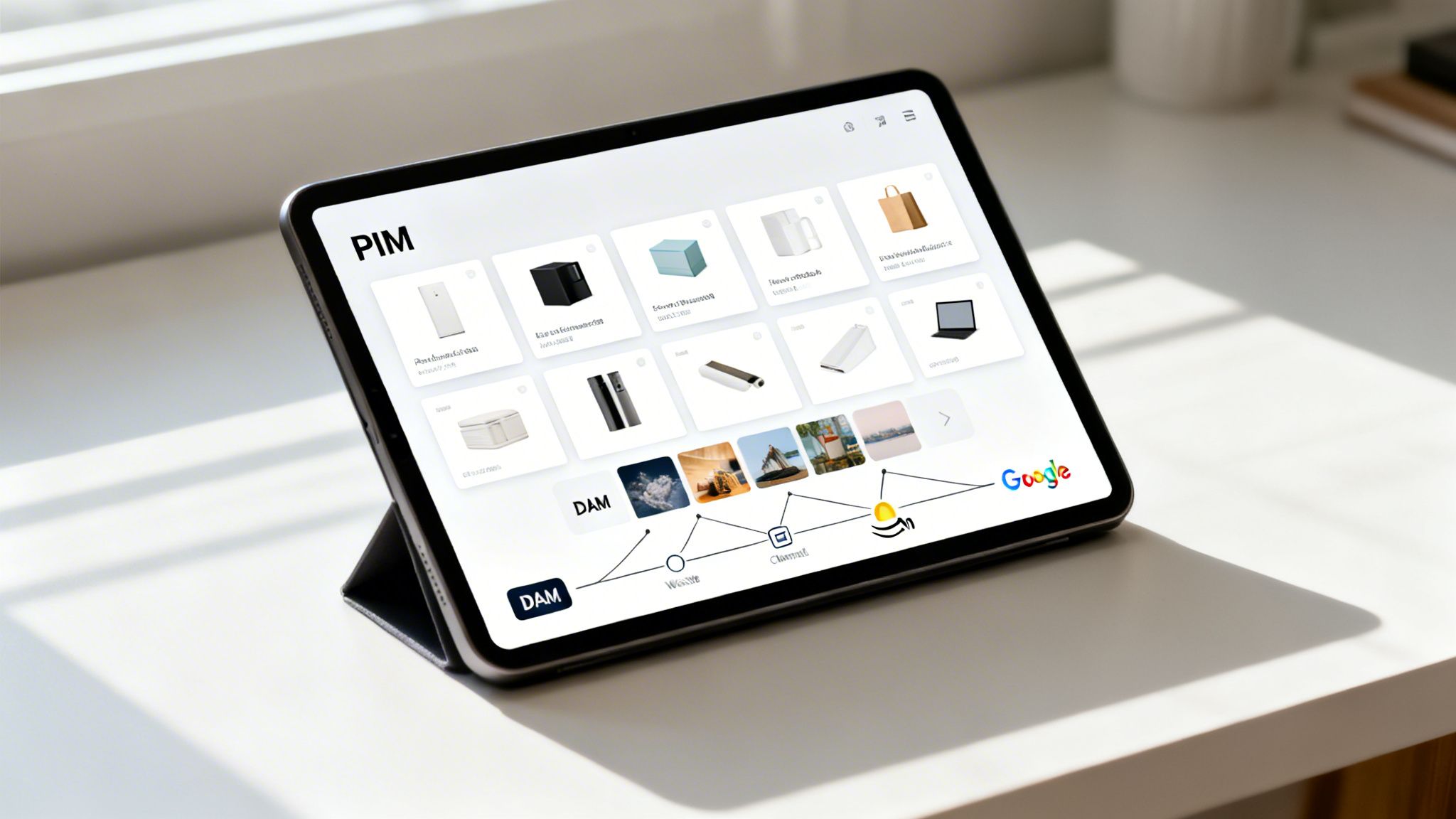
At the core of this modern setup are two tools that are practically inseparable: a Product Information Management (PIM) system and a Digital Asset Management (DAM) system. Let’s break down what they actually do.
Imagine trying to build a house where every contractor has a different blueprint. The walls wouldn't line up and the windows would be in the wrong spots. The whole project would be a disaster. That’s exactly what it feels like to run a store without a central hub for your product data.
This is where a Product Information Management (PIM) system changes the game. Think of it as the one official library for every single piece of information about your products.
A PIM system centralizes all your product data, from SKUs and prices to technical specs and marketing copy, into one organized hub. This creates a single source of truth that every team member and sales channel can rely on.
No more hunting through endless folders or asking which product description is the latest version. Your team has one place to go for everything. This clarity is foundational. To really get how this works, check out this deep dive on what a PIM system is and how it brings order to your operations.
Working right alongside the PIM is its visual counterpart: the Digital Asset Management (DAM) system. If the PIM is the library for your text and data, the DAM is the secure vault for all your visuals. We’re talking every product photo, lifestyle shot, tutorial video, and brand logo you’ve got.
But a DAM is more than just a fancy storage folder. It’s an intelligent system that organizes files with tags and metadata, making it dead simple to find what you need. A quick search for "white background photos of the new summer collection" pulls up exactly what you’re looking for, instantly.
The real magic happens when your PIM and DAM are connected. This integration links each product’s data to its corresponding images and videos. When you update a product, its visuals are right there with it, ensuring you maintain a polished, professional look across your entire digital storefront.
The most recent leap forward in merchandising e commerce tech is the addition of Artificial Intelligence (AI). AI is completely changing the game by automating one of the most tedious jobs for any merchant: writing compelling product content.
Modern PIMs now use AI to spin raw product specs into engaging, benefit-driven descriptions. But it gets better. AI can generate multiple versions of that copy, each one fine-tuned for a specific sales channel.
This level of automation frees up hundreds of hours, ensuring your products are always presented in the best possible light, no matter where you sell them. Some advanced tools can even streamline your photography by turning a simple product shot into a product to model AI image, making high-end visuals accessible to everyone.
At the end of the day, having a modern tech stack isn't a luxury anymore; it's a requirement for growth. By centralizing your data with a PIM and DAM and using AI to handle the grunt work, you can run a massive catalog with a lean, focused team. You get to stop drowning in manual data entry and start focusing on what really matters, creating an amazing shopping experience.
Alright, let's get this done. Here’s a rewrite of the section, crafted to sound like it was written by a seasoned e-commerce expert.
This is where the rubber meets the road. Moving from a chaotic mess of data to a smooth, profitable merchandising machine can feel like a massive undertaking, but it doesn't have to be. Think of this as your personal checklist for turning product information into revenue.
Let's walk through it, step-by-step.
Before you can fix anything, you have to know what’s broken. The very first step is to get brutally honest about the state of your product information.
Gather everything you have: spreadsheets, shared drives, ancient databases, you name it. Go on a scavenger hunt and look for the weak spots. Are there missing descriptions? Inconsistent specs? Low-quality, pixelated images? This initial audit will shine a spotlight on your biggest problems right away.
Once you know what you’re working with, the next mission is to get it all into one place. Scattered information is the sworn enemy of good merchandising. A single source of truth, like a PIM system, is non-negotiable for maintaining consistency and sanity.
This step is all about consolidating those disparate files into one unified hub. When you do this, you guarantee everyone on your team is singing from the same song sheet, which immediately slashes errors and saves a ton of time.
Centralizing your data is the foundation for everything else. It’s the single most important action you can take to build a scalable, efficient, and profitable merchandising operation.
With a central system in place, making updates becomes refreshingly simple. You change it once, and it populates everywhere you sell.
Next up, you have to decide what "winning" actually looks like. As we covered earlier, tracking key performance indicators (KPIs) is the only way to know if your strategy is actually making a difference or just making you busy.
Choose a few core metrics to obsess over at the start. These should tie directly back to your business goals.
Don't try to boil the ocean. Seriously. Instead of trying to overhaul all your sales channels at once, pick one to be your guinea pig. It could be your own DTC website, your Amazon store, or your Google Shopping feed.
Once you’ve picked your battleground, start applying the optimization strategies we've covered. Go in and punch up your product titles, rewrite those descriptions, and swap out mediocre images for great ones. This focused approach lets you test, learn, and see tangible results much faster.
Finally, put a simple review process in place. A quick check to make sure every change meets your quality standards before it goes live is all you need to keep things on track.
As teams start to get serious about their merchandising strategy, a few key questions almost always come up. We've heard them all, so let's tackle them head-on and clear up the common sticking points.
Everyone wants to jump straight to the fancy optimizations, but the best place to start is far less glamorous: a product data audit. You can't improve what you don't understand, and right now, your product information is likely scattered across countless spreadsheets, folders, and legacy systems.
The goal is to pull everything together and shine a light on the gaps, errors, and inconsistencies. This initial cleanup, getting all your data into one clean, centralized place, is the bedrock. It’s the foundational work that makes every other merchandising effort possible.
This simple roadmap lays out the path.
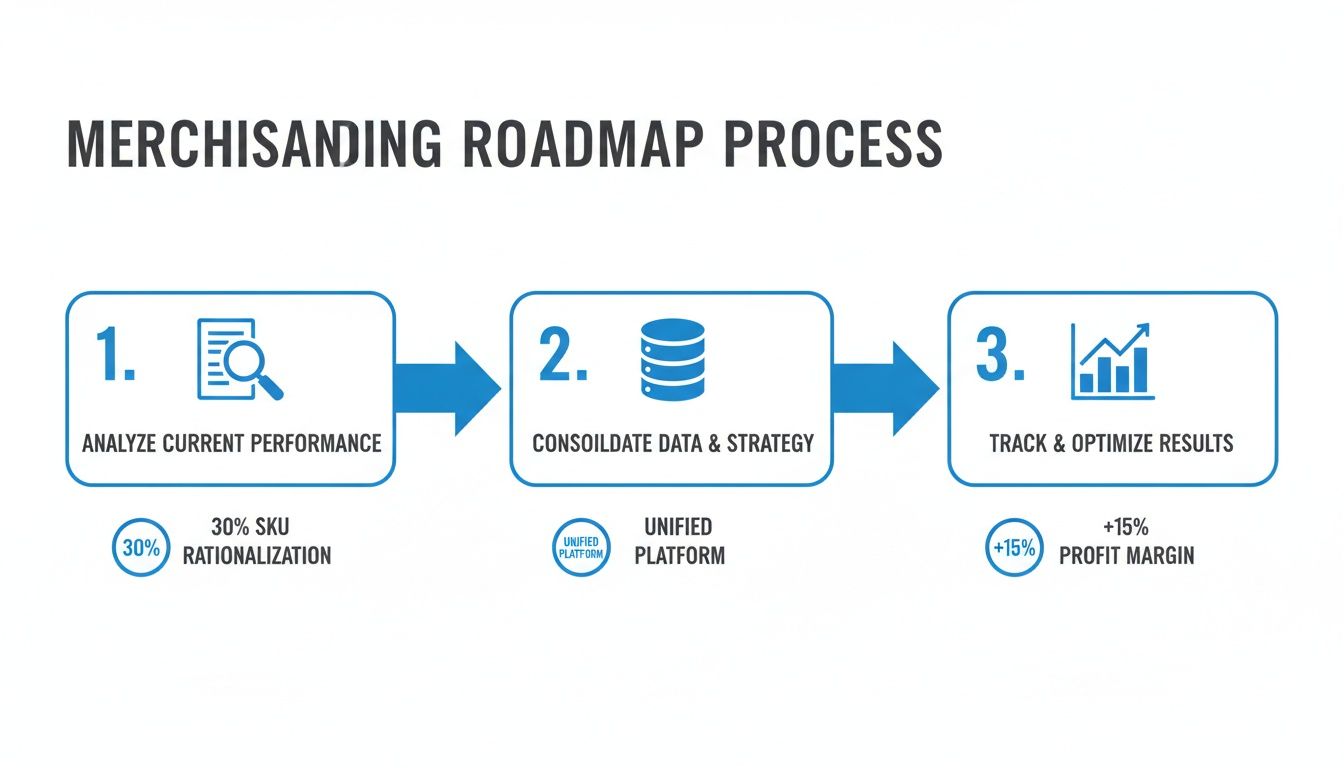
As you can see, auditing your data, centralizing it, and then measuring the results isn't just a suggestion; it's the most reliable path to building a high-performing merchandising engine.
Think of them as two specialists on the same team. Search Engine Optimization (SEO) is your front-of-house expert, focused on getting people from places like Google to walk through your digital front door. It’s all about attracting traffic.
E-commerce merchandising, on the other hand, is what happens after they arrive. It’s the in-store experience. Merchandising takes that traffic and guides them, engages them, and ultimately convinces them to buy. Great SEO brings you visitors, but great merchandising turns those visitors into customers.
That used to be the case, but not anymore. While Product Information Management systems were once reserved for enterprise giants with deep pockets, the landscape has completely changed. Modern tools are now built with flexible, affordable plans designed specifically for growing businesses.
The real question isn't about the cost, but the return on investment (ROI). A solid PIM eliminates hundreds of hours of mind-numbing manual work, slashes costly data errors, and empowers you to sell more effectively on more channels.
When you factor in that efficiency boost, you’ll find that the right tool often pays for itself far quicker than you’d imagine, making it one of the smartest investments you can make for growth.
Ready to stop wrestling with spreadsheets and start building a powerful merchandising strategy? NanoPIM centralizes all your product data and uses AI to create optimized content for every channel, turning manual chaos into automated growth. See how it works at https://nanopim.com.


