

Let's cut through the jargon. At its core, a data integration service is the glue that holds your business software together. It’s the process and the tech that gets all your different systems to talk to each other, combining data from separate places into one clear, unified picture.
Think of it as the universal translator for your business. It allows your CRM, ERP, and ecommerce platform to finally share information and work as a single, cohesive team.
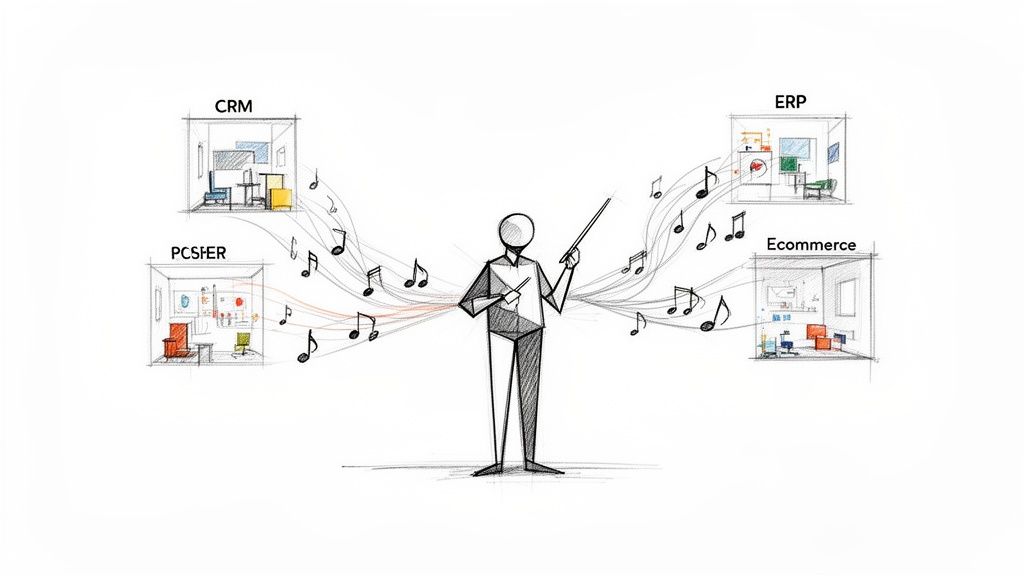
Picture your business as a world-class orchestra. Your marketing team is on strings, sales is on percussion, and your supply chain is the brass section. Each one is a master of their craft, but they're all playing from different sheet music. In separate rooms.
The result isn't music; it's just noise.
This is exactly what happens when your business data is siloed. Your CRM knows a customer's history, but your ecommerce platform doesn't, leading to generic, ineffective marketing. It’s a recipe for confusion, missed opportunities, and a clunky customer experience.
Data integration services play the role of the conductor. They bring everyone into the same concert hall, hand them a single score, and get them playing in perfect harmony. These services are what create that seamless flow of information, making sure every part of your business is in sync.
The table below shows the real-world difference between a business running on disconnected data versus one with a solid integration strategy.
| Business Area | Disconnected Data: The Problem | Integrated Data: The Solution |
|---|---|---|
| Marketing | Campaigns are generic because customer purchase history is in another system. Wasted ad spend and low conversion rates are common. | Personalized campaigns are created using a complete view of customer behavior, from first click to repeat purchase. |
| Sales | The sales team has no idea if a lead has recently interacted with a support ticket or abandoned a cart, leading to awkward, poorly-timed outreach. | Sales reps see every customer touchpoint in one place, allowing them to have relevant, timely conversations that close deals. |
| Customer Service | Support agents have to ask customers for information the company already has (like order numbers), creating a frustrating experience. | Agents have a 360-degree view of the customer, including order history and past interactions, enabling fast and effective problem-solving. |
| Inventory | The ecommerce site shows an item as "in stock," but the warehouse system knows it's gone. This leads to overselling and unhappy customers. | Real-time inventory levels are synced across all channels, from the website to physical stores, preventing stockouts and backorders. |
It's clear that getting your data to work together isn't just a technical exercise; it's a fundamental business advantage.
Without a smart strategy, data becomes a liability. It gets disconnected, messy, and impossible to act on. The first step is a solid understanding platform integration and what it means to connect different pieces of software. It’s about more than just shuttling data back and forth. It’s about making sure that data is consistent, accurate, and ready for anyone who needs it.
The entire point of data integration is to create a single source of truth. This is the holy grail: one reliable, up-to-date dataset that your whole organization can trust for reports, analytics, and big decisions.
For an ecommerce brand, the payoff is immediate and tangible. When a customer updates their shipping address on your site, that change instantly reflects in your fulfillment system with no manual entry needed. Your marketing team can see exactly what a customer bought last month and send them an offer they’ll actually care about.
Data integration isn't a one-and-done task; it's an ongoing process. While the tech stack can change, the core workflow almost always involves three key stages that turn raw, messy data into a priceless business asset.
Data Ingestion: This is step one, getting the raw data out of its original source. It could be sales data from your Shopify store, support tickets from Zendesk, or product info from a supplier's spreadsheet. If you want to go deeper, we have a whole guide on the meaning of data ingestion and its place in the data lifecycle.
Data Transformation: Once you have the data, it's almost never ready to use. This is the cleanup phase. Transformation can mean standardizing date formats, removing duplicate customer entries, or enriching product data with new attributes to make it more useful.
Data Loading: Finally, the clean, transformed data is loaded into its new home. This destination is typically a central system like a data warehouse, a data lake, or even a PIM, where it can be easily accessed for business intelligence, analytics, and operations.
By automating this flow, data integration services get rid of the soul-crushing, error-prone work of copying and pasting information between systems. You don't just save hundreds of hours; you dramatically improve your data quality, giving you the confidence to make the kind of smart, data-backed decisions that actually move the needle.
Not so long ago, data integration was a problem you’d find buried deep in an IT department’s backlog. Now, it’s a topic for the C-suite. So, what happened? The simple truth is that connecting your data has gone from a "nice-to-have" feature to a fundamental part of staying in business.
This isn't just a passing trend. It's a massive market shift with serious money behind it. The global demand for data integration is exploding, projected to rocket from $15.18 billion to $30.27 billion by 2030. That’s a staggering 12.1% compound annual growth rate. North America is leading the pack, with the U.S. market alone on track to hit $12.11 billion by 2030. You can dig into these real-time data integration growth rates to see the full story.
Those figures aren't just numbers on a slide deck. They represent thousands of companies waking up to the fact that siloed data is a dead end. In a world where customers and executives expect instant answers, you simply can't afford to have your information locked away in separate boxes.
What’s really fueling this fire? A few powerful forces are making data integration a top priority for any business that wants to compete, not just survive. This is about more than just a little efficiency boost; it’s about unlocking the next level of business intelligence.
Three main pressures are forcing everyone's hand:
For anyone in retail and ecommerce, this is where the rubber meets the road. It’s the difference between guessing what your customers want and knowing.
Without proper integration, running a business feels like trying to solve a puzzle with half the pieces missing. You might see that a marketing campaign flopped, but you have no idea it was because the featured product went out of stock on day one. You have purchase history in one system and website browsing data in another, with no way to connect them to send a perfectly timed, personalized offer.
Data integration services turn this fragmented guesswork into a reliable, complete picture. They ensure that everyone, from the marketing manager to the supply chain analyst, is looking at the same accurate, up-to-the-minute information.
This is what allows a business to become truly agile. When you can see the whole board, you can start anticipating your customer's next move instead of just reacting to their last one. Companies that don't connect their data aren't just being inefficient; they're essentially competing with a blindfold on while their integrated rivals see everything clearly. In today's market, that’s a handicap no one can afford.
So, we've established that connected data is the lifeblood of a modern business. But how does that data actually get from one system to another? Let's break down the most common ways it’s done.
Think of it like getting groceries. You can go to the store, buy everything, bring it home, and prep it all before you cook (one method). Or, you can have all the raw ingredients delivered and use your high-tech kitchen to do the prep work right before you need it (another method). Each has its place.
Understanding these approaches is key to picking the right one for your specific goals, whether it's powering AI, digging for insights, or just making your cloud tools work together.
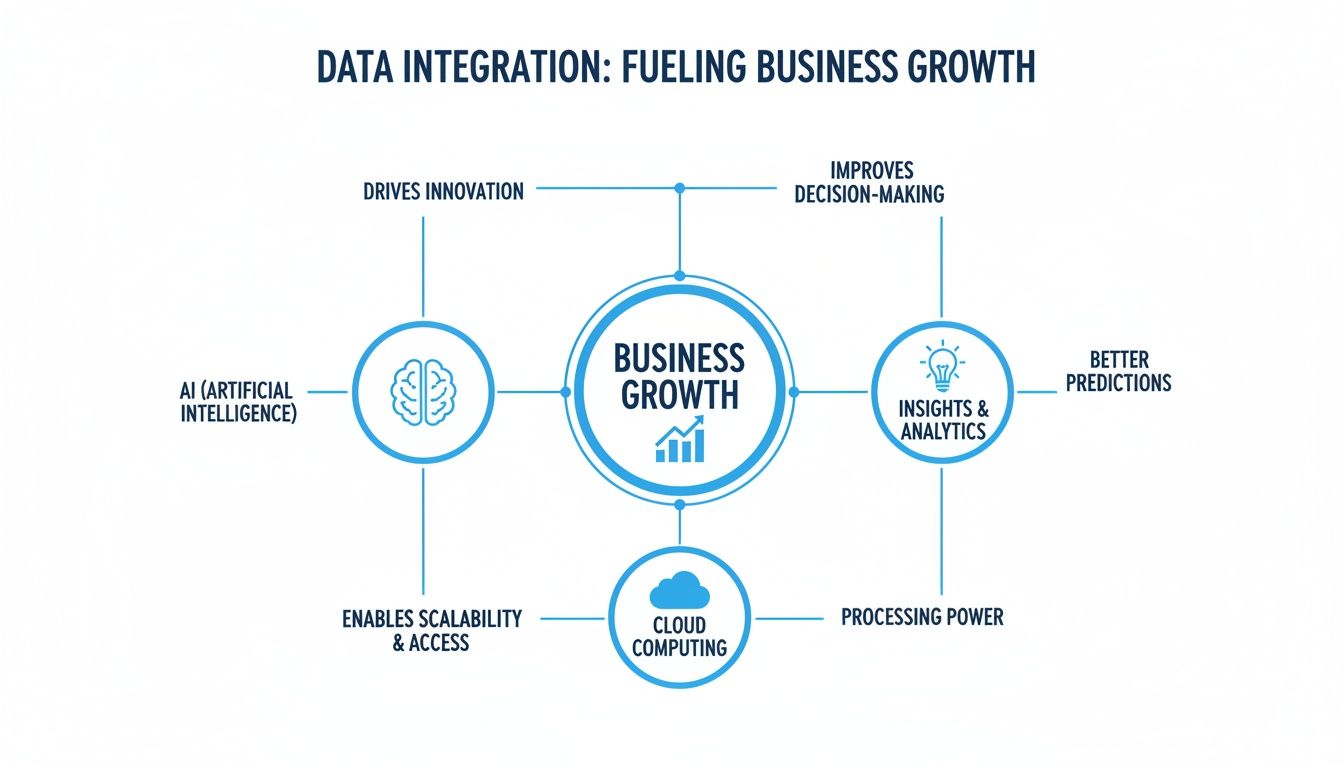
As you can see, all roads to growth, from AI to analytics, start with unified data.
For decades, the undisputed champion of data integration has been ETL: Extract, Transform, and Load. It’s a battle-tested method that many businesses built their foundations on.
The process is exactly what it sounds like:
This is the "prep everything at home" method. You chop all your vegetables and marinate the meat before you go to a friend's house to cook. When you arrive, everything is perfectly prepped and ready to go.
ETL is fantastic for creating highly reliable, structured reports. The main drawback? That transformation step can be a bottleneck, especially when you're dealing with absolutely massive data volumes.
Enter the new kid on the block: ELT, or Extract, Load, and Transform. Thanks to the sheer power of modern cloud data warehouses, we can now flip the script.
The ELT flow looks a little different:
This is like having all your raw groceries delivered directly to a professional-grade kitchen. You do all the chopping and prep work right there, using their top-of-the-line equipment. It’s incredibly fast and flexible, making it perfect for handling huge amounts of both structured and unstructured data. Most modern data integration services are now built around this agile approach.
ELT is a game-changer for teams that need to run fast. By loading raw data first, data scientists can experiment with different transformations on the fly without having to go all the way back to the source systems.
Finally, we have APIs, which stands for Application Programming Interfaces. If ETL and ELT are about moving data in big batches, APIs are all about real-time, on-demand conversations between different software.
Think of an API as a waiter in a restaurant. Your app is the customer at the table. Instead of running into the kitchen (the other app's database) yourself, you simply give your order to the waiter (the API). The waiter goes to the kitchen, gets exactly what you asked for, and brings it straight back.
This is what allows different programs to talk to each other and share small bits of information instantly. When your e-commerce site pulls a live shipping rate from UPS, that's an API at work. When your PIM syncs a new product to your Shopify store, that’s also an API.
For businesses looking to connect a whole ecosystem of cloud apps, platforms have emerged to manage all these API connections. If that's your goal, it's worth learning about how an Integration Platform as a Service (iPaaS) can orchestrate these conversations for you.
Theory is one thing, but let's get real. What do data integration services actually do for retail and ecommerce businesses on the ground? If you’re managing online stores, juggling marketplaces, or running physical shops, integration isn't some abstract IT project. It’s the engine that fixes daily headaches and unlocks real, tangible growth.
Let's walk through a few concrete scenarios. Think about the common frustrations you face every day, and then see how connecting your data offers a direct and powerful solution.
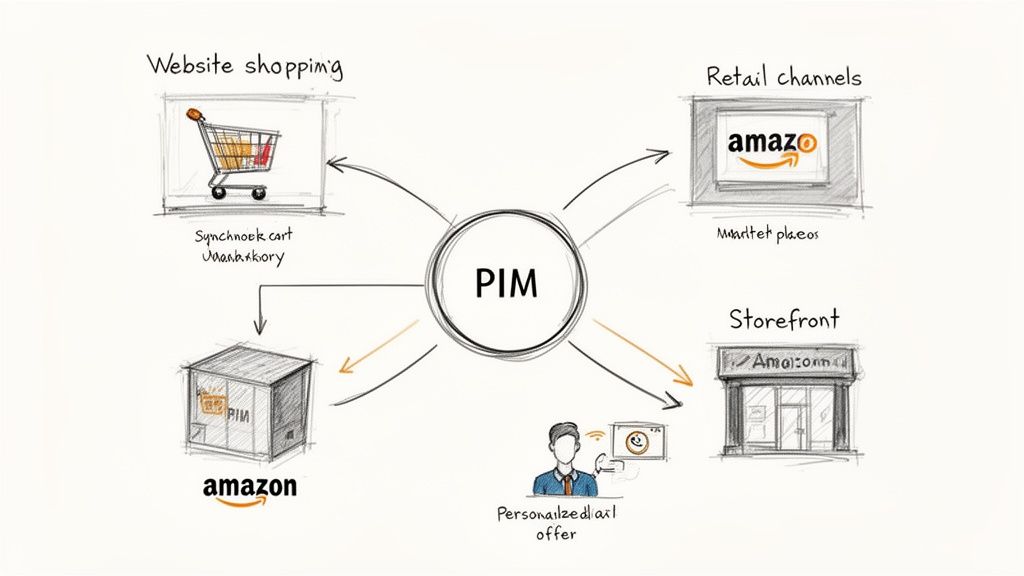
It's one of the worst feelings in multichannel retail: overselling. A customer gets excited about buying that last blue sweater on your website, only to receive a dreaded "out of stock" email an hour later. The reason? That same sweater sold in your brick-and-mortar store ten minutes before, but the systems never got the memo.
This is a textbook data silo problem. Your website inventory, your Amazon store, and your point-of-sale (POS) system are all acting like separate, disconnected businesses.
A data integration service is the central traffic controller for your entire inventory. When an item sells on any channel, whether online, in-store, or anywhere else, the service instantly updates the stock count everywhere else.
This simple, real-time sync is fundamental. It prevents lost sales, stops a flood of angry customer support tickets, and most importantly, protects your brand's reputation.
Now, let's talk about product content. You need to swap out product photos for the new season, tweak descriptions for better SEO, or add a crucial technical spec. Without integration, this turns into a soul-crushing manual task. Someone on your team has to log into Shopify, then Amazon Seller Central, then eBay, painstakingly copying and pasting every single change.
It's slow, tedious, and practically begs for errors. A single typo could mean showing the wrong price or incorrect dimensions on one of your biggest channels.
This is exactly where a Product Information Management (PIM) system like NanoPIM becomes your command center, creating a single source of truth for all product data.
By integrating your PIM with all your sales channels, the game completely changes. You can:
Generic marketing is just noise. Blasting a "20% off everything" email to your entire list might feel productive, but it’s rarely effective. Real personalization, the kind that gets people to buy, requires knowing your customer.
The problem is that this knowledge is usually scattered all over the place. Purchase history lives in your ecommerce platform, browsing behavior is in your analytics tool, and support tickets are siloed in your helpdesk.
Data integration services are the bridge that connects these islands of information. They stitch everything together to build a complete 360-degree customer profile.
With that unified view, you can create automated workflows that are genuinely smart. For example:
This is the kind of relevant, intelligent marketing that drives conversions. It’s only possible when your customer data, marketing platform, and ecommerce store are fully connected. These connections are often built using an ETL process; you can dive deeper into what makes a great data pipeline for ETL in our other guides. This is how you turn chaotic data points into a streamlined, revenue-generating asset.
Picking a partner for data integration services feels like a high-stakes decision because, well, it is. The market is flooded with tools, all promising the moon. It's easy to get lost in feature comparisons and flashy demos.
But making a confident choice is simpler than you think. It's not about finding the best tool; it's about finding the right tool for you. A cheap service that can't grow with you or needs a team of developers to run isn't a bargain. It's a long-term liability. The real key is finding a solution that fits your business reality today and is ready for where you want to be tomorrow.
Before you even glance at a single product page, take a hard look at your own operations. The perfect tool for a solo entrepreneur on Shopify is worlds away from what a multinational retailer needs. Get crystal clear on your specific situation.
Ask yourself these core questions:
Matching the solution to your team's technical comfort zone is non-negotiable. A startup or small business will probably thrive with a clean, no-code tool with a visual interface. An enterprise, on the other hand, might require a more robust and customizable framework to handle its massive scale and complexity.
Once you know what you need, you can start evaluating your options with a sharp, focused lens. You’re looking for a balance of power and simplicity, with enterprise-grade results without the enterprise-grade headache.
Here’s a simple checklist to guide your search:
A great integration platform strikes a balance between pre-built simplicity and the flexibility to adapt. It gives you the power to solve complex data problems without needing to be a data engineer yourself.
This is more important than ever. The data integration market is exploding, projected to leap from around $17 billion in 2026 to between $28-51 billion by 2030-2035, depending on the forecast. This growth is being supercharged by AI and the demand for real-time data. The fastest-growing segment? Services that help businesses actually implement these advanced systems. Choosing a forward-thinking partner is no longer just a good idea. It's essential for survival.
Knowing what data integration is and what it can do is one thing. Actually doing something about it is where the real magic happens.
The good news? You don't have to launch a massive, company-wide project to see results. The path to a smarter, more connected business is paved with small, deliberate improvements. This is about tackling one problem at a time and building momentum with quick, visible wins.
Forget about the tech for a minute. Before you look at a single platform or tool, ask yourself a simple question: What is the single most frustrating data problem we have right now?
Is it that sinking feeling when you oversell a hot product because your inventory systems aren't talking to each other? Maybe it’s the sheer number of hours your team burns manually updating product info across five different sales channels.
Pinpoint that one source of pain. Start there. When you solve a problem that everyone feels, you not only deliver a high-impact solution but also earn the trust and buy-in you'll need for bigger projects down the road.
The best data integration strategies never start with technology. They start with a clear, urgent business problem crying out for a solution.
Once you’ve locked onto your target, it’s time to get practical.
You don’t need to connect everything all at once. That's a recipe for disaster.
For the one problem you just identified, list the two or three systems that hold the data you need. It’s a lot simpler than it sounds.
If your problem is inventory syncing, your key sources are probably:
If your issue is inconsistent product content, you're likely looking at:
By narrowing your focus to only the essential sources, you keep the project manageable. You avoid getting bogged down. This is about connecting what matters most, first.
With your problem defined and your sources mapped, it’s time to run a pilot. Resist the temptation to boil the ocean. A tight, focused pilot project is your best friend. It de-risks the entire process and proves the value of data integration services in weeks, not years. In fact, a Forrester study found some companies see a return on their integration investment in as little as 6 months.
Your pilot needs to be small, specific, and measurable. For instance, set a goal to fully automate inventory updates between your main website and your ERP and nothing else.
Success isn't about connecting every app in your tech stack. It's about making one workflow measurably, undeniably better.
This approach turns a daunting challenge into a series of achievable steps. Each small victory builds the foundation for a more resilient, data-driven business. The most important thing is to just get started.
Still have a few questions about how data integration services actually work? You're in good company. Let's clear up some of the most common things people ask.
It’s easy to get these two confused. Think of data integration as the big-picture strategy. The end goal is to bring data from all your different systems together into one consistent, reliable view.
ETL (Extract, Transform, Load) is just one of the ways to get there. It’s a specific technical process, a tool in the toolbox, not the entire project. So, data integration is the "what" you're trying to achieve, and ETL is just one of the "hows."
This is the classic "it depends" answer, but for good reason. The timeline for an integration project can swing dramatically depending on its complexity and the tools you choose.
A simple project, like connecting two modern cloud apps with a no-code platform, might only take a few hours. On the other hand, a massive, company-wide initiative to connect dozens of old, legacy systems could easily take several months or longer.
The real key is to start small. A Forrester study found that some companies see a return on their integration investment in as little as 6 months. By focusing on a high-impact pilot project first, you can demonstrate value quickly and build momentum for bigger wins.
Yes, absolutely. The days when you needed a full-time developer just to connect two apps are long gone. Modern data integration services, especially the ones known as iPaaS (Integration Platform as a Service), are designed specifically for business users.
These platforms have completely changed the game with features like:
This shift toward accessibility is a huge deal. In fact, Gartner predicts that by 2026, about 70% of new applications will be built using low-code or no-code tools. This puts the power to connect data directly into the hands of the people who actually use it every day.
The cost for data integration services can run anywhere from a few hundred dollars a month for a straightforward tool to tens of thousands for a large-scale, enterprise platform. The price tag usually hinges on factors like how many systems you're connecting, the sheer volume of data you're moving, and the level of support you need.
A lot of modern platforms now use a consumption-based pricing model. This means your costs go up or down with your actual usage, which is a fantastic model for businesses that have seasonal peaks and valleys.
Ready to stop juggling spreadsheets and start building a single source of truth for your product data? NanoPIM gives you the power to centralize, enrich, and syndicate your product information seamlessly. See how our AI-powered platform can transform your ecommerce operations at https://nanopim.com.


