

You’re probably dealing with location data that looks harmless until it breaks something important.
A warehouse gets listed three slightly different ways across your ERP, marketplace feed, and supplier files. A store is renamed in one system but not another. A receiving dock exists in operations, but nobody gave it a clean identifier in product data. Then an EDI document goes out, a shipment lands in the wrong place, and your team starts comparing spreadsheets instead of moving inventory.
That’s where the global location number becomes useful. It gives each business location, legal entity, or functional point a standard identifier that systems can read consistently. For retail and eCommerce teams, that matters most when product data has to travel across ERPs, supplier networks, warehouses, marketplaces, and internal approval workflows without confusion.
The tricky part isn’t understanding the acronym. The tricky part is getting GLNs mapped, governed, and maintained inside the systems your team uses every day.
A lot of location mistakes don’t start in the warehouse. They start much earlier, inside data.
A retailer might have one record called “East DC,” another called “East Distribution Center,” and a third that only stores the street address. A supplier sends one version in an invoice. The ERP stores another. The marketplace team uses a manual export with a third variation. Humans can usually tell those records point to the same place. Systems often can’t.
Say a pallet is meant for a regional distribution center, but the outbound notice references a mistyped location code or a free-text address that doesn’t match the receiver’s record. Operations slows down right away. Someone checks the ASN. Someone else checks the purchase order. Finance later checks the invoice because the “ship to” party and the “bill to” party no longer line up cleanly.
That’s a lot of friction caused by one missing standard.
A global location number solves this by acting like a digital address that systems can trust. Instead of asking every trading partner, channel, and internal team to interpret naming variations, you give them one identifier for one exact place or party.
Multi-channel retail makes the problem bigger. Your products may move through stores, warehouses, drop-ship partners, 3PLs, returns centers, and digital endpoints. Each one needs to be represented consistently if you want clean feeds, accurate order routing, and less manual cleanup.
For product data managers, this quickly becomes a governance issue, not just a logistics issue. If your location records aren’t managed with the same discipline as product attributes, your channel outputs drift. That’s one reason strong location governance belongs inside a broader data management strategy.
With GLNs, teams create a single source of truth for location identity.
That helps in practical ways:
A location name is for people. A GLN is for systems.
That’s why the topic matters today. Retail complexity keeps growing, but tolerance for messy location data keeps shrinking.
Think of a global location number like a contact entry in a shared business address book.
You’re not storing a paragraph about the location every time you reference it. You’re storing one trusted identifier that points to the right record. Once that clicks, the rest of the concept gets much easier.
The Global Location Number (GLN) is a standardized 13-digit identifier developed by GS1 to uniquely recognize legal entities, physical locations, functional units, and digital addresses across global supply chains. GS1 notes that this format ensures global uniqueness and can reduce identification errors in EDI transactions by up to 50% (GS1 US GLN overview).
That definition matters because people often assume GLNs are only for buildings. They aren’t.
A GLN can identify:
Here’s the visual version of that idea.
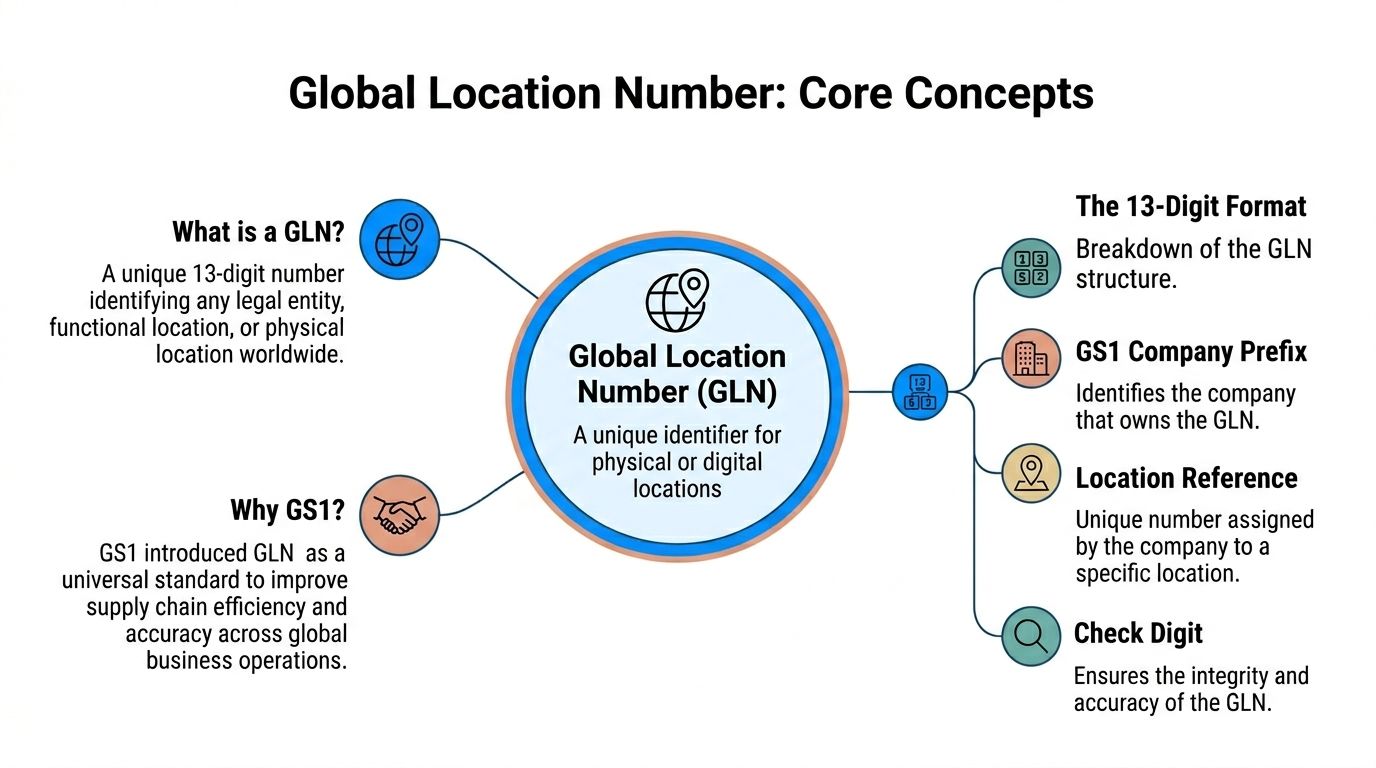
Before standards like GLN, companies often relied on local codes, partner-specific IDs, or plain text addresses. That works for a while, until multiple systems need to exchange data at speed.
Postal addresses are great for people. They are not great identifiers for software.
One system may store “Suite,” another stores “Ste,” and a third leaves that field blank. The address still means the same place to a human, but the records don’t line up neatly in automated workflows. GS1 introduced GLN so companies could refer to the same party or place in the same way.
A GLN has three parts:
| Part | What it does |
|---|---|
| GS1 company prefix | Identifies the company that owns the number |
| Location reference | Identifies the specific site, unit, or endpoint |
| Check digit | Confirms the number is structurally valid |
The company prefix is typically assigned by a local GS1 organization. The business then assigns the location reference for specific locations or units. The final digit is calculated to help validate the number.
That last piece trips people up.
The check digit doesn’t describe the location. It helps catch formatting mistakes. So if someone keys in a GLN incorrectly, your system can flag it before bad data spreads.
Practical rule: Never treat a GLN as just another text field. Treat it as a controlled identifier with validation rules.
A GLN identifies a record. It does not replace the rest of your master data.
You still need the address, contact owner, role, status, and hierarchy. The GLN is the anchor that keeps those details tied to the right entity.
That’s an important distinction for PIM and ERP teams. If someone asks, “Can’t we just use the street address?” the answer is no. The address describes the location. The GLN identifies it in a standardized way.
GLN management works best when teams see it as a lifecycle.
A common mistake is creating GLNs without defining when they should be updated or retired. That leads to “zombie” records that still appear in exports long after the business stopped using them.
Most confusion shows up in three places:
Headquarters versus site GLNs
Teams wonder whether one company needs one GLN or many. The answer depends on what needs distinct identification in operations and data exchange.
Location versus function
A warehouse and its receiving department may need different treatment depending on workflow design.
Identifier versus hierarchy
A GLN can identify a node in your structure, but your system still needs a way to model parent-child relationships around it.
Once you stop thinking of a global location number as “an address code” and start thinking of it as “a controlled identity layer for location data,” the whole model makes more sense.
The easiest way to understand a global location number is to look at where teams use it.
Not every business needs the same level of detail. A smaller operation may identify only the legal entity and one shipping location. A more complex retailer may assign distinct identifiers across stores, warehouses, and digital exchange points.
Stores don’t just sell products. They receive, transfer, return, and sometimes fulfill orders.
When a store has a clear GLN, suppliers and internal systems can reference that location consistently in documents and workflows. That helps when purchase orders, shipping notices, and invoices all need to refer to the same place without relying on naming shortcuts.
In practical terms, store teams benefit when:
Warehouses often need more detail than stores.
A business may identify the warehouse itself with one GLN, while internal operations also distinguish specific functional units such as loading points, receiving areas, or dispatch functions. That matters when different teams or systems need to know not just the site, but the exact operational endpoint involved.
GLN's role evolves beyond an accounting label. It becomes an operational reference.
Supplier relationships are one of the strongest use cases for GLN because EDI depends on precise party and location identification.
According to NAESB, GS1’s Global Location Number underpins electronic data interchange and supply chain automation worldwide, with over 90 countries implementing it and adoption correlating with 20 to 40 percent reductions in transaction errors in EDI-heavy markets (NAESB GLN introduction PDF).
That’s a strong signal for any team still relying on free-text party names in transaction flows.
A supplier may use GLNs to identify:
| Scenario | What the GLN helps identify |
|---|---|
| Purchase order flow | Buyer and ship-to party |
| Advance shipping notice | Dispatching and receiving locations |
| Invoice exchange | Bill-to and service-related entities |
| Returns process | Authorized return destination |
This part is often overlooked.
A global location number can also identify a digital address or functional endpoint involved in electronic exchange. That makes it useful when businesses work with drop-ship vendors, digital invoicing networks, or platform-based fulfillment relationships that don’t fit the old “one building, one record” mindset.
For eCommerce managers, this matters because modern commerce stacks mix physical movement with digital routing. One product might be stocked in a warehouse, listed across marketplaces, fulfilled by a partner, and financially settled through another entity. If the location and party layer is messy, the product layer gets messy too.
Don’t assign GLNs only to places people can walk into. Assign them where your data actually needs exact identity.
The right number of GLNs depends on how much operational distinction your business needs.
A useful test is simple:
That decision should come from workflow design, not guesswork. If you assign too few, systems blur important differences. If you assign too many, your data model becomes hard to manage.
Many teams encounter difficulties at this stage.
They understand what a GLN is. They even have some assigned already. But the identifiers live in supplier docs, ERP tables, old spreadsheets, or EDI maps, while the PIM and DAM environment still treats location data like a side note.
That split creates preventable friction.
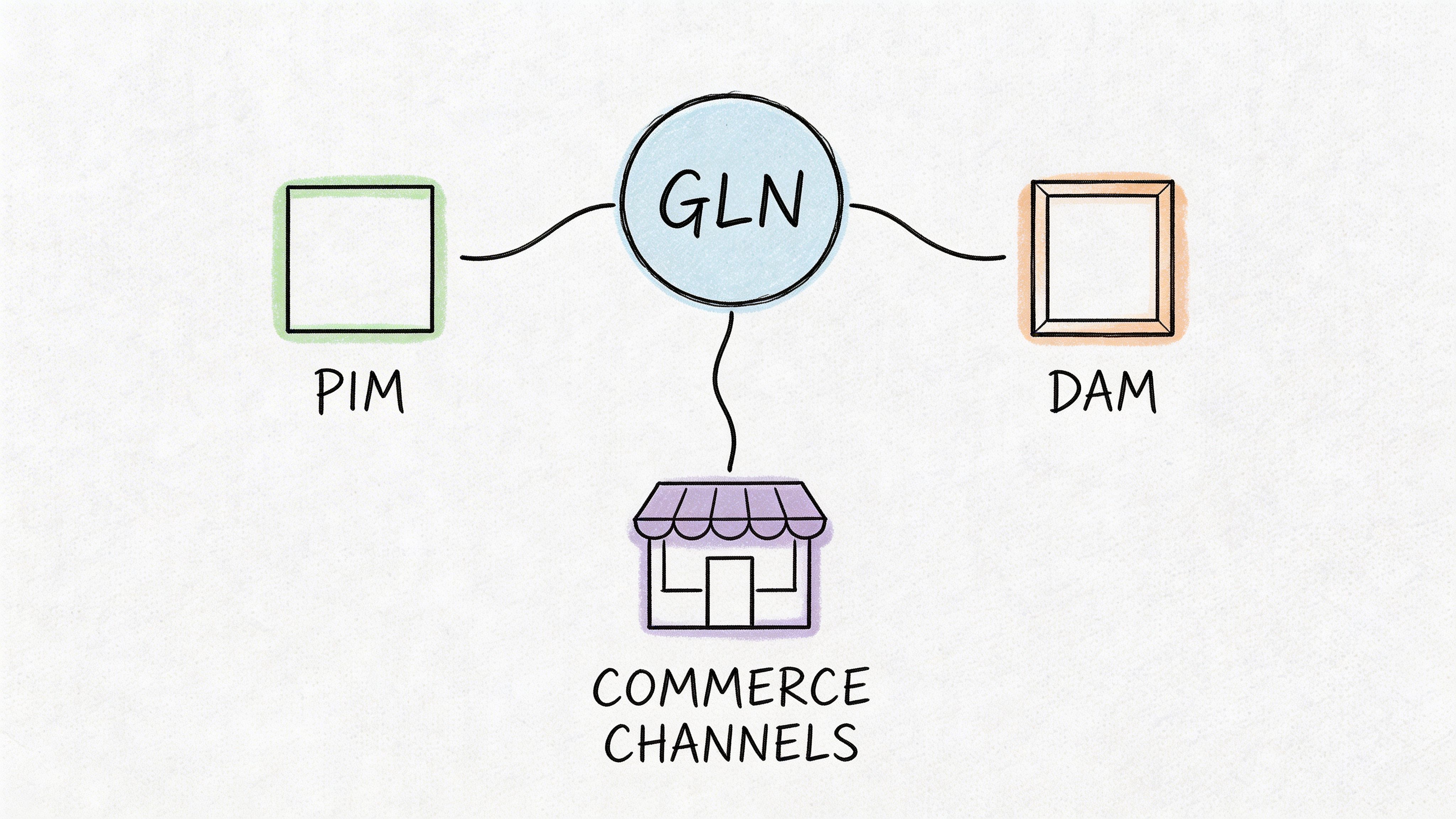
In day-to-day operations, GLN data usually touches more than one system:
The problem isn’t whether GLN belongs in only one place. It doesn’t. The problem is deciding which system owns the master record and which systems consume or enrich it.
The safest model to follow is this:
| System | Recommended role |
|---|---|
| ERP | Operational source for party and site relationships |
| PIM | Structured mapping of GLNs to product-facing attributes and channel rules |
| DAM | Asset tagging when images, documents, or manuals vary by location or entity |
| Channel feeds | Consumption layer for validated outputs |
GLNs work best in PIM when you stop treating them as loose metadata and start modeling them explicitly.
A clean setup often includes:
That model helps your team connect products to the right operational context without stuffing everything into one long attribute.
Marketplaces and commerce platforms don’t always expose GLN as a front-end concept, but the data still matters behind the scenes.
For example, channel teams often need to know:
This is one reason many teams revisit their broader product information management setup before trying to standardize GLN handling. If the product model and the location model don’t speak the same language, feed logic gets brittle.
Here’s a workable sequence for most retail and eCommerce environments.
Clean up the location list before connecting anything downstream.
That means identifying duplicates, deciding which records are active, and confirming whether each GLN points to a legal entity, physical site, function, or digital endpoint. If you skip this, every later integration inherits confusion.
Next, decide how products relate to locations.
Some catalogs only need a brand-to-entity relationship. Others need warehouse-specific availability, region-specific compliance, or destination-specific documentation. Don’t force all of those into one field. Create clear relationships instead.
DAM workflows often need this more than teams expect.
If one instruction sheet applies only to a certain market entity or one warehouse uses different packaging artwork, your asset metadata should reflect the relevant location relationship. Otherwise teams publish correct assets to the wrong destination context.
Only send GLN-linked data after validation rules have run.
That includes checking format, confirming active status, and verifying that the record belongs to the correct business entity or fulfillment flow. In other words, channels should consume trusted outputs, not raw imports.
Clean GLN data doesn’t just improve logistics. It improves confidence in every downstream feed that depends on location context.
Three integration problems appear over and over:
They flatten hierarchy
Headquarters, warehouse, and functional endpoints all get dumped into one list with no relationship model.
They store GLN without governance
The identifier exists, but nobody owns validation, naming, or retirement rules.
They ignore human review
Systems can check structure, but people still need to confirm business meaning.
When your PIM, DAM, ERP, and channel outputs all share a controlled view of location identity, GLN stops being a compliance headache and starts acting like useful infrastructure.
Most GLN projects fail unannounced.
Nobody announces a disaster. Instead, teams create some identifiers, put them in a spreadsheet, map a few fields, and assume the job is done. Six months later, imports contain duplicates, one business unit uses retired records, and nobody can explain which locations are official.
The fix is governance.
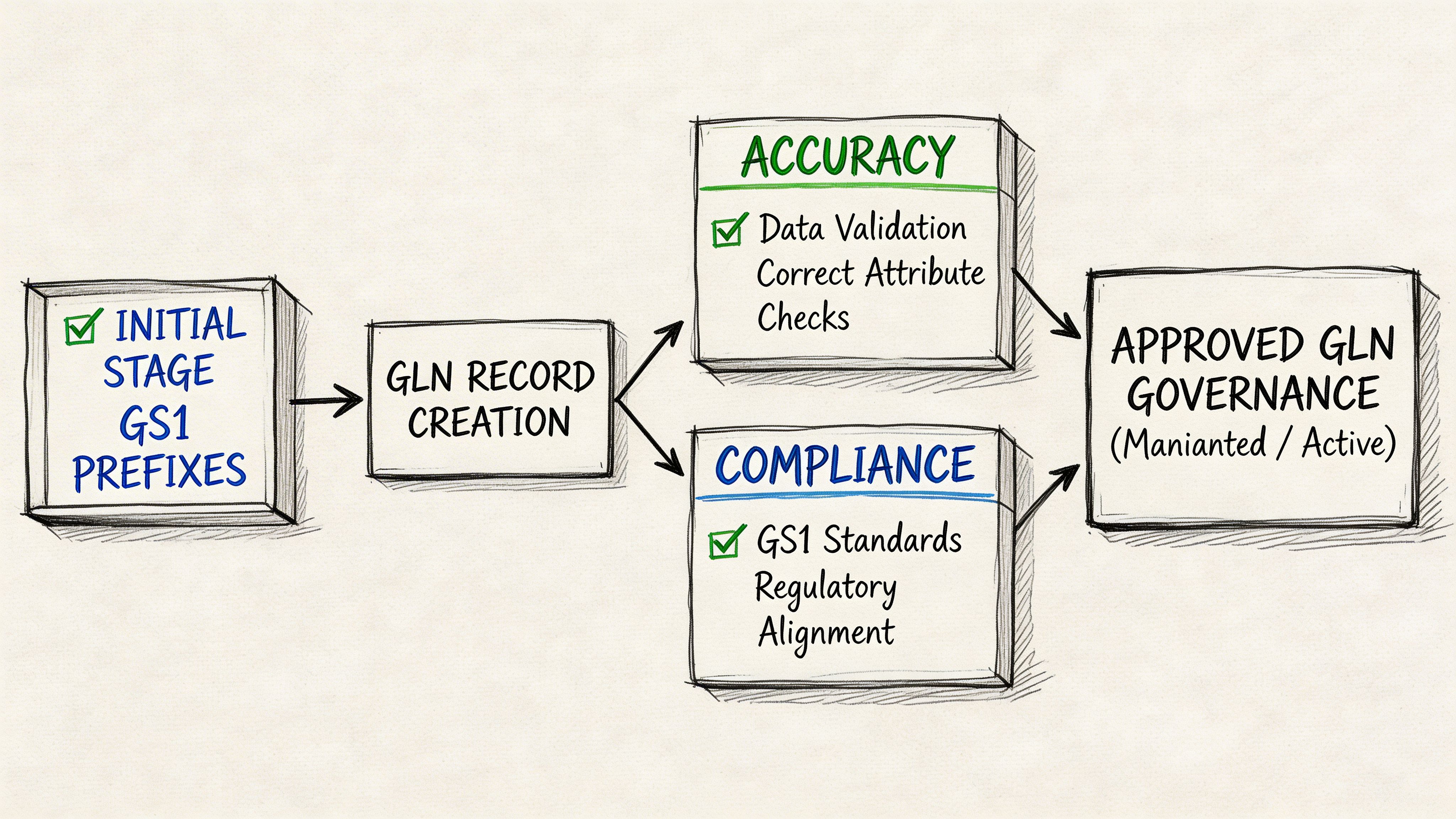
One underserved angle in GLN content is the integration challenge with modern PIM workflows. Missing guidance on attribute mapping and automated assignment can lead to up to 30 percent errors in location data exchange (video reference on GLN and PIM integration challenges).
That’s why policy comes first.
A strong GLN policy should answer:
If those answers live only in someone’s head, the process won’t scale.
Many teams do well with a small stewardship group rather than a giant committee.
| Governance area | What the team should decide |
|---|---|
| Ownership | Which function owns the master location record |
| Validation | How format and check-digit verification are enforced |
| Classification | How legal entities, physical sites, and functions are labeled |
| Lifecycle | How records are activated, changed, and retired |
| Distribution | Which systems receive approved GLN updates |
This doesn’t need to be bureaucratic. It just needs to be clear.
Attribute mapping is where governance becomes real.
For example, don’t just create one field called “location code.” Separate the concepts:
That structure makes imports easier to review and downstream logic easier to trust.
A related governance habit is documenting whether a field is source-owned or system-managed. If an ERP is the source for legal entity assignment, your PIM team shouldn’t manually override it in ad hoc ways.
Many product data teams avoid bad merges with this approach.
If your workflow includes a controlled staging area before updates go live, use it aggressively for location data. Compare incoming GLNs against existing records. Flag suspicious matches. Review records with similar names but different identifiers. Confirm whether “new” records are renames, moves, or duplicates.
That kind of process fits naturally with broader data governance policies, especially when multiple departments contribute files.
Good governance means nobody has to guess whether a GLN is valid, current, or safe to publish.
People should not manually validate numeric structure.
Your systems should check whether the GLN is structurally complete and whether the check digit matches. That won’t catch every business mistake, but it will stop simple input errors from spreading into EDI messages, exports, or marketplace integrations.
A common error is deleting old location records once they’re no longer used.
That creates reporting gaps and breaks audit trails. A better approach is to mark records as retired, preserve their historical relationships, and block them from new assignments or outbound feeds.
The final best practice is simple but often skipped. Train people on what they’re looking at.
A warehouse, a dock, a returns center, and a legal entity may all sit under the same company umbrella. That doesn’t make them interchangeable in data. If your users don’t understand the distinction, they’ll choose whatever record looks closest and move on.
That’s how “small” GLN issues become recurring operational problems.
Most GLN problems look technical at first. Many aren’t.
They’re usually data modeling problems, ownership problems, or review problems that show up inside technical systems.

A retailer had one warehouse, but multiple records for the same receiving point.
Operations used one label. EDI mapping used another. The product data team imported a supplier file that created a third variant because the text description was slightly different. The issue wasn’t that the business lacked a GLN. The issue was that the same operational endpoint had been represented inconsistently in surrounding systems.
The fix was boring and effective. The team chose one approved record, mapped old references to it, and blocked duplicate creation unless a steward approved the request.
Lesson learned: a GLN doesn’t prevent duplication if your workflow still lets users create near-identical records with weak review.
A manufacturer had location records in a shared file and used them in downstream feed preparation. One row contained an incomplete identifier. The number looked plausible enough that nobody noticed during manual review.
The team solved it by moving validation earlier. Instead of checking records at feed-export time, they validated format at import time and sent exceptions to review before the data could travel further.
This is one of the simplest troubleshooting wins available. Catch bad records before they become somebody else’s problem.
Another business assigned identifiers correctly but modeled relationships poorly.
The headquarters, regional distribution center, and local returns point all existed as separate records, but the system didn’t show how they related. Teams kept selecting the parent entity when they really needed the operational child location. Data wasn’t missing. Context was.
The fix was to make hierarchy visible and required in the record design. Once users could see parent-child relationships clearly, selection errors dropped because the records finally matched how the business worked.
The most dangerous GLN record is the one that looks valid but represents the wrong business context.
When something breaks, don’t start by blaming the number itself. Start by checking the record around it.
Format validity
Confirm the identifier is complete and structurally valid.
Record status
Make sure the GLN is active and approved for current use.
Correct entity type
Verify that the record is meant to represent a legal entity, physical site, function, or digital endpoint.
Parent-child mapping
See whether the chosen record belongs at the right level in the hierarchy.
System ownership
Confirm which system is the source of truth for that location.
Cross-system match
Compare the GLN and surrounding metadata across ERP, PIM, EDI maps, and channel exports.
Import review
Was the record approved or merged in a rush?
Naming clarity
Do users understand the difference between similarly named locations?
Retirement controls
Could an old record still be selected by mistake?
For businesses that sell locally, location accuracy also affects how products and entities appear across search and channel experiences. That’s one reason operations teams sometimes benefit from reviewing broader guidance on top local SEO ranking factors. Not because GLN is an SEO field, but because both disciplines depend on clean, consistent location identity.
Create a short exception log.
When a GLN-related issue occurs, write down the root cause in plain language. Was it a duplicate import, a retired record, a hierarchy mismatch, or an approval gap? Over time, that log becomes more useful than a hundred vague support tickets because it tells you which governance rule is still weak.
Troubleshooting gets faster once the team stops treating every GLN problem as a one-off and starts seeing patterns.
A global location number is simple in theory and easy to misuse in practice.
Used well, it gives your business a reliable way to identify locations, entities, and operational endpoints across systems. That reduces ambiguity, supports cleaner transactions, and makes product data workflows easier to trust.
The teams that get the most value usually do a few things consistently:
If you’re planning next steps, audit your current setup first. Check where GLNs live today, who owns them, how they map into product and channel workflows, and where duplicates or unclear relationships keep showing up. It also helps to look at broader categories of general business applications so you can compare how different systems handle shared master data responsibilities.
A good pilot starts small. One entity group, one warehouse network, or one supplier flow is enough to reveal what needs fixing before you scale.
If you want to turn GLNs into governed, channel-ready data instead of spreadsheet chaos, take a look at NanoPIM. It helps teams centralize product and location-related metadata, review imports safely, maintain approval workflows, and keep commerce outputs consistent across Amazon, Google, eBay, and other channels.


