

Ever wish you could get your best content in front of a much bigger audience without starting from scratch? That's the core idea behind content syndication.
Think of it this way: instead of just airing your hit TV show on your own channel, you license it to air on several other popular networks. You’re not just hoping new viewers stumble upon you. You’re taking your best work directly to where they already are.
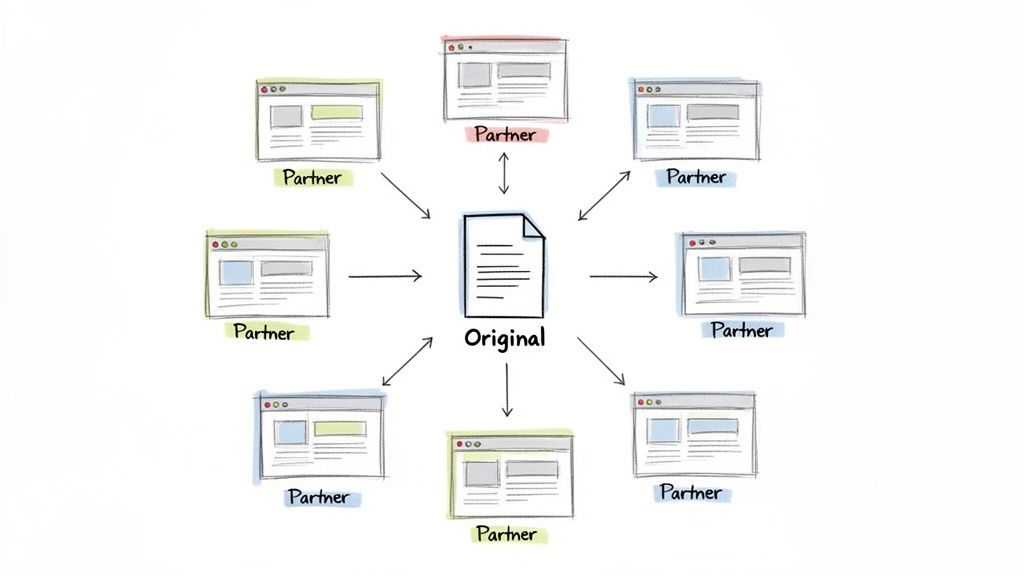
At its heart, content syndication is the practice of republishing your content, like a blog post, product guide, or video, on a third-party website.
It’s a strategic move that places your brand on established platforms, from industry news sites to online communities, that have already earned the trust of your ideal customers. This creates a true win-win. The publisher gets high-quality, relevant content for their audience, and you get incredible brand exposure and credibility by association.
The real power of content syndication isn't just about racking up more page views. It’s about reaching the right people on platforms they already trust and getting your most valuable insights in front of them.
To break it down even further, here's a quick overview of the key moving parts.
This table simplifies the core components of a syndication strategy.
| Component | Description |
|---|---|
| What It Is | Republishing your original content (blogs, guides, videos) on other websites. |
| Who It's For | Brands and retailers looking to expand their reach, build authority, and generate leads. |
| Primary Goal | To get your best content in front of a larger, relevant audience that you don't own. |
Understanding these basics is the first step to building a powerful and scalable syndication program.
The whole process kicks off with a great piece of content. We're talking about something genuinely valuable that educates your audience or solves a real problem for them, not just a sales pitch. This could be anything from an in-depth research report to a detailed "how-to" guide.
With that cornerstone asset in hand, the workflow is pretty straightforward:
And the impact is undeniable. It's not just a niche tactic; it’s a mainstream strategy for growth. By 2026, it's projected that 84% of B2B marketers will credit content syndication with directly fueling brand awareness. On top of that, 87% already use it as a primary method for boosting visibility.
If you're curious, you can explore more data on B2B content syndication trends to see just how foundational this strategy has become.
So, you’re sold on the idea of syndication. Great. The next question is, which kind? This isn't a one-size-fits-all game. The right approach hinges entirely on your goals, your budget, and how much time you can realistically commit.
Think of it like choosing a shipping method for your products. Some are free but you do all the legwork, while others offer premium, guaranteed delivery for a price. There are three main paths to take, and picking the right one is what separates a successful campaign from a failed one.
This is the ground floor of syndication, and it’s where most brands start. Just like the name says, other websites republish your content at no cost to you. It's a powerful play for brands that have killer content but not a massive budget, letting you get your name on some big-time platforms.
Maybe a major industry blog republishes your guide in exchange for getting top-notch material for their readers without having to create it themselves. The catch? Your content has to be genuinely good enough for them to want it in the first place.
The core principle of free syndication is a value exchange. Publishers get excellent, relevant content without the production cost, and you get access to their established audience and a valuable backlink.
This model is your best bet for building brand authority and driving steady, organic traffic over the long haul.
When you need guaranteed eyeballs and have the budget to make it happen, paid syndication is your fast track. With this model, you’re essentially paying platforms to place your content across their massive network of publisher sites.
Think of services like Outbrain or Taboola. They’re the ones behind those "Recommended Reading" and "Sponsored Stories" you see at the bottom of articles on major news outlets. It’s a direct, powerful way to drive a ton of traffic, fast.
This approach is perfect for big lead generation pushes or whenever you need to make a splash in a hurry. If you're looking for more ways to organize your marketing data, you might be interested in our guide on building an effective data management strategy.
This is the most strategic, relationship-driven approach. It’s less of a transaction and more of a handshake agreement between two or more brands that aren't direct competitors. You agree to share each other’s content, but it only works if you both have similar audiences and a mutual respect for quality.
When digging into different distribution strategies, it's worth understanding all the flavors, including white label syndication. This is a specific type of partnership where one company's content is rebranded and presented as another's, making the integration feel completely seamless. Ultimately, these agreements are built on trust and a shared goal: helping both brands grow their audience together.

So, why bother with syndication? Getting more eyeballs on your content is the obvious answer, but the real rewards go much deeper. It’s about transforming your brand from a single storefront into a presence across every major digital marketplace, all at once.
Think of it like this: your website is your neighborhood shop on a quiet side street. Syndication puts your best product guides and articles on the digital equivalent of a massive, bustling city square. Suddenly, you’re in front of thousands of engaged shoppers who would have never found you on their own, driving valuable traffic right back to your site.
When a well-known, reputable site shares your content, their credibility rubs off on you. It’s a borrowed trust that instantly boosts your authority with potential customers who are just discovering your brand.
One of the biggest wins from a solid syndication plan is the steady stream of high-quality leads it generates. Instead of just casting a wide net and hoping for the best, you’re placing your content directly in front of audiences already interested in your niche.
This doesn't just bring traffic; it brings qualified traffic. These aren't just random clicks. They’re potential customers who found you through a source they already trust.
A great syndication campaign doesn't just expand your reach. It improves the quality of that reach, connecting you with prospects who are already halfway through their buying journey and far more likely to convert.
This targeted approach fills your sales funnel with genuinely interested people. That means your sales and marketing teams aren't wasting time on dead-end leads. The result is a much shorter, more efficient path from first glance to final sale, all powered by content you’ve already created.
Maybe the most convincing argument for syndication is the incredible return on investment. In the world of B2B, the numbers speak for themselves. The average cost per lead (CPL) for content syndication is just $43.
When you compare that to channels like paid search, where a single lead can easily cost over $100, the value becomes crystal clear.
This low CPL is backed by a solid conversion rate of 5.31%. According to B2B content syndication benchmarks, brands that nail their strategy see a 45% lift in lead-to-deal conversions. That kind of performance can push the three-year ROI to between 300% and 500%.
Of course, managing all these product descriptions, articles, and images is key to getting that ROI. If you're curious about how technology can help, you can learn more about the role of AI in Digital Asset Management in our other post.
Let's tackle the biggest fear that holds brands back from syndication: the dreaded "duplicate content penalty."
Here’s the thing, Google doesn't actually have a penalty for duplicate content. The real risk isn't a punishment from on high. It's just plain old confusion.
When a search engine finds the same article on two, five, or ten different websites, it has to make a choice. It has to decide which one is the original and deserves to rank. If it guesses wrong, some other site could end up ranking for your hard work, siphoning off your traffic and authority. That's the actual problem you need to solve, not some mythical penalty.
The good news is, that's a pretty straightforward problem to fix. All you have to do is give search engines clear, unmistakable signals about who the original author is. When you get this right, syndication flips from a risk into a powerful and perfectly safe way to boost your SEO.
The absolute best way to protect your rankings is by using a canonical tag. It’s a tiny snippet of code that your syndication partner places in the header of their webpage, and it looks something like rel="canonical".
This little tag acts like a signpost. It tells Google, Bing, and every other search engine, "Hey, this content is a copy. The real, original version lives over at this other URL."
By pointing back to your original article, the canonical tag does a few critical jobs:
Think of it like citing a source in an academic paper. It gives credit where it's due and tells everyone exactly where to find the original work.
Before you even think about signing a syndication deal, you need to get one thing straight: they must use a canonical tag pointing back to your article. This is non-negotiable. It’s the difference between expanding your reach and just giving your SEO equity away for free.
While the canonical tag is the gold standard, you have a couple of other options that can add an extra layer of protection or work in a pinch.
1. The "Noindex" Tag
Your partner can add a noindex tag to their version of your article. This is a direct command telling search engines to completely ignore their page and not include it in search results at all. It's a blunt instrument, but it absolutely removes any chance of the syndicated copy ranking or causing confusion.
2. A Clear Link Back
At the bare minimum, the partner site should include a prominent link back to your original post. This is often just a simple credit line, like, "This article was originally published on [Your Website Name]." While it's not as technically powerful as a canonical tag, it still provides a helpful signal to search engines and, just as importantly, drives real human readers back to your site.
Trying to syndicate content for a handful of products is one thing. But when you’re a brand with thousands of SKUs spread across dozens of channels, doing it by hand isn't just inefficient. It’s impossible.
This is where Product Information Management (PIM) and Digital Asset Management (DAM) systems come in. They’re the engine that powers syndication at scale. Forget trying to manually update a product description on 20 different retail sites. That’s a nightmare of copy-pasting, reformatting, and human error waiting to happen.
PIM and DAM platforms change the game by creating one central, organized hub for every piece of content you own.
Think of a PIM as the "single source of truth" for all your product data. It’s a central library where every product description, specification, and attribute lives, ensuring total consistency everywhere.
This simple shift gets you away from messy spreadsheets and scattered folders. Instead, your entire team works from a single master record for each product, making massive updates simple and virtually error-free. If you're new to the concept, our guide on what a PIM system is is a great place to start.
Your Product Information Management (PIM) system is the foundation. It’s where you store all the text-based details about your products: SKUs, technical specs, marketing copy, SEO keywords, you name it. This guarantees every piece of data is accurate from the start.
Your Digital Asset Management (DAM) system handles the other half of the equation: your media. It’s the secure vault for all your product photos, videos, brand logos, and spec sheets. This ensures that every retailer is using the correct, high-resolution, on-brand imagery every single time. To get the most out of it, it helps to follow established Digital Asset Management (DAM) best practices.
Together, they're the one-two punch for syndication that can actually scale with your business.
The infographic below outlines how a PIM and DAM work together to create a reliable, SEO-friendly syndication workflow.
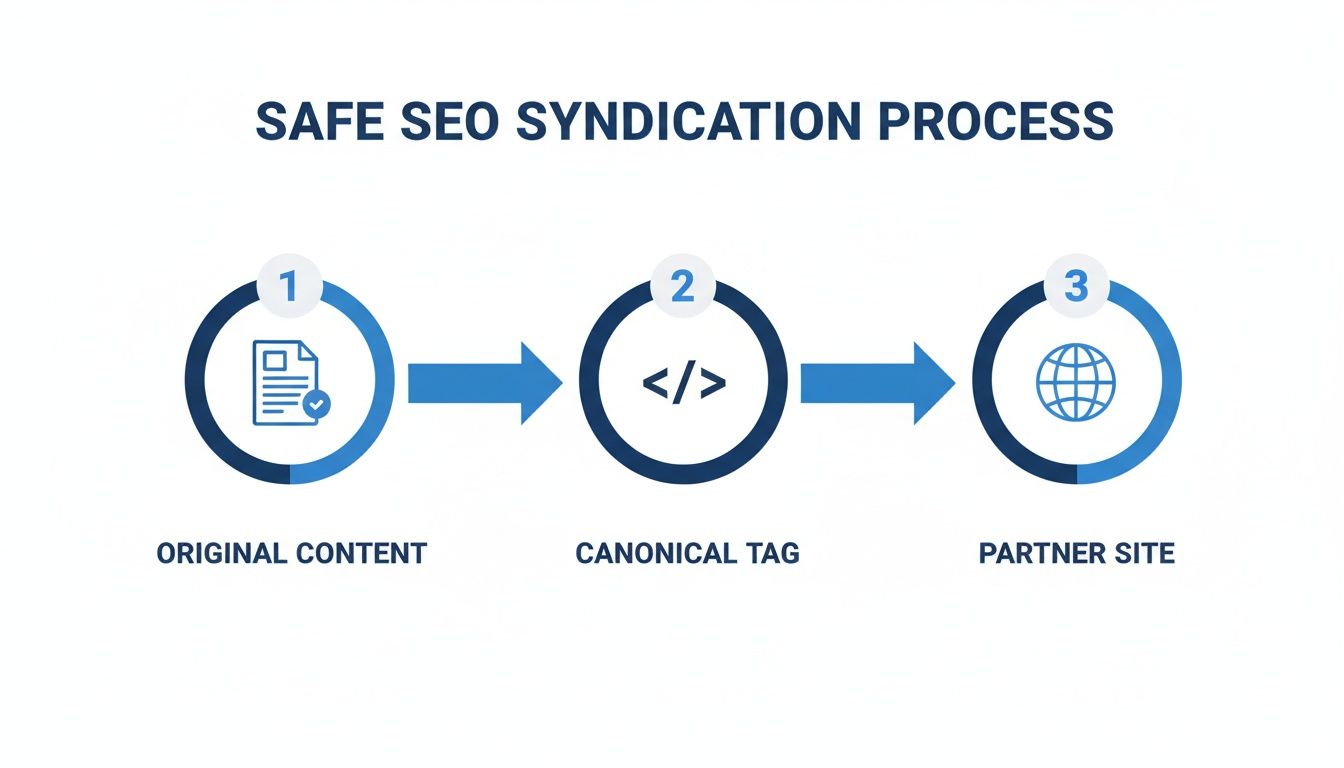
By centralizing everything first, you create a system where you can push updates out to every channel with confidence, knowing the information is correct.
Once all your data is organized in one place, a modern platform like NanoPIM can automatically format and send it to all your different channel partners. It takes your master product information and instantly reworks it to meet the specific requirements of Amazon, eBay, Walmart, or any other retailer.
This automation is what lets your team scale its reach without scaling its workload. It's a practice that's seen huge adoption for a reason.
So, you’re ready to get your content out there. That’s great, but a scattergun approach won’t work. A solid syndication program is built on a clear strategy, not just a burst of activity.
This isn’t just about republishing articles. It’s about making calculated moves. Let’s walk through the steps the pros take to build a syndication engine that actually delivers results.
Before you even think about reaching out to a single partner, you need to know what a "win" looks like for you. What's the point of this whole exercise? Are you trying to generate leads, build brand authority, or just get more eyeballs on your work?
Your goal dictates everything that follows, especially the content you choose to syndicate. Pick your heavy hitters, the evergreen content that has already proven its value. Think about your most comprehensive guides, original research reports, or in-depth tutorials. These pieces have a long shelf life and offer genuine utility, making them far more attractive to the high-quality publishers you want to work with.
This is arguably the most important part of the entire process. The right partner can amplify your message to a new, relevant audience. The wrong one can damage your brand and waste your time.
Your ideal partner serves an audience that looks a lot like yours but isn't a direct competitor. You're looking for common ground, not a turf war.
Before you send that first email, do your diligence.
rel="canonical") that point back to your original article. Without this, you're just creating duplicate content problems that will hurt your SEO.A good syndication partnership is a two-way street. They get fantastic, valuable content for their readers, and you get qualified exposure and powerful SEO signals. Only work with partners who get this and are committed to doing it right.
To keep your efforts organized and ensure no critical steps are missed, use a structured checklist. This turns a complex process into a repeatable workflow for your team.
| Step | Action Item | Key Consideration |
|---|---|---|
| 1. Strategy & Goals | Define primary objectives (e.g., lead gen, brand awareness, traffic). | Your goal determines which KPIs you'll track (e.g., MQLs vs. referral sessions). |
| 2. Content Selection | Identify top-performing, evergreen content for syndication. | Prioritize in-depth guides, original research, or high-value case studies. |
| 3. Partner Prospecting | Create a list of potential publishers with audience overlap. | Look for non-competitors who serve your ideal customer profile. |
| 4. Partner Vetting | Analyze each prospect's domain authority, content quality, and audience engagement. | A low-quality partner can do more harm than good. Aim high. |
| 5. Technical SEO Check | Confirm the partner's policy on using rel="canonical" tags. | This is non-negotiable to prevent duplicate content penalties. |
| 6. Outreach & Pitch | Craft a personalized pitch explaining the mutual benefit. | Show them you understand their audience and how your content adds value. |
| 7. Content Preparation | Prepare the content file (e.g., Google Doc, HTML) and any unique tracking links. | Use UTM parameters to track performance from each specific partner. |
| 8. Performance Tracking | Set up analytics to monitor referral traffic, leads, and brand mentions. | Use your initial goals to define the key metrics for success. |
| 9. Relationship Mgt. | Maintain communication with partners and explore future collaborations. | A strong relationship can lead to more opportunities beyond a single article. |
This checklist provides a framework, but remember to adapt it to your specific needs and the unique opportunities that arise.
Finally, you have to know if any of this is actually working. If you can't measure it, you can't improve it.
Set up your analytics to track the Key Performance Indicators (KPIs) you defined back in step one. Are you seeing a lift in referral traffic from your partner sites? Are the leads coming from syndicated content converting? Is your branded search volume on the rise?
This data is your feedback loop. It tells you which partnerships are gold and which are duds, allowing you to double down on what works and cut what doesn’t.
Even with a solid strategy, a few questions always pop up around content syndication. Let's clear the air on some of the most common ones so you can move forward with confidence.
This is the big one, and thankfully, the answer is no. Google doesn't have a "penalty" for duplicate content in the way most people think.
The actual risk isn't a penalty, but confusion. If you and your syndication partner both publish the same article, Google might not know which version is the original. When that happens, you risk the partner site outranking you for your own work. It's a frustrating, but fixable, problem.
The solution is simple: your partner must use a canonical tag (rel="canonical") on their version of the post. This little piece of code points back to your original article and tells search engines, "This is the source. Give it all the credit and ranking power."
Syndication isn't the place for your latest flash sale or a quick company update. The content that performs best, time and time again, is high-value and evergreen.
Think about assets that have a long shelf life and offer real, tangible help to the reader. The goal is to share something so useful that it serves as a powerful introduction to your brand.
Some of the best candidates are:
The core idea is to share content that acts as a powerful introduction to your brand's expertise. If a reader's first interaction with you is incredibly helpful, they are far more likely to seek you out for more.
Finding the right partners is half the battle. A great place to start is by looking for websites and online publications that serve your ideal audience, but aren't direct competitors. Once you've got a list, reach out to their editors with a short, personalized pitch explaining why your content would be a fantastic resource for their readers.
If you want to scale up faster, you can also look into paid content distribution networks. Platforms like Outbrain or Taboola plug you into a massive network of publishers who are actively looking for great content to share with their audiences.
Yes, it is. While the end goal, reaching more people, is the same, the mechanics are totally different from syndicating a blog post.
Article syndication is about sharing a single piece of content. Product content syndication is about distributing highly structured product data, think SKUs, descriptions, images, pricing, and technical specs, to dozens or even hundreds of retailers and marketplaces. This requires a rock-solid system, like a PIM, to keep that data accurate and consistent everywhere it appears.
Ready to power your product content syndication at scale? NanoPIM centralizes all your product information and digital assets, using AI to optimize and distribute your content to any channel with perfect consistency. Learn more and see how it works at https://nanopim.com.


