

A product information management solution, or PIM, is the central command center for every last detail about the products you sell. It’s the one place you can trust for all your product data.
Think of it as the single source of truth for everything from SKUs and descriptions to images, pricing, and technical specs. Its job is to make sure your information is correct and consistent, no matter where you sell.
Ever tried to run a business where product data lives in a chaotic mix of spreadsheets, shared folders, and random software? It feels a bit like directing an orchestra where every musician has a different version of the sheet music. The result is pure noise.
A Product Information Management (PIM) solution is the definitive sheet music for your entire product catalog. It's a purpose-built system designed to bring order to that chaos, creating one central hub for all product-related content. Instead of your teams juggling dozens of conflicting files, they can all pull from a single, reliable source.
This becomes absolutely critical as you grow. Selling on your own website is one thing, but once you add Amazon, Shopify, social commerce, and other marketplaces into the mix, the complexity explodes. Each channel demands its own unique data formats, image sizes, and descriptions. A PIM is what helps you manage all of this without losing your mind.
When you only have a handful of products, a spreadsheet can feel like a perfectly good solution. But as soon as your catalog starts to grow and you add more sales channels, that manual approach begins to crack under the pressure.
It's a classic story: the marketing team has one set of product descriptions, the e-commerce team has another, and the data you get from suppliers is completely different. This chaos creates inconsistencies that confuse customers and will absolutely cost you sales.
A PIM fixes this by pulling in data from every corner of your business and organizing it in one place. These sources typically include:
By consolidating everything, a PIM makes sure everyone in your company is finally working from the same playbook.
The difference between wrestling with data manually and using a dedicated PIM is night and day. One approach creates bottlenecks and endless errors, while the other introduces speed, efficiency, and most importantly, accuracy.
This table breaks down the common problems businesses face and how each approach stacks up.
| Challenge | Manual Approach (Spreadsheets) | PIM Solution Approach |
|---|---|---|
| Inconsistent Data | Product details vary across channels, leading to customer confusion and lost trust. | A single source of truth ensures every channel has the same accurate information. |
| Slow Product Launches | Manually formatting and uploading data for each new channel takes days or weeks. | Automated workflows and templates allow for rapid product launches across all channels. |
| Costly Errors | Incorrect pricing or specs get published, resulting in returns and unhappy customers. | Validation rules and approval processes catch errors before they go live, protecting revenue. |
| Poor Collaboration | Teams work in silos, using outdated files and causing constant communication breakdowns. | Centralized access allows marketing, sales, and product teams to collaborate in real-time. |
Ultimately, a PIM doesn't just store your data. It makes that data more valuable by ensuring it's always accurate, enriched, and ready for any channel you want to sell on.
While different platforms will have their own unique bells and whistles, any modern PIM system is really built on a handful of core features. These are not just shiny objects on a sales page; they are the essential tools that work together to create that single source of truth your whole organization can rely on.
Understanding what these features actually do is the key to seeing the real value a PIM brings to the table.
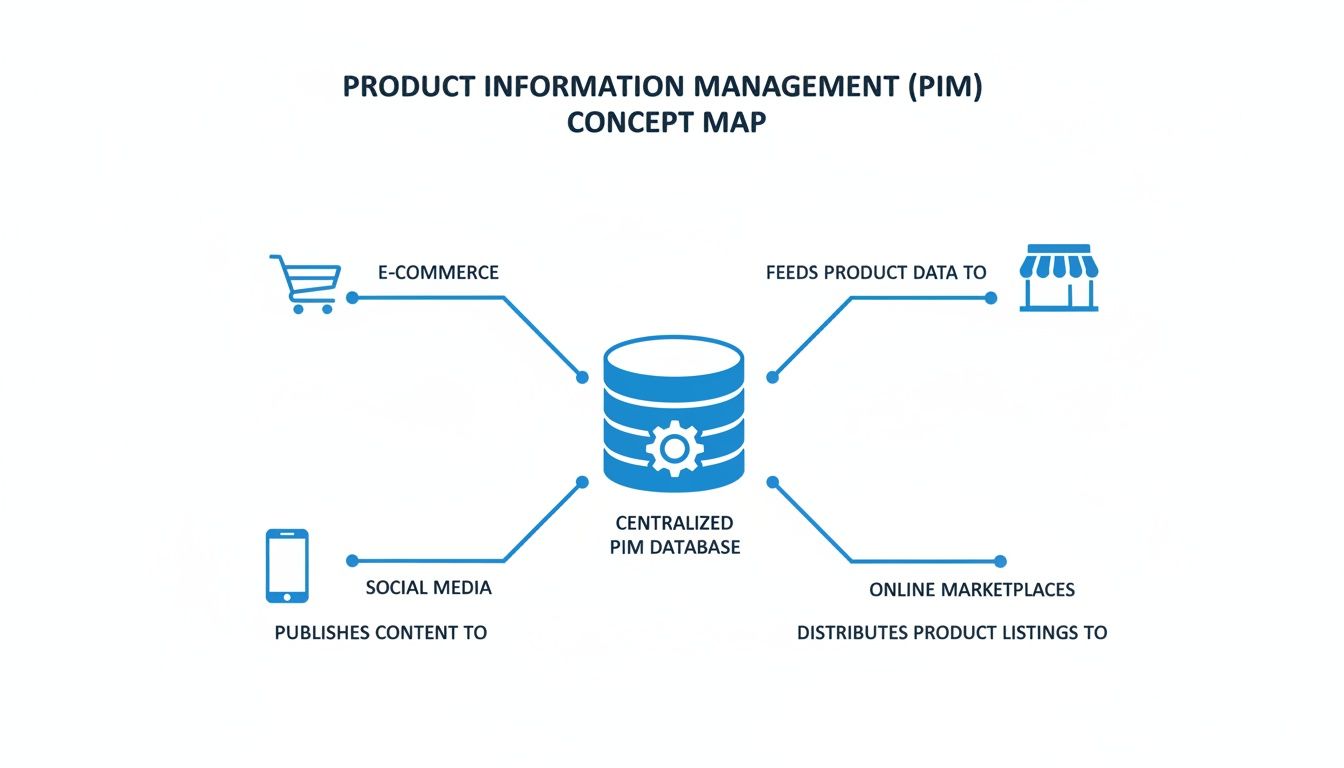
This visual gets right to the heart of it: the hub-and-spoke model. The PIM is your central database, feeding consistent, enriched product info out to every channel, from your webstore to social media and marketplaces. Make one update in the PIM, and it's reflected everywhere. No more soul-crushing manual updates.
Think of data modeling as creating the perfect blueprint for your products. It’s where you define every attribute, spec, and category that matters to your business. A clothing brand’s blueprint might include fields for size, color, and fabric. A company selling electronics would need fields for voltage, dimensions, and warranty details instead.
A strong data model gives you complete control. You decide what information is mandatory, how products relate to one another, and the structure of your entire catalog, ensuring nothing important gets missed.
This flexibility is what makes a PIM so powerful. You're not stuck with a rigid, one-size-fits-all structure. You get to build a system that perfectly mirrors your business rules and your unique product requirements.
Trying to handle products with variations like different sizes, colors, or materials is a special kind of spreadsheet hell. Do you just add a new row for every single combination? A modern PIM kills this chaos with built-in variant management.
This feature lets you create a single "parent" product and then simply attach all its variations. Each variant inherits the core info from the parent, like the main description and brand, but still gets its own unique attributes.
This approach keeps your catalog clean and organized, making it shockingly simple to manage hundreds of variations without creating a mess of duplicate content.
Let's be real, your product data is not just text and numbers. High-quality images, videos, and instruction manuals are what actually create a great customer experience. A Digital Asset Management (DAM) system is the library for all these crucial files.
Today’s PIMs often include robust digital asset management features to organize and optimize your product media. A built-in DAM connects these assets directly to their products. So when you update an image, that change is automatically tied to the right SKU and pushed to every channel. You can even see how this is evolving in our guide on AI in Digital Asset Management.
This integration is a massive time-saver, ending the frustrating hunt for the right image in a maze of shared folders. And it's not just a nice-to-have. Poor product data costs retailers an estimated $1.1 trillion in lost sales globally each year, which is why 80% of enterprises are expected to move to centralized solutions by 2026.
Once you get the basics sorted, the advanced PIM features really give you an edge. This is the point where a PIM goes from being a simple organizational tool to a genuine growth engine for your brand. These capabilities automate the heavy lifting, smooth out team collaboration, and get your product data ready to perform everywhere.
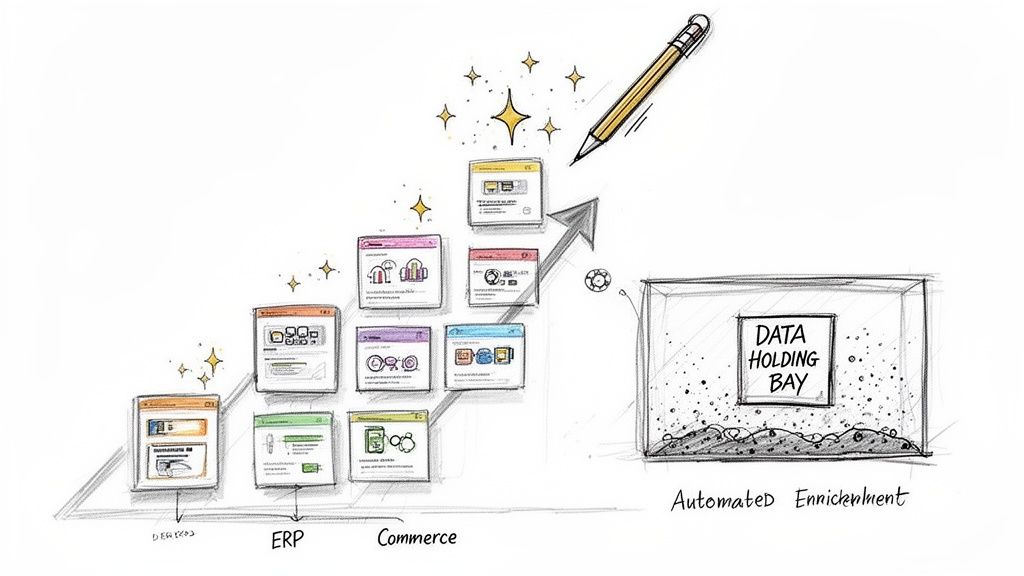
Let's be honest, the raw product data you get from suppliers or your ERP is usually technical, dry, and uninspiring. Data enrichment is the art of turning that bare-bones information into compelling content that actually persuades people to buy. Modern PIMs can now automate a huge chunk of this work with AI.
Imagine taking a bland list of specs and, with a few clicks, turning it into an engaging marketing description for your website. Then, generating a punchier version for a social media campaign and a keyword-rich title for your Amazon store. That’s exactly what AI-powered enrichment does, saving your team from hours of mind-numbing manual writing.
By automatically enriching product content, you're not just saving time. You're ensuring that every product is presented in the best possible light on every single channel. This consistency builds trust and directly impacts your bottom line.
As your team expands, keeping track of who is doing what can turn into chaos. A great product information management solution cuts through the confusion with customizable workflows. You can literally build a visual map of your team’s entire process, from initial data entry to final sign-off.
For instance, a common workflow could be set up like this:
This automated hand-off kills the endless email chains and the constant "who's got this?" questions. Everyone knows exactly what’s on their plate and when it's due, which drastically cuts down your time to market.
A PIM can't be an island. It needs to communicate with the other critical systems you rely on daily. Modern PIMs are designed to integrate seamlessly with your entire tech stack, acting as the central hub that holds everything together.
Key integrations usually include:
These connections create a smooth, automated flow of information across your business, wiping out manual data entry and making sure everyone is working from the same script.
One of the biggest headaches in product management is wrangling messy supplier data. A uniquely powerful feature in some PIMs is the Data Holding Bay. Think of it as a secure quarantine zone for all incoming data before it touches your pristine catalog.
Instead of importing a chaotic spreadsheet directly into your system, you bring it into the Holding Bay first. Here, you can clean it up, map the supplier's bizarre column names to your standard attributes, and fix errors without any risk to your live product data. Once it's perfect, you merge it into your main catalog with total confidence, stopping bad data in its tracks.
If you're trying to sell products across a website, multiple marketplaces, and social media, a PIM is not just a nice-to-have tool. It's a genuine game-changer. It’s what moves your team from putting out fires to actively driving growth.
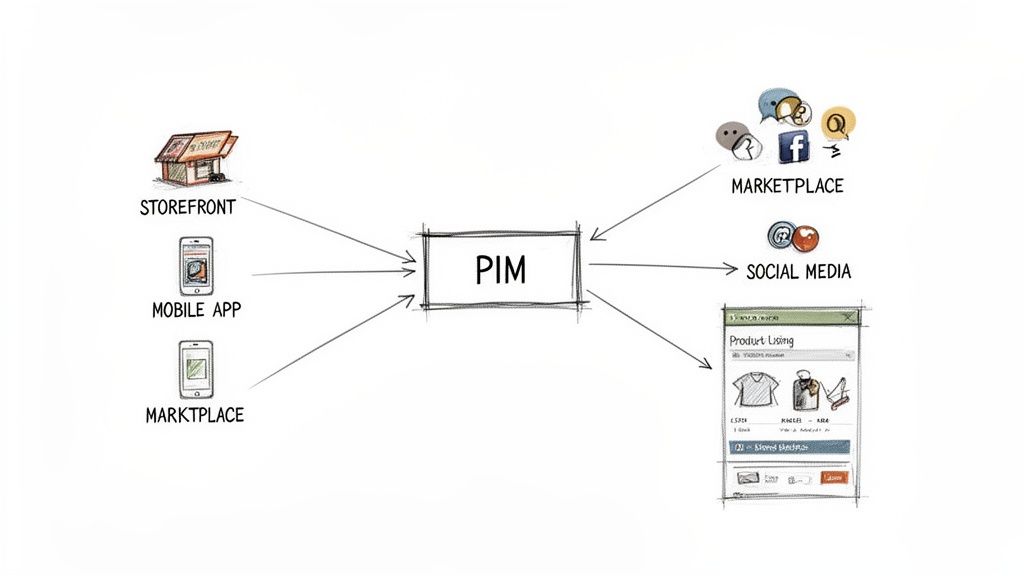
Think about the daily grind for your ecommerce and marketing folks. Without a central source of truth, they’re stuck in an endless loop, updating product info in ten different places for ten different channels. A PIM breaks that cycle for good. It gives them the power to launch products faster, slash errors, and focus on what actually matters: selling more.
Getting a new product live is often a painfully slow process. Someone has to hunt down specs, write descriptions, resize images, and then manually upload everything to each channel, one by one. By the time you’re done, that market trend you were chasing might be long gone.
A PIM puts that entire launch sequence on autopilot. Once a product is approved in the central system, it can be pushed to all your sales channels at the same time. This speed means you can react to market shifts instantly and get your products in front of customers weeks or even months ahead of competitors still stuck in spreadsheet hell.
A faster time to market is not just an internal metric; it's a direct competitive advantage. It allows you to capitalize on sales opportunities before they fade, leading to a significant increase in revenue over time.
This boost in efficiency is absolutely critical for brands with large or seasonal catalogs. Imagine launching an entire spring collection across your website, Amazon store, and social channels in a single afternoon instead of it taking all week. That's the power a PIM brings to the table.
Your product's visibility on Google, Amazon, and other platforms is directly tied to the quality and consistency of its data. These search algorithms reward listings that are complete, accurate, and filled with the right keywords. A PIM is your secret weapon for nailing this.
It lets you create and manage channel-specific content at scale. You can craft keyword-rich titles for Amazon, engaging descriptions for your website, and the specific attributes needed for Google Shopping, all from one dashboard.
By feeding these platforms high-quality, structured data, a PIM helps you show up higher in search results. The result is more organic traffic and more sales, without spending another dime on ads.
Inconsistent or flat-out wrong product information is a major source of customer frustration. When a buyer sees one price on your website and another on a marketplace, trust disappears. When the color they receive does not match the picture online, you are not just getting an abandoned cart, you are getting a costly return.
A PIM guarantees every customer sees the exact same information, no matter where they shop. This builds confidence and helps them make a purchase they won’t regret. It's no surprise the PIM market is exploding, with retail and ecommerce expected to claim a dominant 26.56% share by 2026. After all, consistent data has been shown to boost team productivity by 25-40% while cutting down on lost sales. You can dig deeper into how PIM is shaping online retail by exploring the full product information management market analysis on Fortune Business Insights.
Picking the right PIM solution is a huge decision, but it does not have to feel like one. Don't think of it as a technical exam. Think of it as hiring a new, mission-critical business partner. You’re looking for a system that clicks with your team, fuels your growth, and will not hold you back in a year.
The whole process really boils down to asking the right questions. It's not just about a laundry list of features; it's about finding the right fit. Does this platform actually match how your team works day-to-day? Can it handle the chaotic reality of your product data? And what’s the real cost when you factor everything in?
This is not a niche problem. The global PIM market is exploding, forecasted to grow from USD 20.95 billion in 2025 to a staggering USD 121.48 billion by 2035. That boom is a direct response to the cost of bad data. Inconsistent product info is a major reason for cart abandonment rates hitting 30-50%. You can dig into the numbers yourself in the full product information management market report from Precedence Research.
Before you sit through a single demo, you need to know exactly what you’re looking for. A simple checklist, built around your team’s actual needs, will be your most powerful tool. It helps you cut through the marketing fluff and stay focused on what matters.
Start by getting your key people in a room: marketing, ecommerce, IT, sales, and anyone else who relies on product data. Map out your current process, warts and all. What’s breaking? Where are the bottlenecks? What’s driving everyone crazy? The answers to those questions form the foundation of your checklist.
Your checklist should be a direct reflection of your business goals. If faster product launches are your top priority, then workflow automation and integration capabilities should be at the top of your list.
At a minimum, your checklist needs to cover these four pillars:
Getting the green light from leadership usually comes down to one thing: the bottom line. You have to prove that a PIM is not just another expense, it's an investment that pays for itself. A strong business case connects the dots between the software's features and real financial outcomes.
Don't be vague. Quantify the benefits. Calculate the hours your team wastes on manual data entry and translate that into payroll costs. Estimate the revenue you’re losing from product returns caused by bad information. These numbers make the problem impossible to ignore.
Once you’ve outlined the costs, you can start projecting the return on investment (ROI). Frame it around clear wins:
The implementation and data migration phases are where PIM projects can get messy. A good vendor acts as a partner here, not just a software seller. During your evaluation, grill them on their onboarding process, migration support, and what happens after you sign the contract. A solid plan today prevents a massive headache tomorrow.
Finally, don’t overlook the human element. You need a clear data governance plan from day one to keep your information clean and reliable. We've put together a guide on how to build a successful data governance strategy to help you get it right from the start.
In a market flooded with options, the PIM platforms that are actually pulling ahead are not just storing data, they're making it smarter. The real difference is not just about having enterprise-grade features; it's about merging that power with a design so intuitive it just works.
This is where AI comes in. The most forward-thinking PIMs are using it to completely change how product content gets made. Instead of your team manually grinding out descriptions for every single channel, AI can instantly generate optimized copy that actually helps you rank higher and sell more.
The secret is not just letting AI run wild. The best approach is balancing the raw speed of AI with a crucial layer of human oversight. This human-in-the-loop process means every AI suggestion is reviewed and green-lit by an expert on your team, giving you the perfect blend of velocity and quality.
This is not some abstract concept. It’s a direct solution to the overwhelming demands of modern commerce, helping you get ahead by working smarter, not just harder.
The future of PIM is all about actively improving your data, not just passively holding it. It means using AI to analyze, enrich, and optimize every piece of information for its final destination, whether that’s an Amazon listing, a Google Shopping feed, or a social media campaign.
This intelligent layer brings several key functions to the table:
This evolution turns your PIM from a simple database into an active co-pilot. It’s the tool that guides your team toward creating content that does not just sit there, it performs. The goal is to make your product information not just accurate, but powerful.
You’ve seen what a PIM can do, but a few questions always come up before pulling the trigger. Let’s tackle the most common ones head-on so you know exactly what to expect.
This is a great question because the two systems are partners, not rivals. The simplest way to think about it is that your Enterprise Resource Planning (ERP) system runs the business, while the PIM runs the customer-facing product story.
An ERP is your operational brain. It knows you have 100 blue t-shirts sitting in a specific warehouse and handles the logistics, purchase orders, and accounting. It's all about numbers and locations.
The PIM, on the other hand, is your marketing and sales brain. It knows that t-shirt needs a punchy title for your Shopify store, a different one for Amazon, five high-resolution lifestyle photos, a video, and detailed fabric care instructions. The ERP handles the inventory, but the PIM makes that inventory sellable.
The timeline can vary, but it’s often much faster than people fear. For a straightforward implementation with a well-organized catalog, you could be live in just a few weeks. For massive enterprises with millions of SKUs, custom data models, and dozens of integrations, it might take a few months.
The biggest variable is not the software, it's your preparation. A team that has already mapped out its data structure, defined its channel requirements, and organized its source files will have a radically smoother and faster launch.
Modern, cloud-based PIMs have also dramatically cut down on implementation time. With pre-built connectors and intuitive interfaces, they're designed to get teams productive right out of the box.
Absolutely. The idea that PIMs are only for giant corporations is a leftover from a decade ago. The reality has completely changed. With flexible, cloud-based platforms, PIM is now accessible and essential for growing brands.
Think about it: if you're a small business selling on your own website, a marketplace like Etsy, and through social media, you’re already drowning in the exact data chaos a PIM is built to solve. Trying to manage that manually is a huge drain on your most valuable assets: time and focus.
A modern product information management solution gives you the power to compete with the big players. It ensures your products look professional, consistent, and trustworthy everywhere you sell. It’s an investment that pays for itself by getting products to market faster, eliminating costly errors, and building a customer experience that brings people back.
Ready to see how an AI-powered PIM can transform your product data from a chaotic mess into a powerful sales engine? Discover how NanoPIM can centralize, enrich, and optimize your product catalog for the modern era of commerce. Explore the platform at https://nanopim.com.


